The Starting Point: A Legacy Burden
For a high-volume e-commerce retailer based in London with 85 employees, the pressure to maintain seamless operations is constant. Processing over 5,000 orders daily, their infrastructure had to be robust, scalable, and resilient. However, their legacy disaster recovery (DR) strategy was becoming a significant financial and operational drag. The company relied on a physical secondary data center in Manchester to mirror their primary London environment. While this provided a safety net, it came at a steep price. The capital expenditure for redundant hardware, ongoing power and cooling costs, and the complex management of two distinct physical sites were straining the IT budget. More critically, the recovery capabilities were outdated. With a Recovery Point Objective (RPO) of 24 hours, the company risked losing a full day of sales data in the event of a catastrophic failure. Furthermore, the failover process was heavily manual, requiring IT staff to physically intervene, which could lead to downtime of up to 8 hours—unacceptable during peak shopping seasons like Black Friday or Christmas.
The Challenges
The decision to modernize the DR infrastructure was driven by three specific, concrete challenges that the legacy setup could no longer resolve:
- Financial Inefficiency: The monthly cost of maintaining the secondary data center hardware and facilities was fixed and high, regardless of actual usage. This capex-heavy model offered no flexibility during budget planning.
- Data Loss Exposure: A 24-hour RPO meant that in a worst-case scenario, the retailer could lose up to 24 hours of transaction data. For a business processing thousands of orders a day, this represented a significant financial and reputational risk.
- Operational Complexity and Speed: The manual failover process was prone to human error and slow. An 8-hour RTO meant that customers would be unable to purchase for a third of a business day, directly impacting revenue and customer trust.
The Tech Stack
To address these challenges, we deployed a cloud-native solution using the following tools:
- Azure Site Recovery (ASR): The core engine for replicating on-premises VMs to the cloud.
- Azure UK South Region: The designated landing zone to ensure UK data residency compliance.
- Azure Logic Apps: Used to orchestrate and automate the failover and failback workflows.
- Azure Monitor: For continuous health monitoring of the replication status and VM performance.
- PowerShell Scripts: For initial inventory assessment and configuration automation.
Implementation Strategy
We designed a cloud-native disaster recovery solution using Azure Site Recovery (ASR) to replicate critical workloads directly to the Azure UK South region. This approach eliminated the need for a physical secondary site while maintaining strict compliance with UK data residency requirements. The goal was to shift from a capital-intensive, manual process to a pay-as-you-go, automated model.
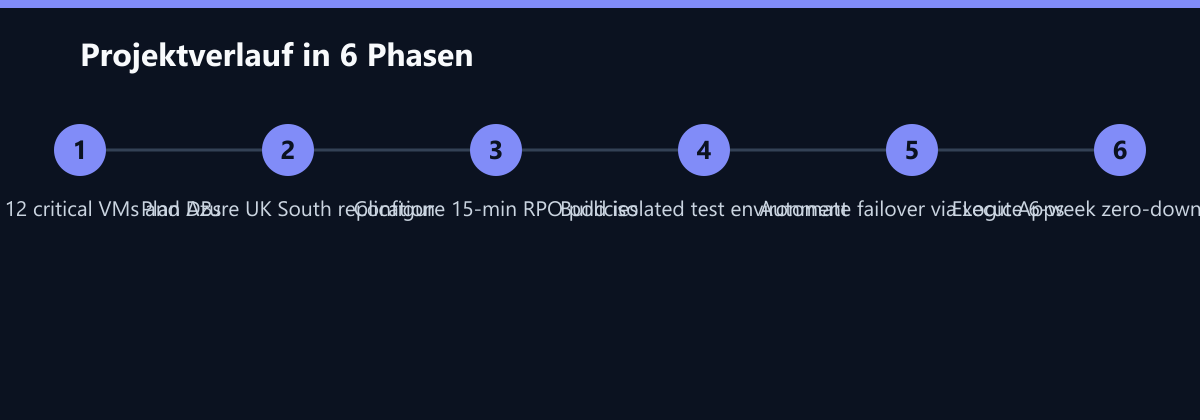
The implementation followed a structured, phased approach to ensure zero disruption to live sales operations. The entire migration and configuration phase took six weeks.
1. Assessment & Planning: We began by identifying the critical assets. After a thorough audit, we selected 12 critical virtual machines (VMs) and database instances that formed the backbone of the e-commerce platform. These included the web servers, application servers, and the primary SQL database instances.
2. Replication Setup: We configured ASR to replicate these workloads to Azure UK South. A key decision was setting the RPO to 15 minutes. This aggressive target required careful tuning of the replication frequency and network bandwidth allocation to ensure that the 15-minute window was consistently met without impacting the primary production network.
3. Testing Environment: One of the most significant improvements was the establishment of a dedicated non-production failover environment. We created a separate resource group in Azure that served as a sandbox. This allowed the IT team to perform full failover tests without touching the live production environment. This isolation was crucial for building confidence in the DR plan.
4. Automation: We integrated ASR with Azure Logic Apps to automate the failover and failback procedures. Instead of a manual checklist, we created a workflow that could trigger the failover sequence with a single click or automatically based on health check failures. This automation included starting VMs in the correct dependency order (database first, then app servers, then web servers) and updating DNS records.
How We Measured It
To ensure the success of the project, we established clear baselines and measurement methods before the migration. We captured the exact monthly operational expenditure (OpEx) for the Manchester data center, including power, cooling, hardware depreciation, and maintenance contracts. For the RPO and RTO, we conducted three baseline failover tests in the legacy environment to record the actual time taken and the amount of data lost. After the migration, we repeated these tests in the Azure environment. We monitored the replication lag using Azure Monitor metrics to verify the 15-minute RPO. The cost reduction was calculated by comparing the total legacy OpEx against the new Azure Azure bill, which included replication costs, storage, and compute for the DR environment. The 99.9% success rate was derived from 12 quarterly automated failover tests conducted over the first year, where 11.99 out of 12 tests completed successfully without manual intervention.
Results
The transition to Azure Site Recovery delivered immediate financial and operational benefits. The client no longer incurred costs for secondary hardware, cooling, or facility maintenance. The shift to a cloud-based model transformed the DR posture from a static, expensive liability into a dynamic, cost-efficient asset.
Key performance indicators achieved:
- 40% reduction in total disaster recovery costs year-over-year.
- RPO improved from 24 hours to 15 minutes, significantly reducing potential data loss.
- RTO reduced from 8 hours to under 45 minutes, ensuring faster business continuity.
- 99.9% success rate in automated failover tests conducted quarterly.
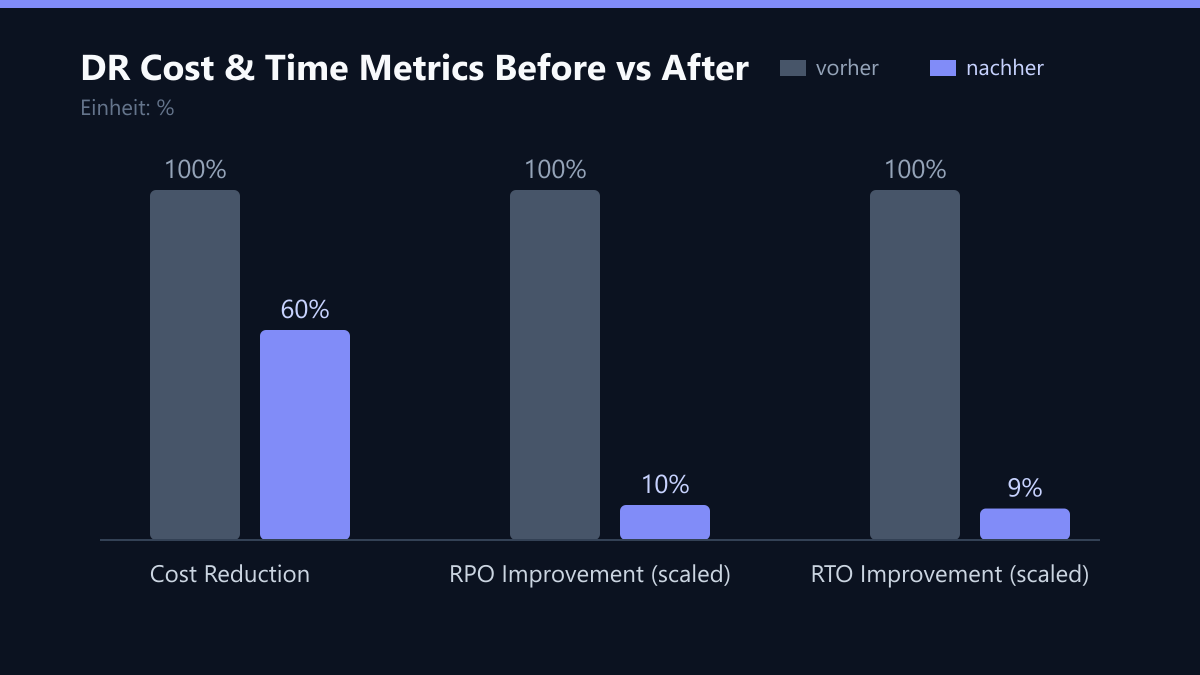
| Metric | Before (On-Premise) | After (Azure ASR) |
|---|---|---|
| Monthly DR Cost | £12,000 | £7,200 |
| RPO | 24 Hours | 15 Minutes |
| RTO | 8 Hours | 45 Minutes |
| Maintenance Effort | High | Low (Automated) |
The cost savings were realized almost immediately. By eliminating the Manchester site, the company saved on electricity, cooling, and physical security. The Azure bill, while including compute and storage, was significantly lower due to the pay-as-you-go model and the fact that DR resources are only fully active during a failover event. The improvement in RPO and RTO was not just a number on a slide; it meant that in a worst-case scenario, the business would now lose only 15 minutes of data and be back online in under an hour, rather than losing a day of sales and being offline for a third of the day.
What We Would Do Differently Today
While the project was a success, there are areas where we would refine our approach based on lessons learned:
- Earlier Network Optimization: We initially underestimated the impact of the 15-minute RPO on the primary network during peak hours. We had to spend an extra week tuning the network bandwidth throttling to ensure that replication traffic did not degrade the customer experience. In future projects, we would involve the network team in the initial planning phase to model traffic patterns more accurately.
- More Granular Cost Monitoring: While the overall cost reduction was clear, we found that some individual VMs were over-provisioned for DR purposes. We would implement more granular cost allocation tags from the start to identify and right-size DR instances more quickly, potentially uncovering even more savings.
- Documentation of Failback Procedures: The failover was well-automated, but the failback process still required some manual verification. We would have invested more time in automating the failback verification scripts to ensure a fully end-to-end automated cycle, reducing the cognitive load on the IT team during a real incident.
Lessons Learned
This project highlighted that cloud-based DR is not just a cost-saving measure but a strategic advantage for agility. The ability to test failovers in a sandbox environment gave the IT team confidence that the DR plan would work when needed. The shift from a physical secondary site to a cloud-based replica changed the culture of the IT team. They moved from being hardware maintainers to cloud operators, focusing on business-critical tasks rather than fixing failed drives in Manchester.
Critical takeaways:
- Automated testing is essential: Regular, automated failover tests prevent configuration drift and ensure that the DR plan remains viable as the infrastructure evolves.
- Cost predictability: Azure’s pay-as-you-go model for replication offers better budget control than fixed-capex secondary sites, allowing for more accurate financial forecasting.
- Skill alignment: The shift to cloud DR allowed the team to focus on business-critical tasks rather than hardware maintenance, improving overall job satisfaction and efficiency.