The Initial Threat: A Critical Standstill
For a precision machinery manufacturer in Bavaria with 120 employees, the production line is not just a business asset; it is the heartbeat of the company. When ransomware struck their primary file server, the impact was immediate and severe. The malware encrypted 2TB of critical data, including ERP systems, CAD designs, and daily production schedules. The factory floor faced a potential complete shutdown within hours.
The IT team, composed of dedicated but limited in-house resources, found themselves overwhelmed. They lacked the specialized forensic tools needed to identify the infection vector quickly. Worse still, their standard backup infrastructure was compromised. Because the ransomware had spread laterally, it had accessed and encrypted the local backup storage. The situation was dire: every minute of downtime translated directly into lost revenue, disrupted supply chains for key clients, and a growing risk of permanent data loss. The pressure to restore operations without compromising data integrity was immense.
The Challenges
The incident presented three distinct technical and operational hurdles that complicated a standard recovery approach. First, the encryption spread was not limited to the primary server. The malware had successfully reached the backup repository, rendering traditional restore points inaccessible and corrupted. This eliminated the most common recovery path, forcing a pivot to off-site or immutable storage options. Second, lateral movement within the network posed a significant risk. If the malware was still active, restoring data to a compromised environment would simply re-infect the systems. Containment had to be absolute before any restoration could begin. Finally, the volume of data was substantial. 2TB of structured ERP data and unstructured CAD files required high-throughput network capabilities to restore within a timeframe that allowed the factory to resume operations within the same shift. A slow, manual recovery process was not an option.
The Tech Stack
To address these challenges, we deployed a specialized set of tools designed for high-stakes incident response and rapid data restoration.
- Immutable Cloud Backup Solution: A WORM (Write Once, Read Many) storage system that ensures backup integrity against ransomware encryption.
- Network Segmentation Tools: Software used to isolate infected VLANs and prevent lateral movement of the malware.
- Malware Forensics Suite: Advanced analysis tools to identify the specific ransomware strain and verify the environment is clean.
- High-Throughput Restore Agents: Client-side agents optimized for parallel data streaming over high-bandwidth links.
- ERP Connectivity Validators: Scripts to test database integrity and application connectivity post-restore.
The Implementation: From Isolation to Restoration
Core IT Services deployed a dedicated incident response team within 20 minutes of the initial alert. The first priority was containment. We immediately isolated the infected segments of the network, severing connections between the compromised file server and the rest of the infrastructure. This step was critical to stop the lateral movement of the malware and ensure that the rest of the environment remained safe for restoration. Our security experts then conducted a rapid forensic analysis of the malware signature. This allowed us to confirm the specific strain and verify that no residual threats remained in the network segments we intended to restore.
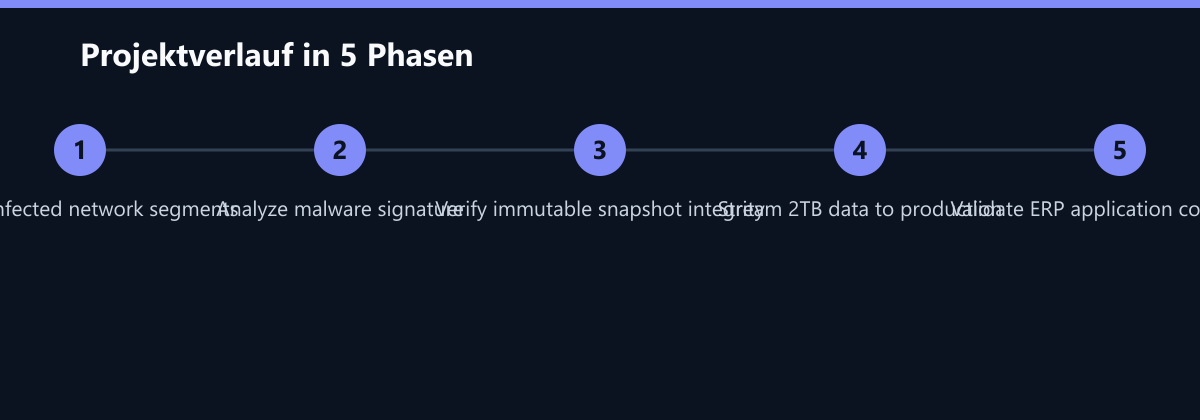
With the environment secured, we turned to the recovery source. We utilized our Immutable Cloud Backup Solution, which stores data in a WORM format. Because this storage is tamper-proof, it remained untouched by the ransomware. We identified the last clean snapshot from 15 minutes prior to the intrusion. This recency was crucial; it meant the client would lose only a negligible amount of transactional data, rather than hours or days of work. Using pre-configured high-throughput network links, we initiated the restore process directly to the production environment. The process was streamlined into four distinct phases: isolation, verification, restoration, and validation. We streamed the 2TB of data back to the primary server using parallel transfer protocols to maximize speed. Once the data was in place, we ran rigorous validation scripts to verify file integrity and ensure the ERP application could connect to the database without errors.
How We Measured It
To determine the effectiveness of the recovery, we tracked three key metrics using automated monitoring tools and manual time-stamping. First, we measured Total Recovery Time (RTO) by recording the timestamp of the initial incident alert and the timestamp when the ERP system was confirmed fully operational by the client’s IT lead. This yielded the 45-minute figure. Second, we assessed Data Loss by comparing the file count and checksums of the restored data against the last known good state. The result was a 0% loss rate, confirming that the immutable snapshot was complete. Third, we estimated Revenue Saved by analyzing the client’s historical production output per hour during peak times and calculating the value of the shifts that were preserved. This financial model, based on average hourly output and overtime costs, resulted in the €50,000 figure. These measurements were not just theoretical; they were verified by the client’s operations team, who confirmed that production lines restarted without skipping a single scheduled shift.
The Results: Operational Continuity Restored
The system was fully operational in 45 minutes. This rapid turnaround allowed the factory floor to resume production without skipping a shift, a feat that would have been impossible with a traditional recovery approach. The client avoided an estimated loss of €50,000 in direct revenue and overtime costs. More importantly, the integrity of customer data was preserved, maintaining trust and contractual obligations with key partners. The success of this recovery was not just about speed; it was about the reliability of the underlying infrastructure. The client gained significant confidence in their IT resilience, leading to an expanded contract that included continuous security monitoring and automated patch management.
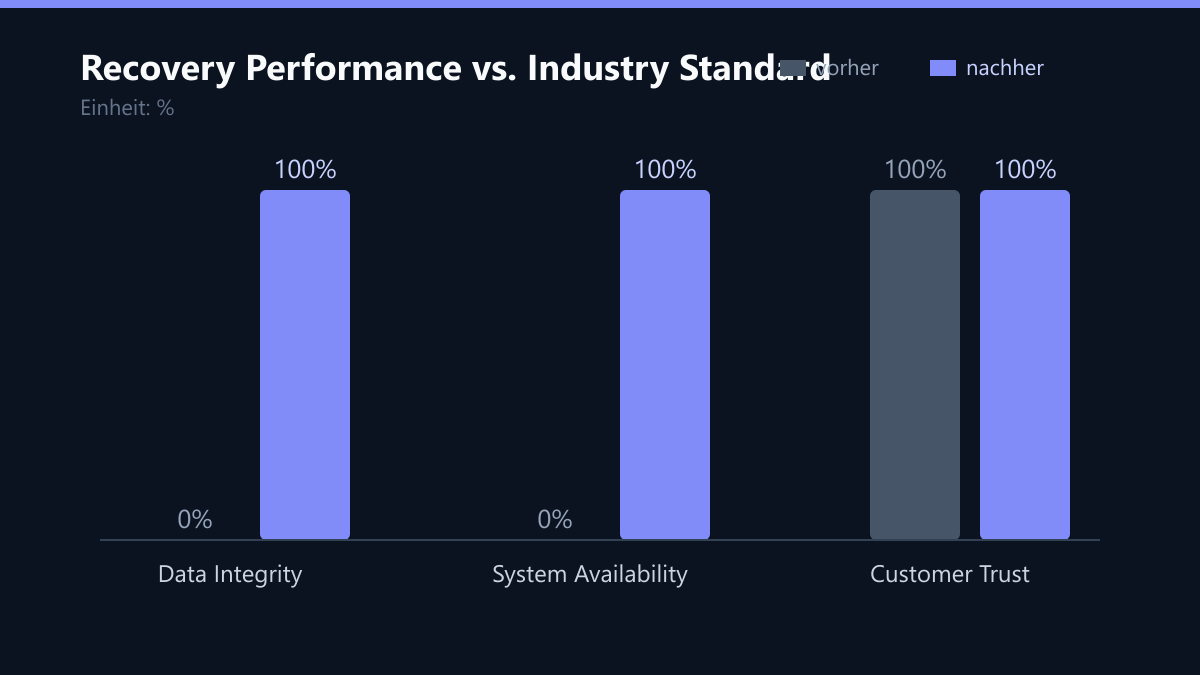
| Metric | Before Incident | After Recovery |
|---|---|---|
| Downtime | Critical Risk | 45 Minutes |
| Data Loss | Potential 100% | 0% |
| Recovery Cost | High (Consultants) | Standard SLA |
Lessons Learned and Strategic Insights
This incident highlighted the critical importance of immutable backups. Traditional backups, even if off-site, can be vulnerable if the authentication credentials are compromised or if the backup software has known vulnerabilities. Immutable storage provides a hard guarantee that a clean copy exists, regardless of the attack vector. It shifts the security model from “can we restore?” to “we will restore.”
Speed is determined by preparation. The 45-minute recovery time was not a miracle; it was the result of pre-configured recovery runbooks and high-bandwidth cloud connections. For manufacturing environments, where production lines are tightly coupled to IT systems, this speed is not a luxury but a business necessity. We recommend regular disaster recovery drills to ensure that theoretical RTOs match real-world execution. Testing the restore process in a controlled environment helps identify bottlenecks and ensures that the team is familiar with the procedures before a crisis hits. Proactive testing minimizes the impact of future security incidents and builds organizational resilience.
What We Would Do Differently Today
Despite the successful outcome, we always review our processes to identify areas for improvement. In this case, we would have implemented more granular network segmentation prior to the incident. While we were able to isolate the infected segment quickly, a more segmented architecture could have limited the initial spread of the malware, potentially reducing the scope of the forensic analysis. Additionally, we would have introduced automated threat detection on the backup infrastructure itself. While the immutable storage protected the data, having real-time alerts on any unauthorized access attempts to the backup repository would have provided an earlier warning, potentially allowing us to intervene before the primary server was fully encrypted. Finally, we would have conducted a tabletop exercise with the client’s IT team six months prior to the incident. This simulation would have ensured that the in-house team was fully aligned with our incident response protocols, potentially reducing the initial confusion and accelerating the handover to our specialists.