The Bottleneck in Sales Operations
For a mid-sized industrial machinery manufacturer with 180 employees in the DACH region, the sales cycle was being strangled by a single, invisible bottleneck: credit checks. In B2B manufacturing, order confirmations are critical for cash flow and customer retention, yet the finance team was spending an average of 45 minutes per case just to verify a new customer’s creditworthiness. This delay wasn’t just a minor inconvenience; it was a significant drag on sales velocity, preventing quick closures and frustrating both the sales team and the customers.
The root cause was a combination of manual inefficiency and outdated processes. The finance team was manually reviewing credit reports, bank statements, and commercial register extracts. This involved copying data from PDFs into the ERP system, a task that was not only time-consuming but also prone to typos. More critically, the assessment process was inconsistent. Different employees applied varying criteria for risk scoring, leading to subjective decisions that could either block viable sales or, worse, approve risky accounts. The human cost was high, too, with employees reporting burnout from the repetitive, high-stress nature of the work.
The Challenges
Before diving into the solution, it is important to understand the specific hurdles that made this automation project complex. It wasn’t just about “adding AI”; it was about solving three concrete problems:
- Data Fragmentation: Financial data was scattered across multiple formats (PDFs, scanned images, Excel sheets) and external providers. There was no single source of truth, making automated extraction difficult.
- Compliance Rigidity: Financial regulations in the DACH region are strict. A pure AI solution that guessed or hallucinated data was not an option. The system needed to be auditable and precise.
- ERP Integration Depth: The existing ERP system was robust but not designed for high-frequency API calls from an AI agent. Ensuring that the automated data pushed into the customer master record was clean and formatted correctly required careful engineering.
The Tech Stack
To address these challenges, we deployed a hybrid architecture that combined the flexibility of Large Language Models (LLMs) with the reliability of traditional rule-based systems.
- LLM Agent for Parsing: A fine-tuned LLM agent was used to extract key financial metrics (revenue, debt ratios, payment history) from unstructured credit reports and PDF statements.
- Rule-Based Risk Engine: A deterministic layer applied predefined DACH market standards to the extracted data, ensuring that risk scores were consistent and compliant.
- API Middleware: A custom middleware handled the communication between the LLM, the external credit data providers, and the client’s ERP system, managing data validation and error handling.
- Workflow Orchestration: A workflow engine managed the end-to-end process, flagging high-risk cases for human review and automatically approving low-risk ones.
Implementation: From Map to Rollout
The project was executed in an agile manner over 8 weeks, divided into four distinct phases. The goal was not just to build a tool, but to change a workflow.
In the first two weeks, we focused on process mapping. We sat with the finance team to document every step of the current credit check process, identifying data sources and decision points. Simultaneously, we began integrating the external credit data providers and establishing the API connections to the ERP. This phase was crucial for understanding the data landscape and identifying gaps.
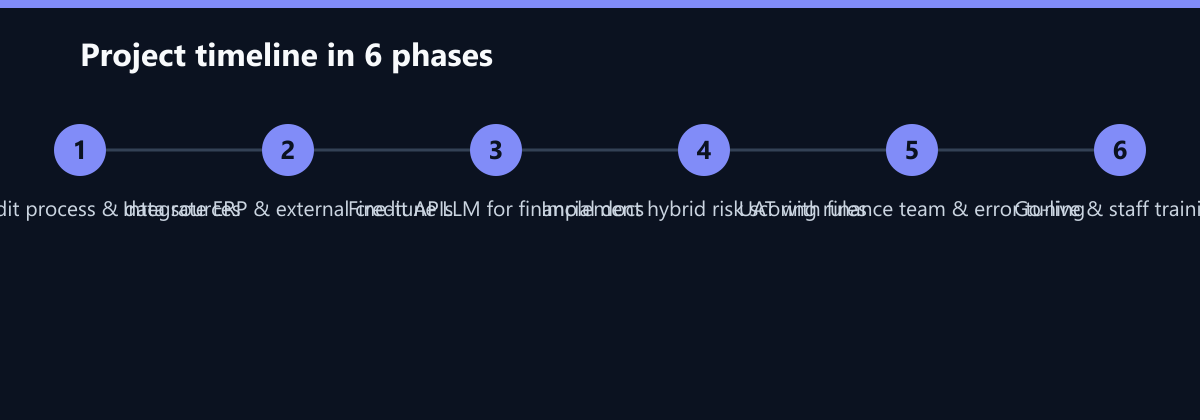
Weeks 3 through 5 were dedicated to the core AI development. This involved prompt engineering and model fine-tuning specifically for financial documents. We trained the LLM to recognize specific patterns in DACH credit reports, such as the format of commercial register entries and the structure of bank statements. The risk scoring engine was built in parallel, encoding the business rules that would dictate the final decision. This hybrid approach was key: the LLM handled the “reading,” while the rules handled the “judging.”
Weeks 6 and 7 were for User Acceptance Testing (UAT) with the finance team. We ran parallel processes, comparing the AI’s output with the manual assessments. This phase revealed edge cases where the LLM struggled, such as unusual corporate structures or missing data. We optimized the prompts and added fallback logic to handle these exceptions. The error rate was monitored closely, and the system was tuned until it met the strict accuracy requirements.
The final week was for go-live and staff training. The finance team was trained on how to interpret the AI’s outputs and how to handle the flagged high-risk cases. The system was deployed to production, with a close monitoring period to ensure stability.
How We Measured It
To ensure the success of the project was not just anecdotal, we defined clear KPIs before deployment. We tracked:
- Processing Time: Measured from the moment a credit check request was initiated in the ERP to the moment the customer master record was updated. This was compared against the pre-implementation average of 45 minutes.
- Automation Rate: The percentage of credit checks that were completed without any human intervention. This was tracked by monitoring the workflow logs for cases that did not trigger a “human review” flag.
- Error Rate: The number of data entry errors identified during post-implementation audits. This was compared to the historical error rate from the manual process.
- Throughput: The number of credit applications processed per day by the finance team. This was measured by counting the number of completed credit checks in the ERP system.
Results and KPIs
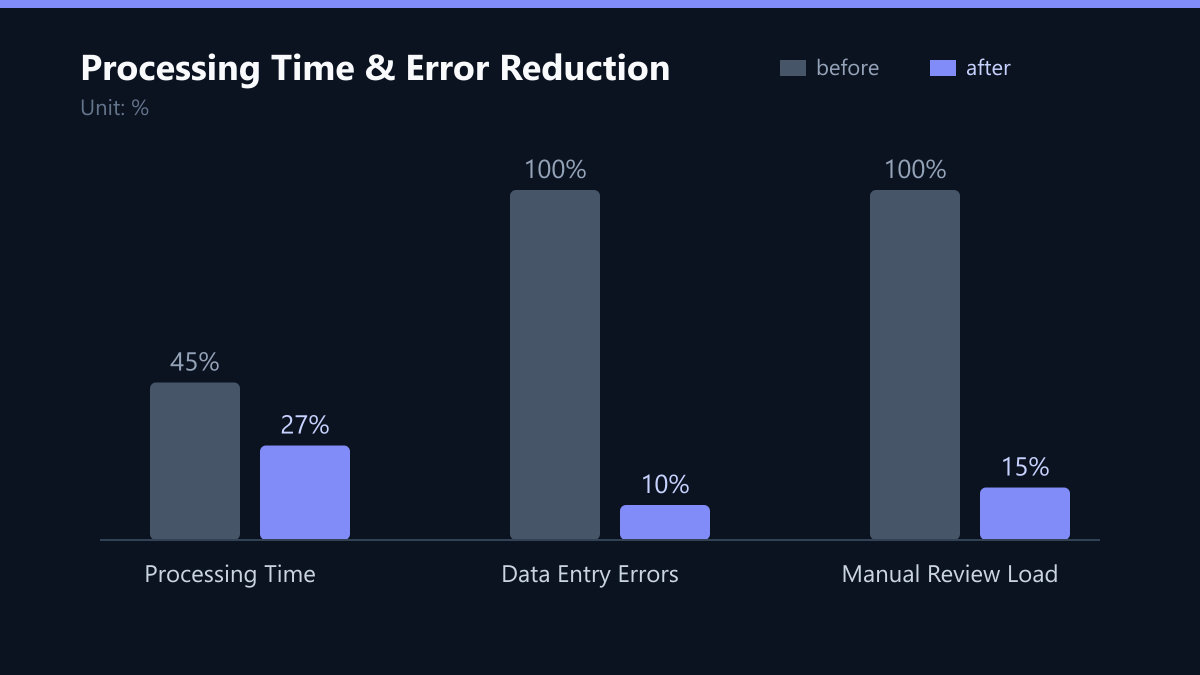
Within three months of deployment, the client achieved significant efficiency gains. The automation handled 85% of low-risk credit checks without human intervention. The remaining 15% high-risk cases were flagged with a pre-populated summary, reducing manual review time. The finance team could now focus on complex edge cases rather than routine data entry.
The impact on the key performance indicators was substantial:
- Processing Time: Reduced from 45 minutes to 27 minutes per case, a 40% faster turnaround.
- Throughput: The finance team now processes 30% more credit applications daily, allowing the sales team to close deals faster.
- Error Rate: Data entry errors dropped by 90% due to automated extraction, significantly improving data quality in the ERP.
- Cost Savings: Estimated annual savings of €12,000 in manual labor costs, not even accounting for the increased sales velocity.
Lessons Learned and What We Would Do Differently
This project highlighted the value of combining LLM flexibility with rigid business rules. Pure LLM output was insufficient for financial compliance; a hybrid approach proved essential. The finance team now focuses on complex edge cases rather than routine data entry, leading to higher job satisfaction and better risk management.
However, there are areas where we would adjust our approach today:
- Early Involvement of IT Security: We could have involved the IT security team earlier in the process to address data privacy concerns related to sending financial data to external LLM providers. This would have streamlined the compliance approval process.
- More Granular UAT: While the UAT phase was thorough, we would have implemented a more granular testing framework for edge cases, particularly those involving international customers with different reporting standards. This would have reduced the number of iterations needed in weeks 6-7.
Next Steps
The success of this project has paved the way for further automation. The client is now planning to:
- Expand the workflow to cover payment terms negotiation, using the LLM to suggest optimal terms based on customer history and risk profile.
- Integrate real-time market data for dynamic risk adjustment, allowing the system to account for economic fluctuations in real-time.
- Roll out the solution to the client’s subsidiary in Austria, adapting the rules to local regulatory requirements.
This case study demonstrates that AI automation is not just about replacing humans, but about augmenting their capabilities. By handling the routine, the finance team can focus on what matters most: making smart, strategic decisions that drive business growth.