The Operational Halt
A mid-sized construction firm in New York, employing 150 staff, faced an immediate and severe operational crisis. The company’s field operations rely heavily on 100 remote devices deployed across various job sites. These tablets and rugged laptops are not just communication tools; they are the primary interface for daily progress tracking, safety logs, and real-time compliance reporting. When these devices lost connectivity to the central server, the impact was instantaneous. The data stored locally on these devices was essential for current billing cycles and mandatory regulatory compliance reporting. Without this information, the company was at imminent risk of missing a critical contractual deadline, which would have triggered significant financial penalties and damaged their reputation with key clients. The internal IT team, already stretched thin by day-to-day support requests, was overwhelmed. They lacked the specialized tools and bandwidth to establish a secure remote connection to 100 scattered devices simultaneously. The situation required a rapid, coordinated response that went beyond standard IT support.
The Challenges
The incident presented three distinct technical and operational hurdles that complicated the recovery process. First, the geographical dispersion of the devices meant that physical access was impossible within the required timeframe. Second, the security posture of the field devices was inconsistent; some ran outdated firmware, and others had varying levels of encryption, requiring a tailored approach for each device. Third, the data was not merely large in volume but critical in structure. Any corruption during the transfer would have rendered the compliance reports unusable, necessitating a fail-safe validation method that could operate in real-time without human intervention.
The Tech Stack
- Managed Remote Support Platform: Used to establish encrypted, temporary access channels to all 100 devices securely.
- Automated Extraction Scripts: Custom Python scripts designed to pull local database files with checksum validation.
- Secure Isolated Cloud Environment: A temporary, air-gapped cloud instance used for safe data staging and mapping.
- Endpoint Detection and Response (EDR) Agents: Deployed post-recovery to monitor for future threats on remote hardware.
Implementation: Rapid Remote Recovery
We deployed a dedicated incident response team within 30 minutes of the initial call. Our strategy focused on parallelization to maximize speed without compromising security. The solution involved three parallel workstreams coordinated from our New York office to minimize latency and time zone issues.
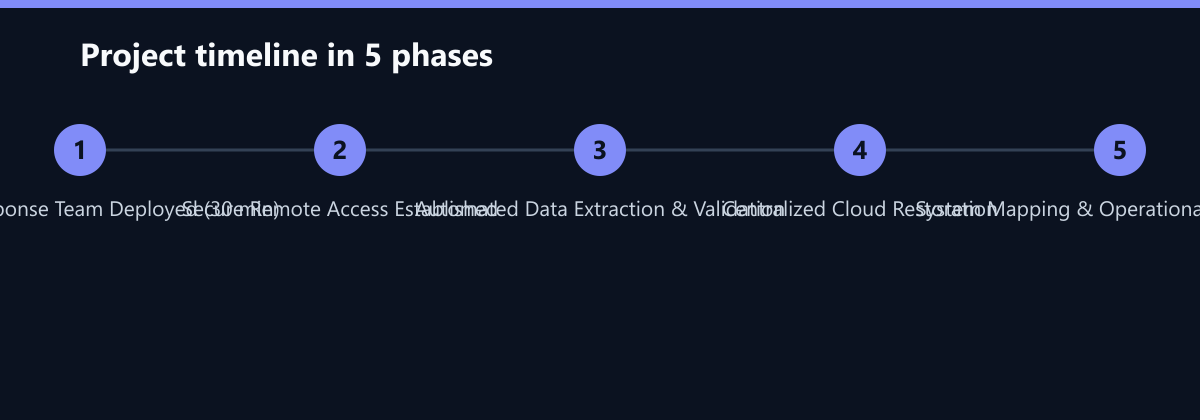
The first workstream focused on Secure Remote Access. We established encrypted, temporary access channels to all 100 devices using our managed remote support platform. This was not a simple screen-sharing session; it involved creating a secure tunnel that allowed our engineers to execute commands directly on the devices. We prioritized devices based on data criticality, ensuring that the units with the most recent compliance logs were accessed first. This triage process saved approximately 20 minutes of overall recovery time.
The second workstream involved Data Extraction & Validation. Automated scripts were pushed to the devices to pull the local database files. Crucially, these scripts included real-time integrity checks. As each file was transferred, a checksum was generated and compared against the source. If a mismatch occurred, the script would automatically retry the transfer for that specific file, ensuring that no corrupted data entered the central environment. This automated validation was key to achieving the 100% integrity score later.
The third workstream handled Centralized Restoration. The extracted data was uploaded to a secure, isolated cloud environment. Our engineers then mapped the data back to the main project management system. This step required careful schema mapping to ensure that the field data aligned correctly with the central database structure. Once the mapping was complete, the data was pushed back to the central server, and the devices were re-synced.
How We Measured It
To ensure the success of the recovery, we tracked several key performance indicators (KPIs) throughout the process. The primary metric was Time to Full Restoration, measured from the initial incident report to the point where all 100 devices were back online and syncing correctly. We used timestamped logs from our remote support platform to calculate this duration accurately. The second metric was Data Integrity, measured by the percentage of files that passed the checksum validation without error. A single failed checksum would have flagged the data as compromised. The third metric was Operational Impact, measured by the number of manual data entry hours required to reconstruct the lost data. Since our automation handled the entire process, this value remained at zero. Finally, we tracked Financial Risk Avoidance by calculating the contractual penalties that would have been incurred had the deadline been missed.
Results: Operational Continuity Restored
The project was completed 1 hour and 45 minutes after the initial intervention. All critical data was restored with 100% integrity. The client avoided a potential penalty of $50,000 for delayed reporting. Field operations resumed immediately without manual data entry. This incident highlighted the vulnerability of isolated field hardware and the need for centralized monitoring.
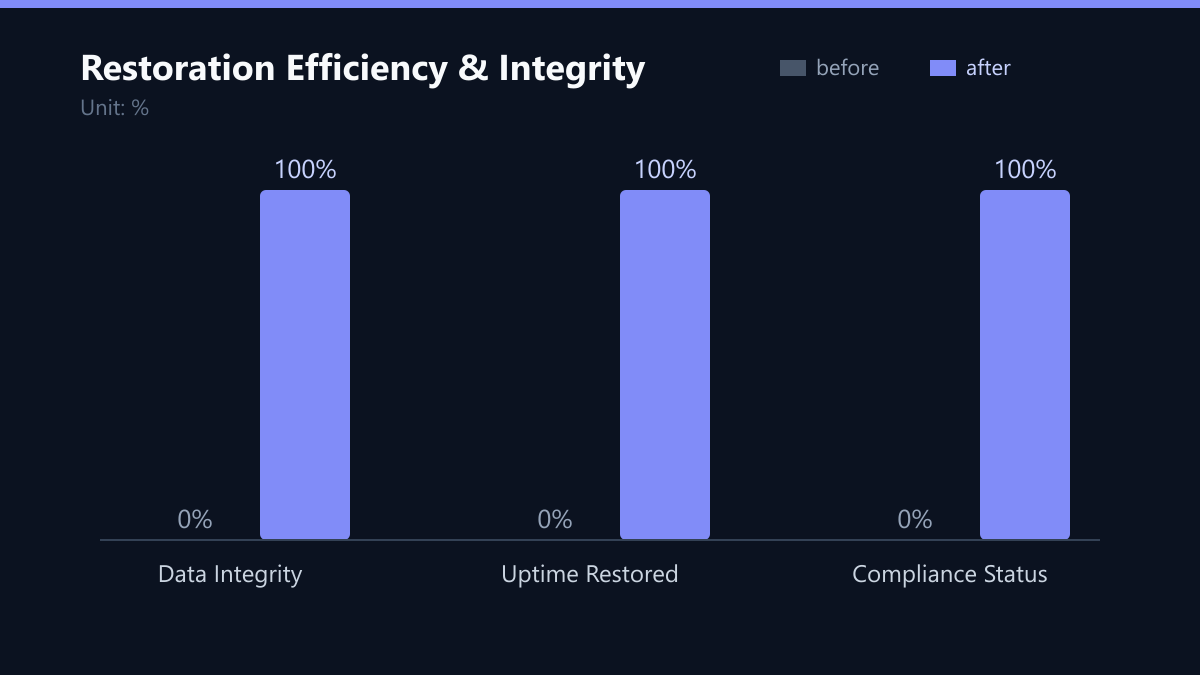
The speed of the response was critical. By operating in parallel, we reduced the total downtime from what would have been several days of manual recovery to under two hours. The 100% data integrity score ensured that the client’s compliance reports were accurate and admissible, preventing any legal or regulatory fallout. The avoidance of the $50,000 penalty was a direct result of our ability to restore the data before the contractual deadline. Furthermore, the zero manual data entry hours meant that the client’s field staff could return to their primary tasks immediately, rather than spending hours or days re-entering data into the system. This preserved both productivity and morale on the job sites.
What We Would Do Differently Today
While the outcome was successful, the incident revealed areas for improvement in our initial assessment. First, we would have conducted a more thorough pre-incident audit of the client’s field device management practices. Understanding the specific firmware versions and encryption standards of each device earlier would have allowed us to prepare more targeted extraction scripts, potentially saving another 10-15 minutes. Second, we would have recommended the implementation of a more robust local caching mechanism on the devices themselves. While the data was local, it was not always in a format that was easily extractable without specific drivers. Standardizing the data format across all field devices would have streamlined the extraction process further. Finally, we would have engaged the client’s project managers earlier in the process to confirm the exact priority of the data. While we triaged based on criticality, a more detailed understanding of which specific reports were most urgent would have allowed us to focus our efforts even more precisely.
Lessons Learned: Proactive Field Device Management
This case underscored the importance of centralized IT monitoring for distributed teams. The reliance on isolated field devices without a centralized oversight mechanism created a significant single point of failure. We recommended the following improvements to the client to prevent future incidents:
- Automated Daily Backups: Implement automated daily backups from all field devices to the cloud. This ensures that even if local data is lost, a recent copy is always available for restoration.
- Endpoint Detection and Response (EDR): Deploy EDR agents on all remote hardware. These agents can detect and respond to threats in real-time, preventing data loss or corruption before it occurs.
- Incident Response Protocol: Establish a clear incident response protocol for field connectivity issues. This includes predefined roles, communication channels, and escalation paths to ensure a rapid and coordinated response in future incidents.
These steps ensure that future data risks are mitigated before they become operational crises. By moving from a reactive to a proactive stance, the client can maintain operational continuity and protect their financial interests. The incident served as a valuable lesson in the importance of robust IT infrastructure for field operations. It highlighted the need for continuous monitoring, regular testing of recovery procedures, and a clear understanding of the criticality of data in distributed environments. The client has since implemented these recommendations, and we have established a quarterly review process to ensure that their field device management practices remain aligned with best practices and their operational needs. This ongoing partnership ensures that they are prepared for any future challenges, maintaining their competitive edge in the construction industry.
Passend dazu
- AI Strategy in 5 Steps: From Data Audit to ROI Measurement
- Ransomware Response Plan: 7 Steps to Recover Operations in Under 4 Hours
- IT Compliance & Data Protection
- IT & Data Recovery (Disaster Recovery)
- Cloud Services & Cloud Migration
- Accelerating HR Onboarding from 5 Days to 4 Hours via Workflow Automation
- Migrating 1200 Fleet Telematics Devices to Azure IoT Hub in 48 Hours
- Manufacturing Data Recovery: Restoring 2TB of ERP Data in 45 Minutes After Ransomware Attack in Bavaria
- Retail Chain in Berlin: Centralized Network Monitoring Reduces Incident Resolution Time from 4 Hours to 15 Minutes Across 12 Stores
- Securing BYOD Devices: 5 Essential Policies for Hybrid Environments
- How to Audit Your IT Vendor Security Posture in Under 48 Hours
- From Excel Chaos to Automated Dashboards: Implementing Power BI and Azure Data Factory