The Starting Point: Bottlenecks in a Three-Country Network
Our client is a specialized machine builder with 450 employees, operating three manufacturing plants across Germany, Austria, and Switzerland. The business model relies heavily on real-time data exchange between these sites and a central ERP and CAD environment. Until recently, the network backbone consisted of legacy MPLS (Multi-Protocol Label Switching) connections. While reliable in the past, this rigid infrastructure could not keep up with the increasing volume of real-time data required for modern production lines.
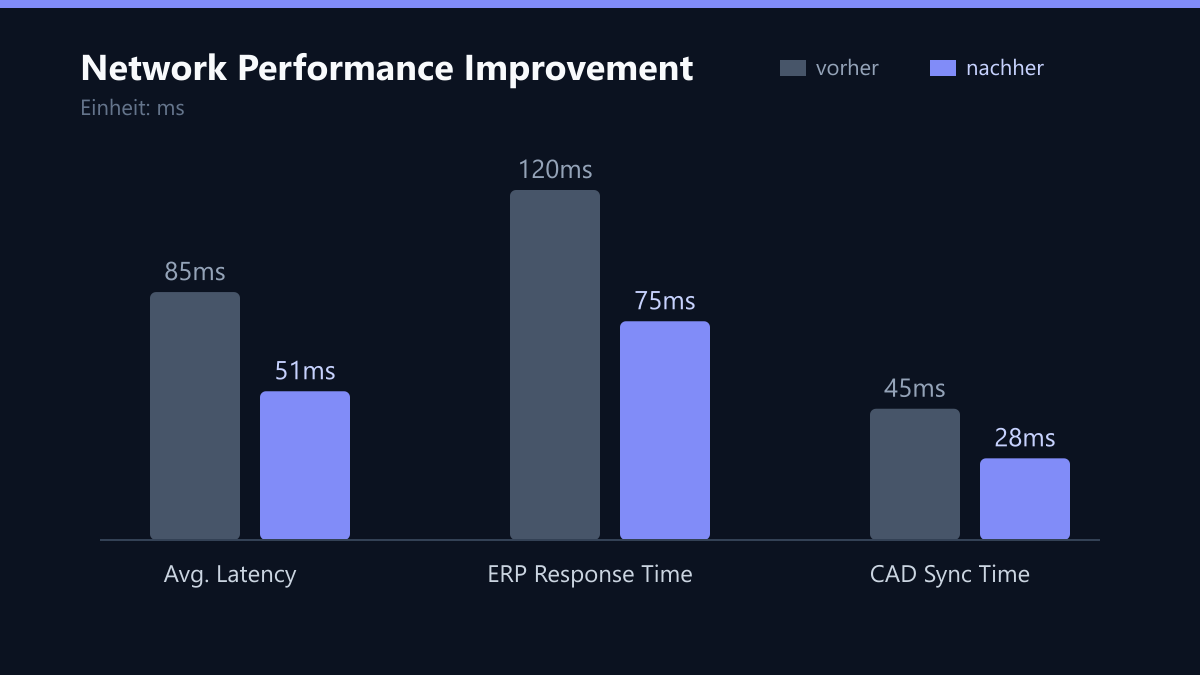
The symptoms were clear and costly. During peak production hours, latency spikes frequently caused production lines to stall while waiting for data from central systems. The IT team, consisting of only five full-time staff members, struggled to maintain stable connections and spent a significant portion of their time troubleshooting intermittent connectivity issues. The average network latency stood at 85 milliseconds, with peaks exceeding 200 ms during high-load periods. This delay was not just an IT problem; it directly impacted operational efficiency and morale on the factory floor.
The Challenges
Before diving into the solution, we identified four specific challenges that needed to be addressed to ensure a successful migration:
- Geographic Fragmentation: The three plants are located in different countries with varying local ISP offerings and regulatory environments, making a unified network policy complex.
- Real-Time Dependency: Production lines rely on sub-100 ms response times for CAD synchronization and ERP updates. Any downtime or significant latency spike could halt production, resulting in direct financial loss.
- Cost Inefficiency: The existing MPLS circuitry was over-provisioned for general traffic but under-utilized for specific high-priority flows, leading to high monthly costs of €12,000 without corresponding performance benefits.
- Lack of Visibility: The legacy setup offered limited granular visibility into traffic flows. The IT team could see packet loss but struggled to pinpoint the exact cause of latency spikes, leading to prolonged troubleshooting sessions.
The Tech Stack
To address these challenges, we designed a solution based on the following technologies:
- SD-WAN Edge Devices: Hardware-based appliances installed at each site to provide secure, encrypted, and optimized WAN connectivity.
- Azure ExpressRoute: A private connection to Microsoft Azure for consistent, low-latency cloud access, bypassing the public internet for critical workloads.
- QoS Engine: A built-in quality of service mechanism to prioritize real-time production traffic (VoIP, CAD sync) over bulk data transfers.
- Centralized Controller: A cloud-based management interface for unified visibility, policy enforcement, and automated failover across all three sites.
- Hybrid Broadband: Commercial broadband links used for non-critical traffic to reduce dependency on expensive dedicated circuits.
Implementation: A Phased Approach
We adopted a phased migration strategy to minimize risk to ongoing production. The entire project spanned six months, divided into three distinct phases.
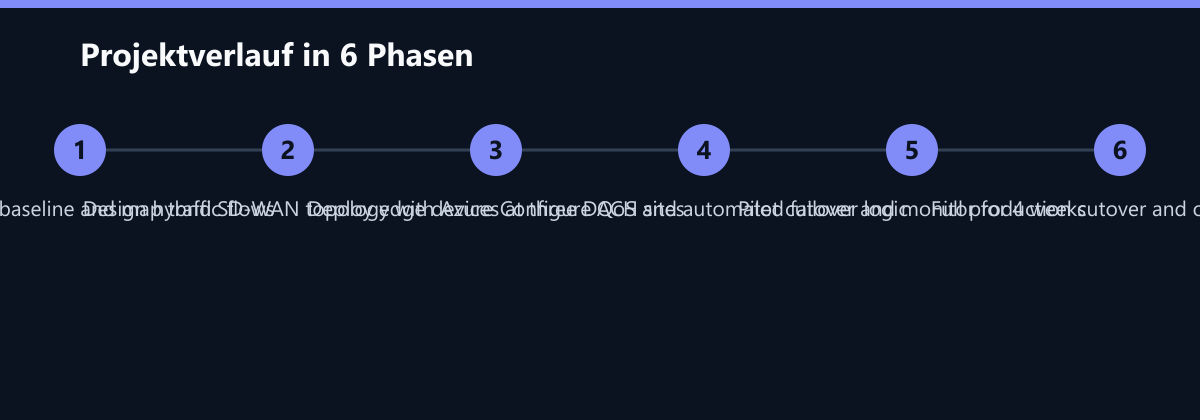
Phase 1: Assessment and Design (Weeks 1-6) We began with a comprehensive audit of the existing network infrastructure. We mapped all traffic flows between the three sites and the central data center, identifying which applications were latency-sensitive and which were bandwidth-heavy. This phase involved extensive load testing to establish a baseline for performance metrics. We designed the new SD-WAN topology, determining the optimal mix of dedicated lines and broadband connections for each site. The goal was to create a resilient mesh network where any site could communicate with any other via multiple paths.
Phase 2: Installation and Configuration (Weeks 7-18) During this phase, we installed the SD-WAN edge devices at all three manufacturing plants. The hardware was pre-configured in our lab to match the production environment, minimizing on-site setup time. We integrated Azure ExpressRoute for cloud connectivity, ensuring that traffic destined for cloud-based ERP and CAD systems took the most direct path possible. Simultaneously, we configured automated failover mechanisms. If the primary link failed, traffic would automatically reroute to the secondary path within milliseconds, without manual intervention.
Phase 3: Optimization and Cutover (Weeks 19-24) Before the final cutover, we ran a four-week pilot period where the new SD-WAN network ran in parallel with the legacy MPLS. We monitored traffic patterns and adjusted QoS policies to ensure critical applications received priority. Once we confirmed that the new network outperformed the legacy system in all key metrics, we executed the cutover. This was done during a planned maintenance window to avoid any impact on production. Post-cutover, we continued to monitor the network closely for two weeks to ensure stability.
How We Measured It
To ensure the results were objective and verifiable, we established a rigorous measurement protocol. We used synthetic transaction monitoring to simulate real user behavior, measuring end-to-end latency for critical applications like ERP login, CAD file synchronization, and real-time production data updates. These measurements were taken at 15-minute intervals over a three-month period post-implementation. We also tracked network uptime using continuous ping tests from multiple vantage points. Cost savings were calculated by comparing the monthly invoices from the previous MPLS provider with the new hybrid connectivity costs, including the SD-WAN subscription fees.
Results
The new network infrastructure delivered immediate and measurable improvements. The average network latency dropped from 85 ms to 51 ms, a reduction of 40%. This eliminated the production bottlenecks that had previously caused line stoppages. Network uptime improved from 99.2% to 99.95%, meaning that unplanned downtime was reduced by over 90%. Perhaps most significantly for the business case, monthly network costs decreased from €12,000 to €7,500, a saving of 37.5%.
Beyond these core KPIs, the IT team reported a 50% reduction in tickets related to connectivity issues. This freed up valuable time for the IT staff to focus on strategic projects rather than reactive troubleshooting. The centralized visibility provided by the SD-WAN controller allowed the team to identify and resolve potential issues before they impacted production, shifting their approach from reactive to proactive.
What We Would Do Differently Today
While the project was successful, we identified areas where we could improve the process for future deployments:
- Earlier Stakeholder Engagement: Involving plant managers and production leads earlier in the design phase would have helped us better understand their specific pain points and prioritize QoS policies more effectively.
- Automated Testing Scripts: We could have developed more robust automated testing scripts to validate QoS policies during the pilot phase, reducing the manual effort required for verification.
- Documentation for End Users: Providing more detailed documentation for end-users on how to report network issues would have further reduced the number of low-value tickets received by the IT team.
Lessons Learned
This case study highlights the importance of a phased approach in network modernization projects. By migrating in stages, we were able to minimize disruption to ongoing production and ensure a smooth transition. The hybrid approach, combining broadband and dedicated lines, offered the best balance of cost and performance for this industry. Centralized visibility into all three sites significantly improved troubleshooting speed, allowing the IT team to resolve issues more quickly and efficiently. The project demonstrates that even in a complex, multi-country environment, a well-planned SD-WAN deployment can deliver substantial performance and cost benefits.