The Hidden Price of Confident Errors
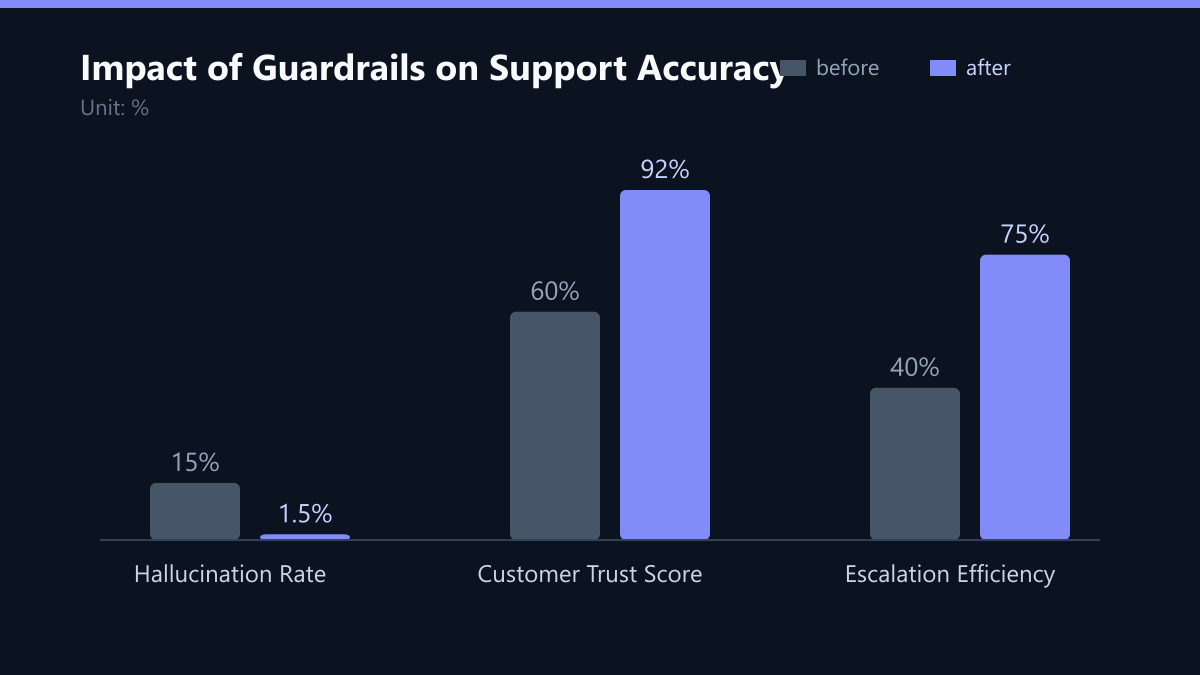
Large Language Models (LLMs) operate on probability, not certainty. They predict the next most likely word based on training data, which means they can confidently state incorrect facts. In customer support, this manifests as hallucinations: fabricated policies, wrong pricing, or invented technical solutions. For mid-sized enterprises, the cost of a single hallucinated answer is not just a refund. It includes brand damage, churn, and potential legal liability if the AI provides false compliance advice. Unlike human agents, AI does not know when it does not know. Without strict constraints, an AI agent will always attempt to answer, even when the information is missing from its knowledge base. This creates a trust gap between the customer and your brand. You must treat AI accuracy as a core IT service level agreement (SLA), not just a feature of a chatbot. The risk is highest in complex scenarios where multiple variables interact, such as return policies with regional exceptions or tiered pricing models.
Bridging the Knowledge Gap
General-purpose LLMs are trained on broad internet data, which is often outdated or contradictory. They lack access to your internal knowledge base, such as current product manuals, specific contract terms, or live order status. When a user asks, “What is my refund status?”, a standard LLM cannot access your CRM. It may hallucinate a plausible-sounding response based on generic e-commerce patterns. This is known as the “knowledge gap.” Furthermore, LLMs are sensitive to prompt injection. A malicious user might try to trick the AI into revealing system prompts or internal data. In a support environment, this can lead to data breaches or the exposure of sensitive backend information. You need to understand that the model itself is not the source of truth. The source of truth is your enterprise data. The AI is merely the interface. If the interface is not connected to the truth, it will invent it. This is why “prompt engineering” alone is insufficient for high-stakes support interactions. You need architectural controls.
Architectural Defense: Implementing RAG
Retrieval-Augmented Generation (RAG) is the primary technical defense against hallucinations. Instead of relying solely on the model’s internal memory, RAG forces the AI to search your approved documents before generating an answer. The workflow is simple: 1. The user asks a question. 2. The system retrieves relevant chunks from your vector database. 3. The AI generates an answer using only the retrieved context. 4. If no relevant context is found, the system triggers a fallback to a human agent. This approach significantly reduces fabrication because the AI is constrained by factual data. However, RAG is only as good as the data it retrieves. You must ensure your knowledge base is clean, structured, and up-to-date. Outdated PDFs or conflicting help articles will lead to inconsistent answers. Implement a data governance process to regularly audit and update support documentation. Use metadata filtering to ensure the AI only retrieves documents relevant to the user’s specific region or product tier. This precision is critical for maintaining accuracy in a global support environment.
Hard Guardrails and Output Validation
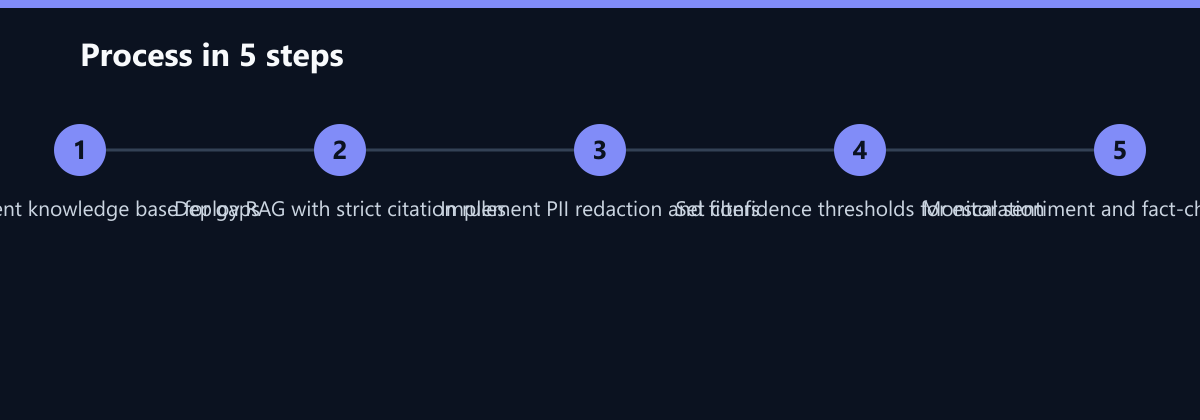
Beyond RAG, you must implement hard technical guardrails. These are rules that the AI must follow regardless of the user’s input. Key guardrails include: Citation Enforcement: The AI must provide a link or reference to the source document for every factual claim. If it cannot cite a source, it must refuse to answer. Tone and Scope Filters: Use classifiers to detect if the AI is straying from the support topic or adopting an inappropriate tone. PII Redaction: Automatically strip Personal Identifiable Information (PII) from inputs and outputs to comply with GDPR and other privacy laws. Confidence Thresholds: If the AI’s internal confidence score is below a certain threshold (e.g., 0.85), the system should automatically escalate the query to a human agent. This “human-in-the-loop” mechanism is essential for high-risk queries. Do not rely on the AI to self-assess its accuracy. Use external evaluation models to check the output against the retrieved context. This multi-layered approach ensures that even if one layer fails, another catches the error.
Measuring Success: KPIs and Monitoring
Deployment is not the end; it is the beginning of continuous optimization. You need a robust monitoring system to track AI performance in real-time. Key metrics to monitor include: Resolution Rate: The percentage of queries resolved by AI without human intervention. Escalation Rate: The frequency with which AI queries are passed to humans. A high escalation rate may indicate poor RAG retrieval or overly strict guardrails. Customer Sentiment: Use NLP to analyze the customer’s reaction to the AI’s answer. Negative sentiment after an AI response is a strong indicator of a hallucination or irrelevant answer. Fact-Checking Samples: Randomly sample AI responses and have human experts verify their accuracy. This provides a ground truth for your evaluation metrics. Implement a feedback loop where corrected answers are fed back into the training data or the knowledge base. This ensures that the system learns from its mistakes. Regularly review logs for patterns of failure. If the AI frequently hallucinates about a specific product feature, investigate the underlying documentation. Is it missing? Is it ambiguous? Fixing the source data is often more effective than tweaking the AI model.
Typical Mistakes to Avoid
- Ignoring Data Hygiene: Teams often deploy RAG without cleaning the underlying documents. If the source PDFs are outdated or contradictory, the AI will confidently cite incorrect information. Always establish a data governance workflow before launch.
- Over-Reliance on Prompt Engineering: Assuming that better prompts can fix bad data is a common trap. Prompts guide behavior, but they cannot create facts that do not exist in the knowledge base. Architectural controls are non-negotiable.
- Setting Static Thresholds: Confidence scores vary by query complexity. A static threshold of 0.85 might be too low for simple FAQs and too high for complex legal queries. Dynamic thresholds or query-type-specific rules are more effective.
- Lack of Cross-Functional Alignment: IT teams often deploy AI without Legal or Customer Success input. This leads to guardrails that are either too loose (risking compliance) or too strict (frustrating customers). Define boundaries jointly.
Strategic Considerations for IT Leaders
Implementing these guardrails requires cross-functional collaboration. IT, Legal, and Customer Success must align on acceptable risk levels. Define clear boundaries for what the AI can and cannot discuss. For example, the AI should never provide legal advice or make promises regarding service credits. Document these policies in a “AI Usage Policy” that is shared with all stakeholders. Ensure that your vendors provide transparency into how their models handle data. Ask for details on data retention, encryption, and whether your data is used for model training. In the EU, the AI Act introduces strict requirements for high-risk AI systems. Customer support AI may fall under transparency obligations. Ensure your solution is compliant with local regulations. Finally, consider the total cost of ownership. While AI can reduce ticket volume, the cost of building and maintaining a robust RAG infrastructure with guardrails is non-trivial. Calculate the ROI based on reduced agent workload and improved customer satisfaction, not just on deflected tickets. A reliable AI support system is a strategic asset, not a cost-cutting tool.
Implementation Checklist
- Audit Knowledge Base: Verify that all support documents are current, structured, and free of contradictions. Assign ownership for updates.
- Configure RAG Pipeline: Set up vector database integration with metadata filtering for region and product tier. Test retrieval accuracy.
- Deploy Guardrails: Implement citation enforcement, PII redaction, and tone filters. Configure confidence thresholds for escalation.
- Establish Monitoring: Set up dashboards for resolution rate, escalation rate, and sentiment analysis. Define alerting rules for anomalies.
- Run Pilot Test: Launch with a small user group. Collect feedback and fact-check samples. Adjust thresholds and documentation based on findings.
- Scale and Optimize: Gradually expand to full user base. Continue monitoring and refining the feedback loop for continuous improvement.