The Hidden Liability Trap in Standard AI Adoption
The rapid adoption of Large Language Models (LLMs) in the mid-market has outpaced legal and technical governance. Many companies integrate tools like ChatGPT or Claude into daily workflows without a comprehensive review of their data protection posture. This creates a silent liability trap. The core issue is not just the technology, but the lack of a valid Data Processing Agreement (DPA) and the opacity surrounding data retention practices by US-based providers.
For managing directors, the stakes are high. Under GDPR, fines for severe violations can reach 4% of global annual turnover. Beyond financial penalties, the reputational damage from leaking trade secrets or sensitive customer data is often irreversible. Therefore, a thorough legal and technical review is not optional; it is a prerequisite for any AI initiative.
Legal Foundations: The DPA and Data Sovereignty
The central legal hurdle is the classification of the AI provider as a data processor. According to Article 28 of the GDPR, you must conclude a DPA with the provider. This contract must explicitly state that the provider processes data exclusively on your instructions and does not use it for its own purposes, such as model training.
A critical nuance often overlooked is the transfer of data to third countries. If data flows to the USA, you need adequate safeguards. The EU-US Data Privacy Framework offers a pathway, but its legal standing is still being tested in courts. Consequently, most robust implementations rely on Standard Contractual Clauses (SCCs) combined with a Transfer Impact Assessment (TIA). This TIA is a documented analysis proving that the local laws in the destination country do not endanger the privacy of the transferred data. This documentation must be readily available for data protection authority audits.
Technical Controls: Minimizing the Data Footprint
Legal contracts are only as strong as the technical measures that back them. The most effective strategy is data minimization at the source. You must ensure that no personal data, such as names, email addresses, or social security numbers, is transmitted to the LLM. This requires technical pre-processing before data hits the API.
Implement these four technical controls to create a secure perimeter:
- Pseudonymization and Anonymization: Strip direct identifiers from input data. Replace names with internal codes that can only be decrypted by authorized staff after the AI response is generated.
- Input Validation Middleware: Deploy a layer that scans prompts for sensitive data patterns (PII). If detected, the system should automatically mask or block the request. This acts as a safety net against human error.
- Local Processing Options: Where feasible, utilize On-Premise LLMs or Private Cloud instances. This ensures data never leaves your data center, significantly simplifying the compliance landscape.
- Comprehensive Logging: Document every request and data flow. This serves your duty of proof and enables rapid incident response if a breach is suspected.
Strategic Choice: Public APIs vs. Private Deployment
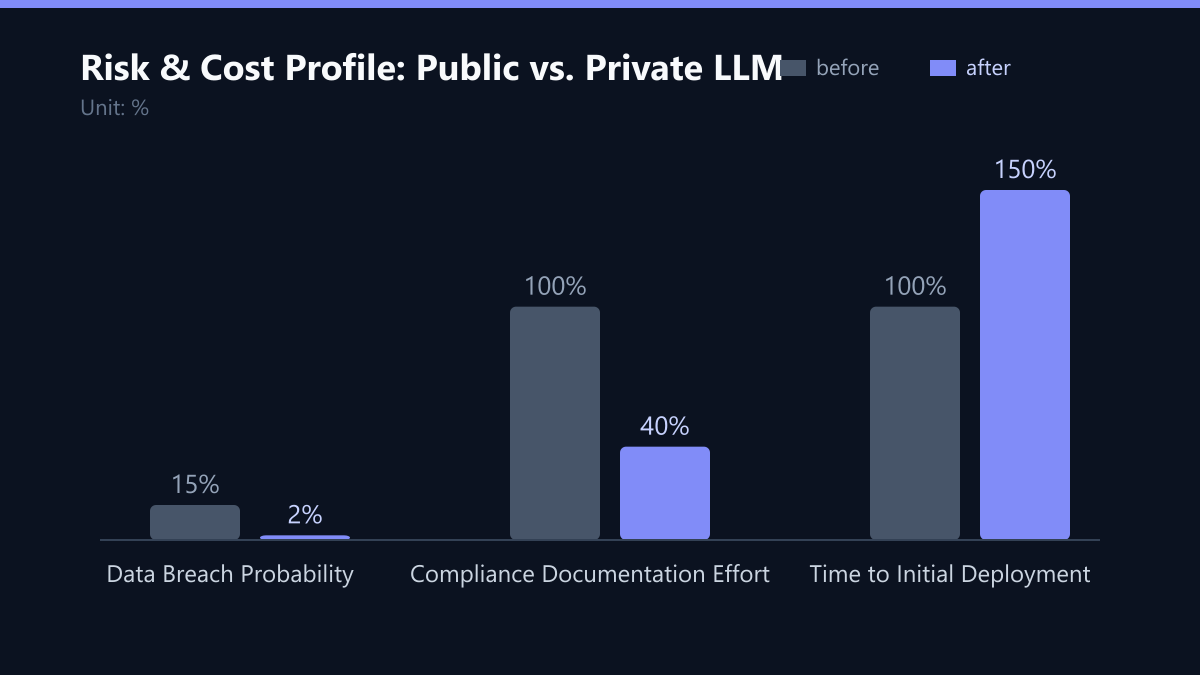
The decision between public APIs and private deployments depends on your risk profile. Public APIs offer rapid scaling and low entry barriers but demand rigorous data protection efforts. Private Deployments, whether on-premise or in a dedicated cloud, offer maximum control but require higher investment and maintenance.
The following comparison highlights the trade-offs:
| Criterion | Public API (e.g., OpenAI) | Private Deployment (On-Premise/Cloud) |
|---|---|---|
| Data Security | Medium (Dependent on DPA/SCCs) | High (Data remains in own environment) |
| Scalability | Very high | Medium (Dependent on hardware) |
| Cost Structure | Pay-per-Use, low fixed costs | High fixed costs, low variable costs |
| Compliance Effort | High (Documentation, TIA) | Lower (after initial setup) |
| Deployment Time | Days to weeks | Weeks to months |
For companies handling highly sensitive data, such as healthcare or finance, a Private Deployment is often the only permissible option. For less sensitive data, a Public API with strict input filtering and robust contracts can be a cost-effective alternative.
Organizational Governance and Human Factors
Technology alone cannot ensure compliance. Organizational processes are crucial. You must define clear guidelines for AI usage. These guidelines should specify which data categories are approved for processing, which tools are officially sanctioned, and who holds the authority to approve new AI applications.
Employee training is equally vital. Many violations stem from convenience or ignorance rather than malice. Staff must understand why they cannot paste customer contracts into a chatbot. Implement a reporting system that allows employees to flag suspicious incidents or unintentional data leaks. An AI Compliance Officer or a dedicated team should monitor these processes, adjusting policies as the legal landscape and provider terms evolve.
Typical Mistakes to Avoid
Even with good intentions, companies often stumble on specific pitfalls during AI implementation:
- Assuming “Free” Means “Safe”: Many assume that because an API is free or low-cost, the data protection risk is low. In reality, free tiers often lack the contractual clarity of enterprise DPAs, leaving you exposed.
- Ignoring Prompt Injection Risks: Failing to secure the interface against prompt injection, where malicious inputs manipulate the AI to reveal system prompts or sensitive data, creates a vector for data exfiltration.
- One-Off Compliance Audits: Treating GDPR compliance as a one-time project rather than a continuous process. AI models and regulations change rapidly; static documentation becomes obsolete quickly.
- Lack of Vendor Due Diligence: Selecting providers based solely on model performance without verifying their ISO 27001 or SOC 2 certifications, which are critical indicators of robust security practices.
How You Measure Success
Compliance is not just about avoiding fines; it is about operational efficiency and trust. You can measure the success of your GDPR-compliant AI implementation through these KPIs:
- Data Incident Rate: Track the number of accidental data leaks or PII exposures per quarter. A successful implementation should show a downward trend, ideally reaching zero.
- Time to Audit Readiness: Measure how long it takes to provide complete documentation (DPAs, TIAs, logs) to a regulator or internal auditor. Target a reduction from weeks to days through automated documentation.
- Employee Adoption vs. Policy Adherence: Monitor the percentage of AI usage that goes through approved, filtered channels versus shadow AI usage. High adherence indicates effective training and user-friendly tools.
Checklist for GDPR-Compliant LLM Implementation
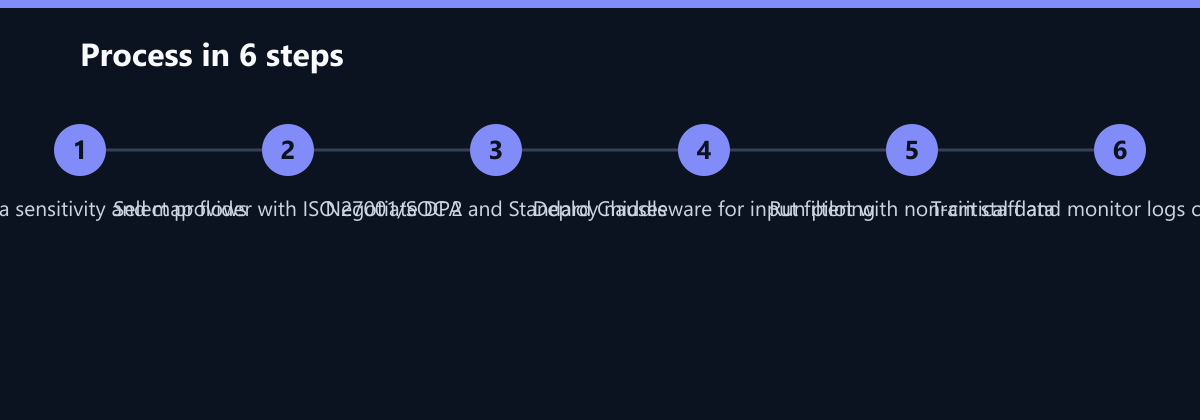
- Data Inventory: Identify all data flows involving AI and classify them by sensitivity.
- Legal Review: Ensure a valid DPA and SCCs are signed with the provider. Complete the TIA if data leaves the EU.
- Technical Setup: Deploy input filtering middleware and configure logging for all AI interactions.
- Access Control: Restrict AI tool access to authorized personnel only, using role-based access control (RBAC).
- Training: Conduct mandatory training for all users, focusing on data minimization and incident reporting.
- Monitoring: Set up alerts for unusual data patterns or high-volume requests that may indicate misuse.
By following this structured approach, you transform AI from a liability into a secure, scalable asset. The initial investment in legal and technical groundwork pays off in reduced risk, operational clarity, and the ability to innovate confidently within the bounds of GDPR.
Passend dazu
- IT & Data Recovery (Disaster Recovery)
- GDPR Audit in Manufacturing: Risk Reduction via Automated Data Classification
- IT Consulting & IT Strategy
- Increasing Conversion Rate by 18% through Implementation of AI-Powered Product Recommendations in a US B2B Industrial Trade
- IT Compliance & Data Protection
- Cloud Services & Cloud Migration
- E-Commerce Development
- Pharma Company in Singapore: Ensuring 99.9% Uptime for GxP-Compliant Systems
- Understanding Hosting KPIs: What to Monitor Beyond CPU and Memory Usage