The Hidden Cost of Self-Managed Complexity
Kubernetes has become the de facto standard for container orchestration, promising superior scalability and efficiency. However, for mid-market companies, the reality often diverges from the promise. While the technology offers immense power, it demands a level of operational expertise that most mid-sized IT teams simply do not possess. The result is a silent drain on resources: engineering teams spend the majority of their time maintaining the platform rather than building products.
The operational burden of self-managing Kubernetes is substantial. Industry data suggests that managing control planes, node health, and cluster upgrades consumes 30-50% of engineering time. This is not merely a productivity issue; it is a strategic bottleneck. When your developers are troubleshooting node drift or patching vulnerabilities, they are not optimizing user experience or launching new features. Furthermore, security risks escalate when teams lack dedicated platform engineers. Misconfigured RBAC (Role-Based Access Control) or network policies remain the leading cause of cloud breaches, exposing companies to significant financial and reputational damage.
Managed Kubernetes services shift this burden to specialized providers. By outsourcing the infrastructure layer, your team can refocus on application development, leveraging the expertise of a provider that treats Kubernetes as its core competency rather than a side project.
Breaking Down the TCO: CapEx vs. OpEx
One of the most common misconceptions is that managed services are inherently more expensive than self-hosting. This view often stems from comparing only the direct compute costs, ignoring the total cost of ownership (TCO). Traditional on-premise setups require high upfront capital expenditure (CapEx) for hardware, which depreciates over time. Cloud-native approaches convert these costs into operational expenditure (OpEx), aligning spending with actual usage.
To understand the true economic impact, we must look beyond the invoice. The break-even point typically occurs when internal engineering costs exceed 20% of the total infrastructure budget. For companies with fewer than five dedicated infrastructure engineers, managed hosting is often more cost-effective. The table below illustrates the cost structure differences:
| Cost Factor | Self-Managed On-Prem | Self-Managed Public Cloud | Managed Kubernetes |
|---|---|---|---|
| Hardware/Compute | High (Depreciation) | Variable | Included in SLA |
| Staffing | 2-3 FTEs (SysAdmins) | 1-2 FTEs (DevOps) | Minimal (App Devs) |
| Licensing | Vendor Lock-in | Variable | Transparent Pricing |
| Uptime Cost | Downtime = Revenue Loss | Downtime = Revenue Loss | SLA Guaranteed (99.9%+) |
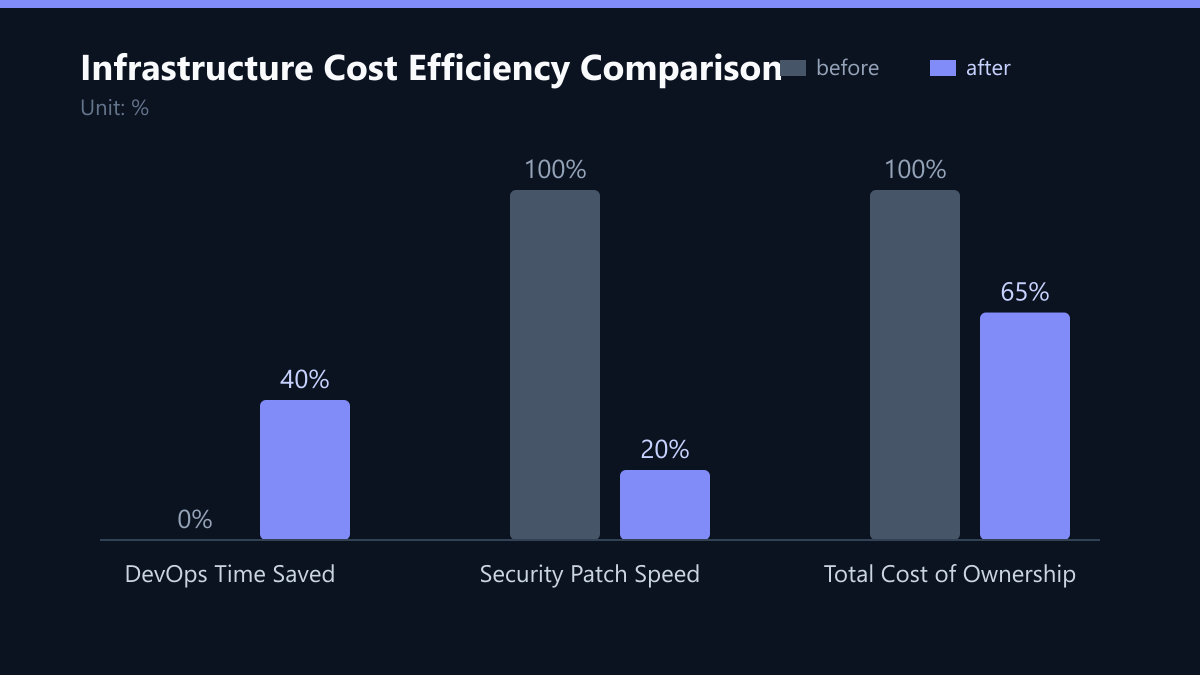
When you factor in the salary of 2-3 full-time DevOps engineers, hardware maintenance, and the financial risk of downtime, managed Kubernetes is often 20-40% cheaper for mid-market companies. The shift from CapEx to OpEx also provides financial flexibility, allowing you to scale resources up or down without the long-term commitment of hardware procurement.
Security and Compliance as a Service
Mid-market companies face increasing regulatory pressure under GDPR and NIS2. Building a compliant infrastructure in-house is a complex, ongoing task that requires constant vigilance. Managed Kubernetes providers offer pre-configured security baselines that are difficult and expensive to replicate internally.
Key security advantages include:
- Automated Patching: Critical vulnerabilities are patched within 24-48 hours of release, significantly reducing the window of exposure compared to in-house patch cycles that often take weeks.
- Compliance Ready: Providers typically offer ISO 27001 and SOC 2 Type II certifications. This simplifies audit processes, as much of the evidence collection is automated and maintained by the provider.
- Network Isolation: Built-in service mesh and network policies reduce the attack surface by default, ensuring that even if one application is compromised, the breach is contained.
By inheriting the security posture of a specialized provider, you reduce the risk of costly data breaches and compliance fines. This is particularly relevant for industries handling sensitive customer data, where a single breach can be existential.
When Managed Hosting is the Strategic Choice
Not every company needs Kubernetes, and not every Kubernetes deployment should be managed. However, managed hosting becomes the clear strategic choice if you meet any of the following criteria:
- Rapid Growth: Your user base or data volume is growing faster than your IT hiring capacity.
- Microservices Architecture: You have migrated from monolithic to microservices and need robust orchestration to manage complexity.
- 24/7 Availability: Your business model requires high uptime without the need for dedicated night shifts or on-call rotations for your core team.
- Talent Scarcity: You struggle to attract or retain senior DevOps engineers in your local market due to salary competition or geographic limitations.
If your IT team is overwhelmed with routine tasks, managed services free up resources for strategic projects. For startups with limited budgets but high growth potential, this model provides enterprise-grade infrastructure without the need for enterprise-grade headcount.
Step-by-Step Implementation Guide
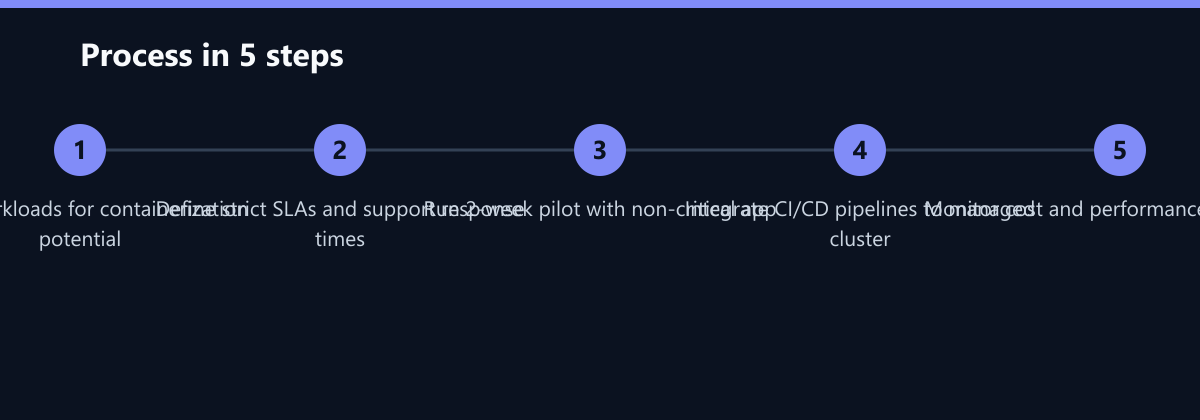
Transitioning to managed Kubernetes requires a structured approach to avoid vendor lock-in and ensure a smooth migration. A phased rollout minimizes risk and allows your team to build expertise in cloud-native operations gradually.
- Assess Workloads: Identify which applications benefit most from containerization. Start with stateless services that have low coupling to legacy systems.
- Define SLAs: Agree on uptime guarantees (typically 99.9%+), response times for critical incidents, and support channels. Ensure these SLAs are contractually binding.
- Pilot Project: Start with one non-critical application to test performance, cost, and integration. This 2-4 week pilot allows you to validate the provider’s capabilities without risking core business operations.
- Integrate CI/CD: Connect your development pipelines to the managed cluster. Automate the deployment process to ensure consistency and speed.
- Monitor and Optimize: Use built-in monitoring tools to track resource usage and costs. Adjust resource requests and limits based on actual usage patterns to optimize spend.
Typical Mistakes to Avoid
Even with a managed service, poor implementation can lead to suboptimal results. Here are the most common pitfalls:
- Lifting and Shifting Without Refactoring: Moving monolithic applications to Kubernetes without decoupling them leads to complex networking and scaling issues. Always refactor for cloud-native patterns where possible.
- Ignoring Cost Monitoring: Without active monitoring, resource over-provisioning can lead to unexpected cost spikes. Set up alerts for budget thresholds and unused resources.
- Over-Reliance on the Provider: While the provider manages the infrastructure, you remain responsible for the application code and configuration. Do not assume that all security best practices are automatically applied to your specific workload.
- Lack of Exit Strategy: Ensure your configurations are portable and that you have access to your data and logs. Avoid proprietary features that make migration back to self-managed or a different provider difficult.
How You Measure Success
To determine if your managed Kubernetes investment is delivering value, track these Key Performance Indicators (KPIs):
- Deployment Frequency: Measure how often your team can deploy new features. Managed Kubernetes should increase this frequency by reducing infrastructure bottlenecks.
- Mean Time to Recovery (MTTR): Track the time it takes to recover from incidents. Automated scaling and patching should reduce MTTR significantly compared to self-managed environments.
- Infrastructure Cost per Unit: Monitor the cost per transaction or per user. This helps identify inefficiencies and ensures that your scaling is cost-effective.
- Developer Productivity: Survey your engineering team to measure the percentage of time spent on infrastructure vs. application development. Aim for a shift where at least 70% of time is spent on product development.
Vendor Selection Checklist
Choosing the right provider is critical. Look beyond price and evaluate these factors:
- Support Quality: Do they offer 24/7 access to certified Kubernetes experts, or just a ticket system? Proactive support is essential for critical workloads.
- Transparency: Are there hidden costs for egress traffic, support tickets, or additional monitoring? Clear pricing models are non-negotiable.
- Scalability: Can they scale from small clusters to multi-region deployments? Ensure their architecture supports your future growth plans.
- Ecosystem Integration: Do they have native support for your existing tools (e.g., Azure, AWS, GCP)? Integration friction can significantly increase onboarding time.
- Case Studies: Ask for case studies from similar mid-market companies. Validating their capabilities with peers in your industry provides confidence in their suitability.
A reliable partner acts as an extension of your IT team, providing proactive insights rather than just reactive support. By following this guide and selecting a provider that aligns with your strategic goals, you can transform Kubernetes from a source of complexity into a driver of innovation and efficiency.