The Bottleneck: Scaling Pain in a Pan-European Fintech
For a fast-growing fintech startup with 85 employees spread across Germany, the UK, and France, growth was coming at a steep operational cost. The primary pain point was not in product development or customer acquisition, but in the internal machinery of employee onboarding. New hires were frequently left waiting up to 10 business days for basic IT access. This delay was not just an inconvenience; it was a direct drag on productivity. In a competitive fintech environment, having a new engineer or sales representative sit idle for a week is a significant waste of capital.
The root cause was a fragmented, manual process. Local HR teams in each country coordinated directly with central IT via email and spreadsheets. This lack of a unified pipeline led to three critical issues: inconsistent user experiences, compliance gaps regarding GDPR and NIS2, and a high error rate in account provisioning. As the company scaled, the IT department realized that hiring more support staff was not a viable solution. They needed a scalable, automated infrastructure that could handle cross-border complexity without increasing headcount.
The Challenges
The project team identified four specific hurdles that needed to be addressed before any automation could begin:
- Fragmented Identity Data: HR data was stored in different formats across the three countries, making it difficult to create a single source of truth for user identities.
- Compliance Complexity: Each region had slightly different data residency and consent requirements. A one-size-fits-all approach would have violated local regulations.
- Device Management Lag: Laptops were often ordered after the contract was signed, leading to further delays. There was no pre-provisioning capability.
- Access Over-Privileging: To save time, IT often granted broad departmental access rather than specific role-based permissions, creating security risks.
The Tech Stack
We selected a cloud-native stack focused on integration and security:
- Azure Logic Apps: The orchestration layer that triggers workflows from the HRIS.
- Microsoft 365 & Azure AD: The identity backbone for user accounts and permissions.
- Intune: For zero-touch device enrollment and policy enforcement.
- Power Automate: For lightweight notifications and status updates to HR.
- Azure Key Vault: For secure storage of API keys and secrets.
Implementation: Building the Automated Pipeline
We designed a centralized, automated onboarding pipeline that integrates directly with the client’s HRIS. The goal was to trigger workflows automatically upon contract signing, eliminating manual email chains.
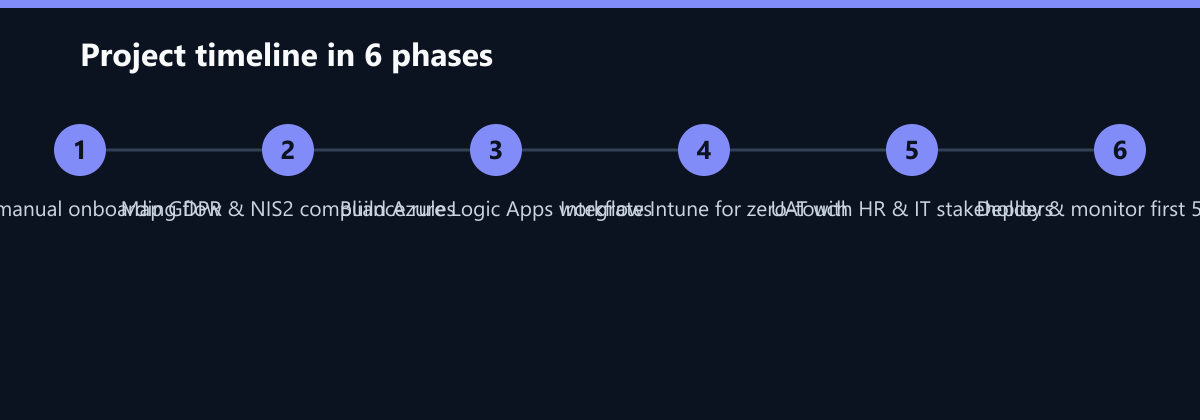
The implementation followed a six-week sprint cycle. The first week was dedicated to mapping the existing manual process and defining the new state. We worked closely with HR and IT stakeholders to define granular roles. Instead of broad “Marketing” or “Engineering” access, we defined specific job functions (e.g., “Backend Developer,” “Compliance Officer”) with tailored RBAC (Role-Based Access Control) policies.
The core of the solution is an Azure Logic App that listens for a “New Employee” event in the HRIS. Once triggered, the workflow executes a series of parallel tasks:
- Identity Creation: An Azure AD account is created with a standardized naming convention. MFA is enforced immediately.
- Device Provisioning: The system sends a request to Intune to prepare a device. The laptop is imaged with the necessary security policies, software, and applications before it is even shipped to the employee. This ensures that when the device arrives, it is ready to use out of the box.
- Compliance Verification: The workflow checks the employee’s location. If the hire is in the UK, it verifies UK GDPR consent. If in Germany, it checks for data residency in the EU. If consent forms are missing, the workflow pauses and notifies HR, preventing access until compliance is met.
- Staged Access: Permissions are not granted all at once. Basic access (email, Teams) is granted on day one. Access to sensitive data or production environments is staged, aligning with the employee’s first-week training schedule. This reduces security risks during the vulnerable onboarding period.
How We Measured It
To ensure the project delivered tangible value, we established a baseline before implementation. We tracked the average time from contract signature to first productive workday for the previous 10 hires. We also monitored the number of IT support tickets tagged with “Onboarding” and the number of configuration errors reported by new users.
Post-implementation, we measured these same metrics for the next 50 hires. Time-to-productivity was measured from the day the employee logged in for the first time to the day they completed their first meaningful task (e.g., committed code, closed a deal, completed a training module). IT support costs were calculated based on the average cost per ticket and the reduction in ticket volume.
Results
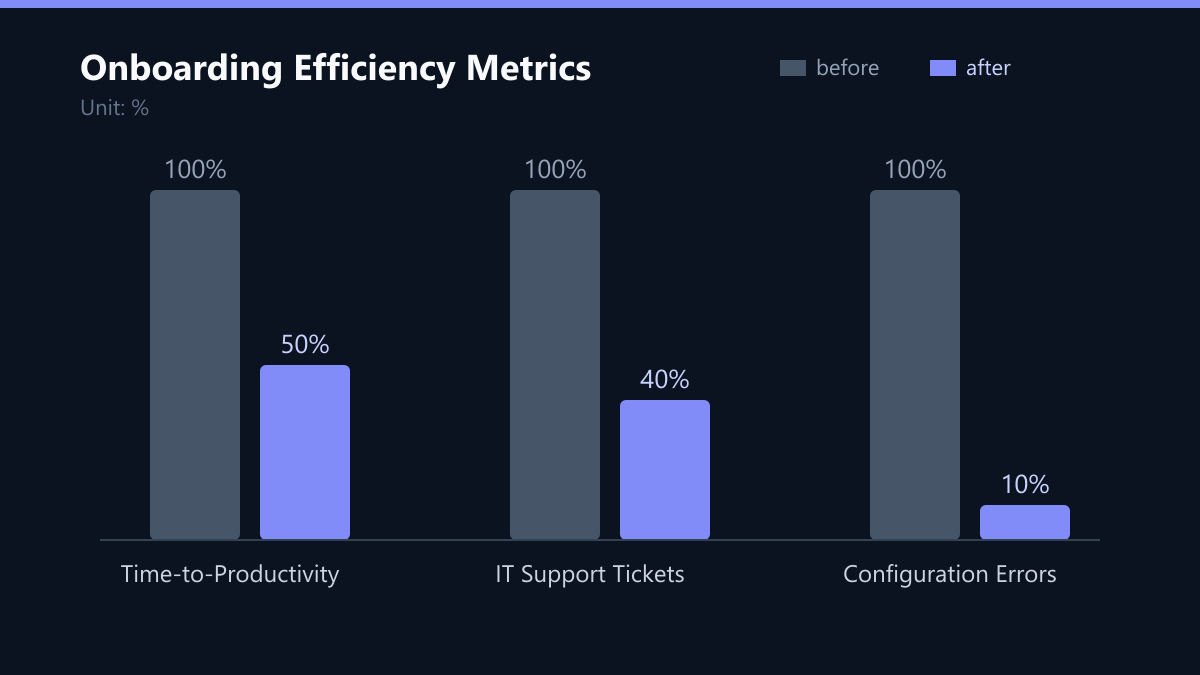
The automation significantly improved operational efficiency and employee satisfaction. By removing manual steps, IT support tickets related to onboarding dropped by 60%. The system now supports onboarding for up to 50 new hires per month without additional IT headcount.
- Time-to-Productivity: Reduced from 10 days to 5 days (50% improvement).
- IT Support Costs: Saved approximately €12,000 per month in manual provisioning labor.
- Error Rate: Reduced configuration errors by 90%, ensuring consistent security baselines.
- Employee Satisfaction: Onboarding satisfaction scores increased from 3.2 to 4.6 (on a 5-point scale).
The financial impact was immediate. The €12,000 monthly savings in labor costs paid for the initial development and ongoing maintenance of the solution within the first quarter. More importantly, the reduction in errors and the consistent security baseline mitigated potential compliance fines and security breaches.
What We Would Do Differently Today
While the project was successful, there are areas we would refine in future engagements:
- Earlier HR Involvement: We would involve HR in the initial scoping phase more deeply. Some role definitions were ambiguous, leading to rework during UAT. Early alignment on job functions would have saved time.
- Device Pre-Ordering: We would integrate with the procurement system to trigger device orders earlier in the hiring process, not just at contract signing. This would further reduce the time-to-productivity.
- Self-Service Portal: We would build a self-service portal for new hires to track their onboarding status. This would further reduce IT support tickets by providing transparency.
Lessons Learned
This project highlighted the importance of early HR-IT alignment in defining user roles. We learned that granular role definitions are more effective than broad departmental access for security and compliance. Additionally, integrating compliance checks directly into the technical workflow, rather than treating them as a separate administrative step, ensures consistent adherence to GDPR and NIS2 requirements. For pan-European companies, a single, cloud-based orchestration layer is essential to manage varying local regulations and infrastructure standards efficiently.
The key takeaway is that onboarding is not just an HR process; it is an IT process. By treating it as a technical challenge to be automated, companies can unlock significant value in terms of speed, cost, and security.