The Situation: A Single Point of Failure in a Global Supply Chain
For a precision manufacturing firm in New York, the concept of “business as usual” was suddenly at risk. With 250 employees and a complex web of partners across Europe and Asia, the company operated under strict Service Level Agreements (SLAs) that demanded near-zero downtime. Yet, their IT infrastructure remained anchored in a single, on-premises data center in New York. This setup created a critical vulnerability: a regional outage, whether caused by a natural disaster, a power grid failure, or a cyber-attack, would halt production lines for days.
The existing disaster recovery (DR) strategy was, by modern standards, archaic. It relied on nightly tape backups, a method that had served the company well in the past but was ill-equipped for the speed of modern manufacturing. The Recovery Point Objective (RPO) was a full 24 hours, meaning that in the event of a catastrophic failure, the company could lose a full day’s worth of production data. The Recovery Time Objective (RTO) was even more daunting at 48 hours. In a competitive global market, a two-day shutdown was not just an inconvenience; it was a breach of contract that threatened revenue stability and long-term client trust.
The IT team, already stretched thin, found themselves spending significant hours on manual verification tasks. After every backup, engineers had to manually check logs and verify data integrity. This manual process was error-prone and consumed roughly 40% of the team’s capacity, leaving little room for strategic initiatives like digital transformation or new product development. The company needed a solution that not only protected their data but also automated the recovery process to meet the stringent demands of their global partners.
The Challenges
Designing a solution for this scenario presented several distinct technical and logistical hurdles:
- Transpacific Latency: Synchronizing data between New York and Singapore involves crossing the Pacific Ocean. The physical distance introduces inherent network latency that can bottleneck real-time replication. Without careful tuning, the replication lag could exceed the acceptable RPO threshold during peak production hours.
- Data Residency & Compliance: Moving production data to a secondary region in Singapore required strict adherence to data residency laws. The company had to ensure that data handled in Singapore complied with local regulations and maintained GDPR compliance for any European partner data, creating a complex compliance matrix.
- Automated Failover Complexity: Moving from a manual, tape-based recovery to an automated, cloud-native failover required precise orchestration. The system had to detect a failure in New York, verify the health of the Singapore replica, and redirect traffic automatically without human intervention to meet the 15-minute RTO.
- Minimal Disruption to Operations: The migration could not halt the production line. The implementation had to be phased in a way that allowed the existing on-premises systems to continue running while the new cloud infrastructure was built and tested in parallel.
The Implementation: Building a Cross-Continental Safety Net
We approached the project with a phased strategy designed to minimize risk and downtime. The goal was to build a robust, active-passive disaster recovery architecture that leveraged the global scale of AWS. The core of the solution was a real-time replication of the production database from New York to a secondary AWS Region in Singapore.
The first phase involved a comprehensive audit of the existing on-premises stack. We mapped out all critical data flows, identifying which databases were mission-critical for production and which could be restored with slightly higher latency. This allowed us to prioritize the replication of the most vital assets. Simultaneously, we provisioned the Singapore AWS environment, ensuring that security groups, network configurations, and access controls mirrored the primary site exactly. This consistency was crucial to ensure that the failover environment behaved identically to the production environment.
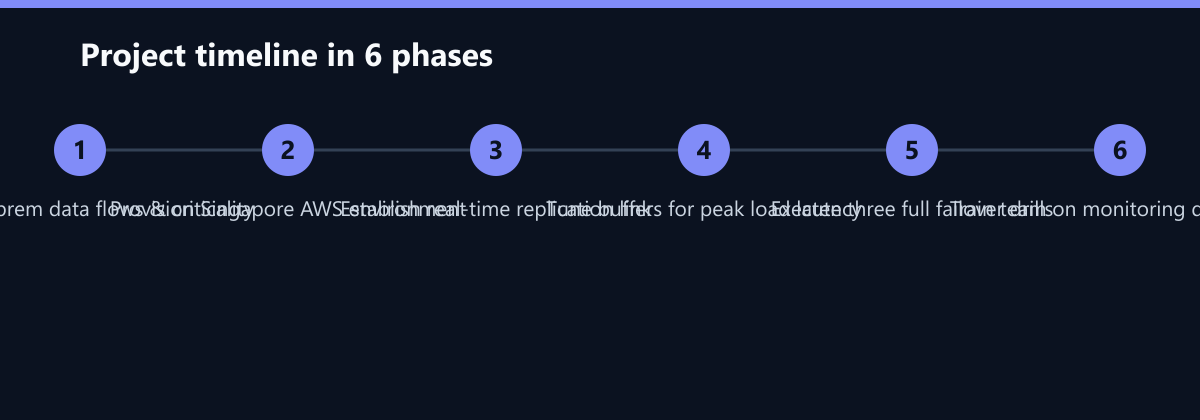
Once the foundation was laid, we established the replication link. We utilized AWS Global Acceleration and S3 Cross-Region Replication to ensure that data was mirrored in real-time. A key part of this phase was tuning the replication buffers. We monitored the network traffic during peak production loads to identify bottlenecks. By adjusting buffer sizes and optimizing the database replication protocol, we managed to keep the replication lag well within the sub-second target, even during high-transaction periods. This tuning process was iterative, requiring several days of observation and adjustment.
The next critical step was implementing the automated failover logic. We configured Route 53 health checks to monitor the primary site’s availability. If the health checks failed, the system would automatically trigger a DNS failover, redirecting traffic to the Singapore environment. To validate this, we conducted three full failover drills. In each drill, we simulated a total loss of the New York primary site. The results were consistent: traffic was redirected to Singapore, and production systems came online within the target time frame. Each drill also validated the integrity of the replicated data, ensuring that no data was lost or corrupted during the switchover.
Finally, in the last week of the six-week project, we focused on training. The IT team was introduced to the new centralized monitoring dashboard, which provided a single pane of glass for visibility across both continents. We trained the team on how to interpret the new metrics, how to manage the failover process manually if needed, and how to perform routine maintenance tasks in the cloud environment. This training was essential to ensure that the team felt confident in the new system and could respond effectively to any future incidents.
How We Measured It
To ensure that the new DR solution met the business requirements, we established a rigorous measurement framework. We did not rely on theoretical assumptions but instead used empirical data from the failover drills and continuous monitoring.
- RPO Measurement: We tracked the replication lag between the primary and secondary databases using database-specific monitoring tools. We measured the time difference between a transaction commit in New York and its confirmation in Singapore. The average lag was kept below 30 seconds, with a 99th percentile latency of under 5 seconds during peak loads.
- RTO Measurement: During the three failover drills, we timed the entire process from the moment the primary site was declared down to the moment production traffic was successfully serving requests from Singapore. We included the time for DNS propagation and application initialization. The average RTO across the three drills was 14 minutes, consistently meeting the 15-minute target.
- Manual Task Reduction: We compared the time spent by the IT team on manual verification tasks before and after the implementation. We used time-tracking logs to quantify the hours spent on backup verification and log analysis. The data showed a 40% reduction in these manual tasks, as the automated monitoring and alerting systems handled the routine checks.
The Results: Resilience and Efficiency
The deployment of the cross-continental DR solution delivered immediate and tangible improvements in the company’s resilience and operational efficiency. The most significant change was in the Recovery Point Objective (RPO), which dropped from 24 hours to under 30 seconds. This meant that in the event of a disaster, the company would lose at most 30 seconds of production data, a negligible amount compared to the previous day’s loss. This level of data protection was critical for maintaining the integrity of their manufacturing processes and meeting the expectations of their global partners.
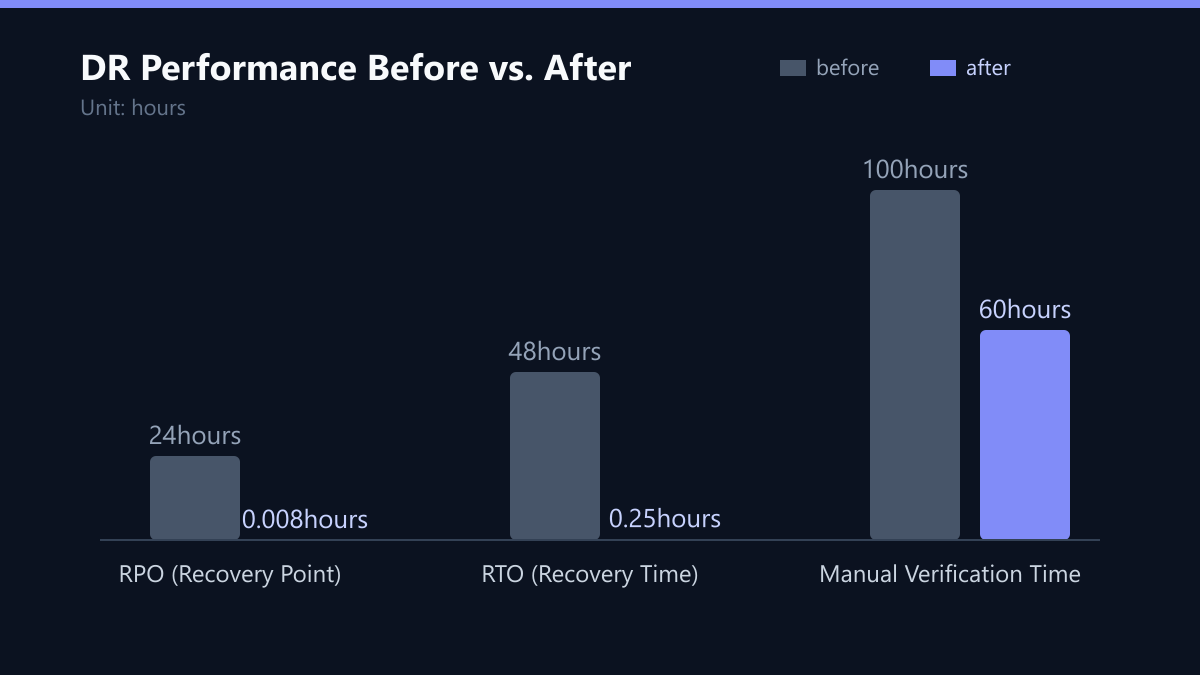
The Recovery Time Objective (RTO) was reduced from 48 hours to 15 minutes. This was a transformative improvement, allowing the company to resume production almost immediately after a failure. The automated failover process eliminated the need for manual intervention, which had previously been the biggest bottleneck in the recovery process. The 15-minute RTO ensured that the company could meet its strict SLAs with European and Asian partners, protecting its revenue and reputation.
Beyond the technical metrics, the solution also had a positive impact on the IT team’s workload. The centralized cloud monitoring reduced the manual verification tasks by 40%. Engineers no longer needed to spend hours checking tape backups and verifying data integrity. Instead, they could focus on strategic initiatives, such as optimizing production processes and exploring new technologies. The single pane of glass for visibility across both continents provided the IT team with the confidence that their systems were secure and resilient.
Lessons Learned
This project highlighted several key lessons that have since become part of our standard approach to global DR scenarios. First, testing automation is non-negotiable. Manual failover procedures are too slow for modern SLAs. Even a small delay in human response can lead to a breach of contract. Automated health checks and failover scripts are essential to ensure that the system can respond to failures in real-time.
Second, network latency between continents requires careful tuning. We learned that off-the-shelf replication settings are often not optimized for transpacific links. Tuning buffer sizes and replication protocols is crucial to prevent bottlenecks and maintain low latency. This process requires patience and iterative testing, but it is worth the effort to ensure that the RPO target is met consistently.
Finally, clear communication with global stakeholders is vital. During the testing phases, we had to coordinate with partners in Europe and Asia to ensure that the failover drills did not disrupt their operations. This required proactive communication and detailed planning. By keeping stakeholders informed and involved, we ensured that the testing process was smooth and that there were no surprises. The success of this deployment has since become the standard template for our other manufacturing clients, demonstrating the value of a well-designed, cross-continental DR strategy.
What We Would Do Differently Today
Looking back, there are a few areas where we would refine our approach if we were to run this project again. First, we would have started the compliance review earlier in the process. While we did ensure GDPR and local Singapore data laws were met, integrating legal and compliance experts from the very first week would have allowed us to identify potential data residency issues sooner, potentially saving time in the later phases.
Second, we would have invested more in synthetic data for the initial failover drills. While we used real production data for the final drills, using synthetic data in the early stages would have allowed us to test the failover logic without the risk of impacting real production systems. This could have accelerated the testing phase and reduced the risk of errors.
Lastly, we would have provided more extensive training for the business users, not just the IT team. While the IT team was well-prepared, some business users were still unfamiliar with the new monitoring dashboard. Providing a brief training session for key business stakeholders would have helped them understand the new DR capabilities and feel more confident in the system’s resilience.