The Starting Point: A Friction-Heavy Onboarding Process
For an asset manager in the DACH region with 85 employees, onboarding institutional investors was a critical bottleneck. The process relied heavily on static PDF forms and manual email exchanges, creating a high-friction experience for clients and a significant operational burden for the internal team. This legacy approach not only increased the risk of data entry errors but also made it difficult to maintain the rigorous audit trails required by modern regulatory standards.
Compliance teams found themselves spending excessive hours verifying document completeness. Any single missing field in a PDF would trigger a full re-review cycle, delaying the entire onboarding process. Furthermore, the IT infrastructure lacked centralized logging, making it nearly impossible to reconstruct the approval history for a single client efficiently. This inefficiency was a direct threat to their ability to meet NIS2 incident reporting requirements in a timely manner.
The Challenges
The core issues were not just technical but deeply procedural. First, there was a high drop-off rate; 25% of potential clients abandoned the process due to the complexity of multi-page PDFs. Second, the manual transcription of data from these PDFs into the CRM resulted in a 15% error rate, requiring constant manual correction. Third, audit inefficiency was severe; reconstructing the approval history for a single client took an average of 4 hours of manual effort. Finally, there were significant security risks, as sensitive KYC documents were stored on local drives without automated encryption or granular access controls.
The Tech Stack
To address these challenges, we deployed a robust, cloud-native solution stack:
- Microsoft 365 Forms: Used to replace static PDFs with dynamic, web-based forms that validate data in real-time.
- Azure Blob Storage: Implemented for secure, encrypted storage of all documents with role-based access control (RBAC).
- Azure API Management: Facilitated the secure integration between the onboarding portal and the client’s existing CRM system.
- Microsoft Sentinel: Leveraged for immutable audit logging to meet NIS2 requirements and provide centralized monitoring.
- Power Automate: Used to orchestrate the workflow, triggering notifications and data pushes upon successful validation.
Implementation: Building a Secure Digital Workflow
We designed a centralized onboarding portal integrated directly with Microsoft 365 and Azure. The solution replaced the static PDFs with a dynamic, web-based form. This system automatically validates data fields in real-time, preventing incomplete or incorrect submissions before they enter the workflow. The goal was to shift the burden of validation from the human to the machine, ensuring that data quality is high at the point of entry.
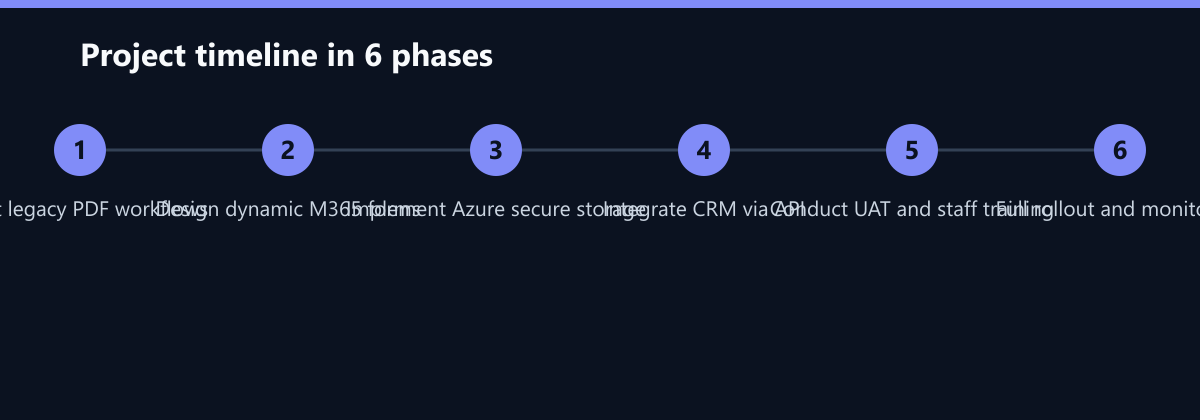
The workflow was structured to handle four key components. First, Automated Validation ensures that mandatory fields are checked against regex patterns and external databases. This prevents errors at the source. Second, Secure Storage means all documents are encrypted at rest using Azure Blob Storage, with access strictly controlled via role-based permissions. Third, Audit Logging captures every action immutably, creating a tamper-proof record that satisfies NIS2 incident reporting requirements. Finally, CRM Integration pushes validated data directly to the client’s CRM via API, completely eliminating the need for manual data entry.
Compliance Architecture: NIS2 and GDPR Alignment
Security and compliance were not afterthoughts; they were foundational. The system was built with a zero-trust architecture, assuming that no user or device should be trusted by default. Access to sensitive KYC data is restricted to authorized compliance officers, requiring Multi-Factor Authentication (MFA) for every access attempt. Data residency is strictly maintained within EU regions to ensure full GDPR compliance, preventing any cross-border data transfer that could complicate legal obligations.
We also implemented automated retention policies to manage the data lifecycle. Documents are automatically archived after 7 years and securely deleted after 10 years, as required by local financial regulations. This automation reduces the manual housekeeping burden on the IT team and ensures consistent, policy-driven data lifecycle management, eliminating the risk of non-compliant data retention.
How We Measured It
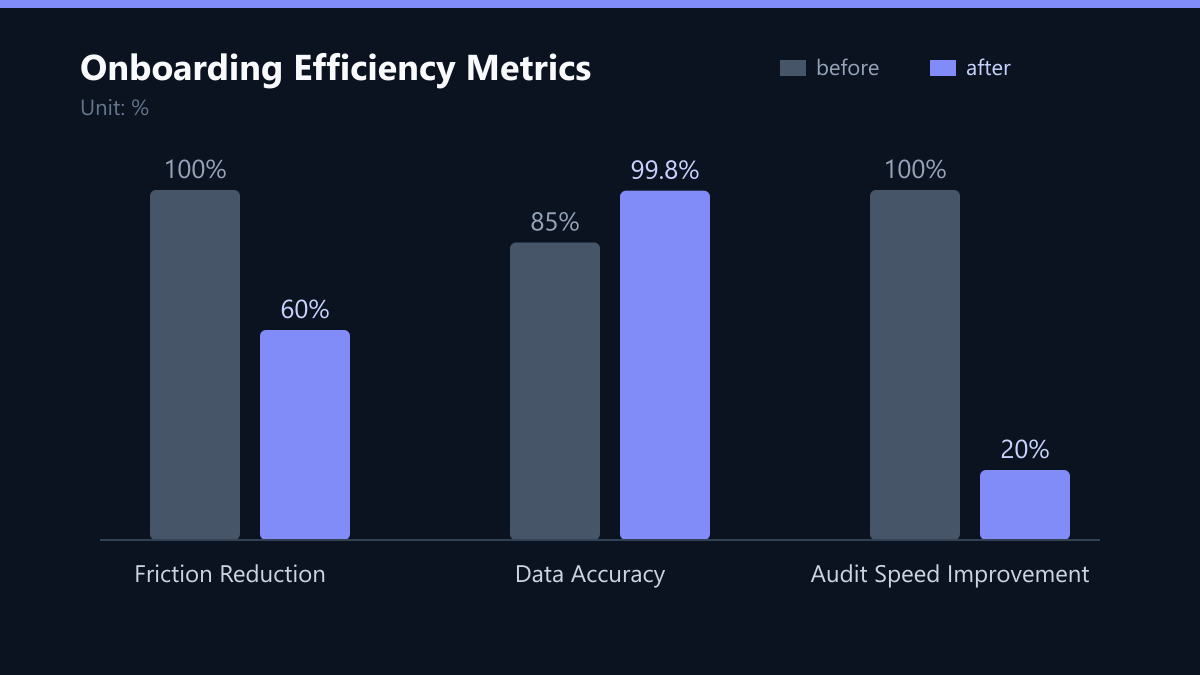
To ensure the solution delivered tangible value, we established a clear baseline before implementation. We tracked the average time from initial contact to full onboarding, the number of data entry errors per 100 clients, and the time taken to retrieve a complete audit trail for a random sample of 10 clients. Post-implementation, we measured these same metrics over a 3-month period. The friction reduction was calculated by comparing the average onboarding time (5 days pre-implementation vs. 3 days post-implementation) and the drop-off rate. Data accuracy was measured by comparing the number of manual corrections required in the CRM. Audit speed was determined by timing the retrieval of full audit trails for the same sample of clients. This rigorous measurement approach allowed us to quantify the impact of the new workflow accurately.
Results: Efficiency and Security Gains
The new system was deployed in three phases over 12 weeks. The initial phase covered form redesign and backend integration, taking 4 weeks. The second phase focused on security hardening and user acceptance testing, lasting 5 weeks. The final phase involved staff training and full rollout, completed in 3 weeks. This phased approach minimized disruption to daily operations and allowed for iterative feedback.
The outcomes were significant. We achieved a 40% reduction in friction, with the average onboarding time dropping from 5 days to 3 days. Data accuracy improved to 99.8%, as manual entry errors were virtually eliminated through automated validation. Most notably, compliance teams could now retrieve full audit trails in minutes instead of hours, representing an 80% faster audit process. These improvements not only enhanced client satisfaction but also significantly reduced the operational risk associated with manual processes.
Lessons Learned: Balancing UX and Regulation
The project highlighted that compliance and user experience are not mutually exclusive. By automating validation, we reduced the burden on both clients and staff. The key lesson is to involve compliance officers early in the design phase. This ensures that regulatory requirements are embedded in the workflow logic rather than added as afterthoughts, which often leads to bottlenecks and workarounds.
We also learned that regular security reviews are essential to adapt to evolving NIS2 guidelines. Regulations in the financial sector are dynamic, and a static compliance framework is insufficient. This approach provides a scalable foundation for future digital transformation initiatives, allowing the client to adapt to new regulatory requirements without a complete system overhaul.
What We Would Do Differently Today
If we were to repeat this project today, we would focus on three areas for improvement. First, we would invest more time in user research during the design phase to better understand the specific pain points of institutional investors, potentially leading to an even more streamlined form. Second, we would implement a more granular monitoring dashboard from the start, allowing for real-time visibility into form completion rates and validation errors. Finally, we would explore the use of AI-driven document verification to further reduce the need for manual review of complex KYC documents, although this was outside the scope of the initial project.
This case study demonstrates how a focused, security-first approach to digital transformation can yield significant efficiency gains and compliance benefits. By addressing the root causes of friction and error, we were able to create a sustainable, scalable solution that meets the highest standards of regulatory compliance.
Passend dazu
- IT Compliance & Data Protection
- Cloud Services & Cloud Migration
- IT & Data Recovery (Disaster Recovery)
- Compliance-automatisierung: Ein Finanzdienstleister in London erfüllt NIS2-Anforderungen in 8 Wochen durch zentralisiertes Risiko-Management
- Magento 2 Performance-Optimierung im DACH-Raum
- Phishing-Reduktion um 78 Prozent: Security-Awareness-Programm für einen 400-köpfigen Maschinenbauer im DACH-Raum
- Automated Invoice Processing with OCR and LLM: Reducing Accounting Backlog by 40 Percent in DACH Manufacturing