The Regulatory Deadline and the Operational Reality
For a mid-sized financial services provider in London with 150 employees, the arrival of the NIS2 directive was not just a regulatory update; it was an operational crisis. The firm, operating in a highly regulated environment, found itself relying on a patchwork of manual spreadsheets and disjointed tools to track security incidents and maintain asset inventories. This fragmented approach created significant blind spots, making it impossible to demonstrate compliance to regulators efficiently or accurately. The pressure was immediate: the regulatory deadline was fixed, and the current state of IT security documentation was far from audit-ready. The IT team was spending over 20 hours per week manually compiling reports, a drain on resources that could have been directed toward strategic security improvements. The risk of non-compliance fines was not just theoretical; it was a tangible threat due to the inability to provide a centralized, verifiable view of the company’s security posture.
The Challenges
The path to compliance was blocked by several concrete operational hurdles that required immediate attention.
- Fragmented Data Sources: Asset data was scattered across on-premise servers, cloud instances, and third-party applications. There was no single source of truth, leading to inconsistent reporting and missed vulnerabilities.
- Manual Reporting Bottleneck: The IT team was acting as data entry clerks rather than security strategists. The 20 hours per week spent on manual reporting created a bottleneck that slowed down incident response and remediation.
- Lack of Real-Time Visibility: Security incidents were often discovered after the fact, through manual checks or user reports. There was no continuous monitoring in place to detect policy deviations or new vulnerabilities in real time.
- Audit Readiness Gaps: Preparing for an audit required weeks of manual effort to gather evidence. The lack of automated logging and reporting meant that the firm could not produce compliance reports on demand, a critical requirement under NIS2.
The Tech Stack
To address these challenges, we selected a technology stack that prioritized integration, automation, and scalability. Each tool was chosen to minimize friction with the existing infrastructure while maximizing data accuracy.
- Centralized Risk Management Platform: A unified dashboard to aggregate data from all sources and provide a single view of compliance status.
- Azure Integration Modules: Native connectors to leverage the existing Azure infrastructure for data collection and log aggregation.
- Automated Vulnerability Scanning Agents: Lightweight agents deployed on all endpoints to continuously detect and report vulnerabilities.
- Real-Time Analytics Engine: A processing layer that correlates data from different sources to identify patterns and anomalies.
- Executive Reporting Dashboard: A user-friendly interface designed for non-technical stakeholders to track compliance progress and risk levels.
Implementation: From Chaos to Control
The implementation was structured as a strict eight-week project to meet the regulatory deadline. The goal was to automate data collection, vulnerability scanning, and incident reporting, thereby reducing manual effort and ensuring real-time visibility into the security posture. The project began with a comprehensive asset discovery phase. We deployed automated scanning tools across all on-premise and cloud environments to create a live, accurate inventory of all IT assets. This step was critical because accurate data is the foundation of any meaningful risk assessment. Once the inventory was complete, we moved to policy mapping. We mapped the company’s internal security controls directly to NIS2 requirements using a structured framework. This ensured that every control was aligned with regulatory expectations and that no gaps were overlooked.
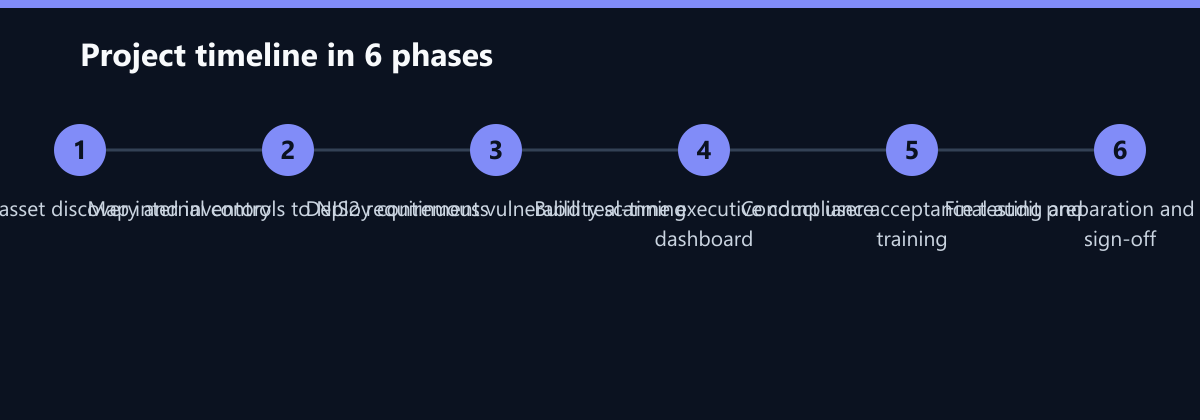
The next phase involved deploying monitoring agents for continuous vulnerability detection and log aggregation. These agents were installed on all endpoints, including servers, workstations, and cloud instances. They ran in the background, collecting data on system health, security events, and vulnerabilities. This data was streamed to the centralized risk management platform, where it was processed and correlated. We also built a real-time dashboard for executives and auditors. This dashboard provided instant visibility into compliance status, risk levels, and remediation progress. It allowed stakeholders to track the project’s progress in real time and make informed decisions based on up-to-date data.
How We Measured It
To ensure the success of the project, we defined clear Key Performance Indicators (KPIs) and established a rigorous measurement methodology. The primary KPI was the reduction in manual reporting time. We measured this by tracking the hours spent by the IT team on compliance-related tasks before and after the implementation. The baseline was established during the first two weeks of the project, where we observed and logged the time spent on manual reporting. After the implementation, we continued to track these hours to measure the impact of automation. Another critical KPI was asset coverage. We measured this by comparing the number of assets identified by the automated discovery process against the total number of assets in the company’s inventory. The goal was to achieve 100% coverage, ensuring that no assets were left unmonitored. Finally, we measured compliance gaps by tracking the number of unremediated vulnerabilities and policy deviations. This metric was derived from the real-time data collected by the monitoring agents. By comparing the number of gaps before and after the implementation, we could quantify the improvement in the company’s security posture. These measurements were conducted weekly and reported to the project steering committee to ensure transparency and accountability.
Results: Measurable Efficiency and Compliance
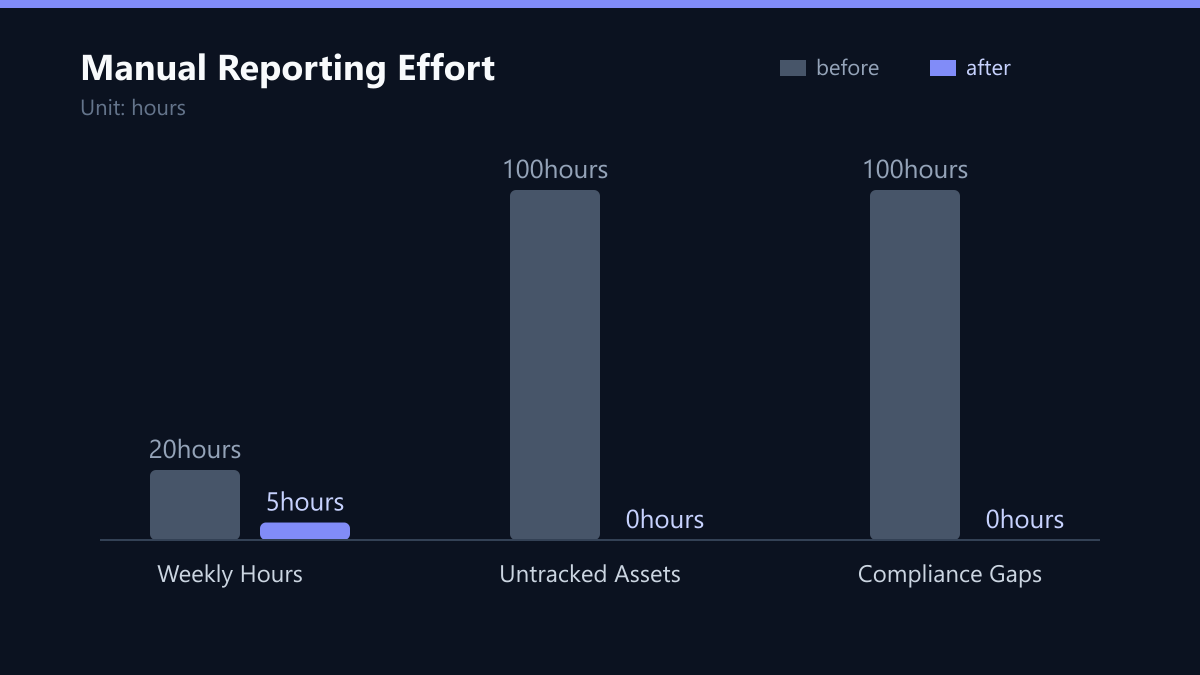
The automation initiative transformed the company’s compliance posture. The results were not just anecdotal; they were quantifiable and significant. The most immediate impact was the reduction in manual effort. The time spent on manual reporting dropped from 20 hours per week to just 5 hours, a 75% reduction. This freed up the IT team to focus on strategic security improvements, such as threat hunting and incident response. The centralized dashboard provided instant clarity on risk levels and remediation progress. Executives could now see the company’s compliance status at a glance, without waiting for manual reports. This improved decision-making and ensured that leadership remained engaged with the security program. The project achieved 100% NIS2 compliance, with all mandatory controls verified and documented. The automated monitoring system ensured that new vulnerabilities and policy deviations were detected in real time, allowing for rapid remediation. The firm was now audit-ready, with one-click export of compliance reports for regulatory bodies. This eliminated the weeks of manual effort previously required to prepare for an audit.
The success of the project was not just about meeting the deadline; it was about creating a sustainable security posture. The company now has a proactive approach to security, with continuous monitoring and automated reporting. This has reduced the risk of non-compliance fines and improved the overall security posture. The IT team is no longer bogged down by manual tasks, allowing them to focus on strategic initiatives. The executive team has greater confidence in the company’s security, knowing that they have real-time visibility into the security posture. The project demonstrated that compliance automation is not just a regulatory necessity but a strategic advantage. By centralizing risk management, the company gained a proactive approach to security, reducing risk and improving efficiency.
Lessons Learned and What We Would Do Differently
This project provided valuable insights into the challenges and opportunities of compliance automation. One key lesson was the importance of data accuracy. Automated discovery must be accurate to avoid false positives, which can erode trust in the system. We learned that investing time in validating the asset inventory is critical to the success of the project. Another lesson was the importance of executive buy-in. Regular dashboard reviews helped maintain leadership support and ensured that the project remained a priority. We found that involving executives early in the process and providing them with clear, concise reports was essential to maintaining momentum. Finally, we learned that compliance is an ongoing process, not a one-time project. The system must be continuously monitored and updated to reflect changes in the regulatory landscape and the company’s IT environment.
If we were to repeat this project, there are a few things we would do differently. First, we would invest more time in change management. While the technical implementation was smooth, the cultural shift from manual to automated processes required more attention. We would have provided more training and support to the IT team to ensure they felt comfortable with the new tools. Second, we would have started the asset discovery phase earlier. The initial discovery process took longer than expected due to the complexity of the environment. Starting this phase earlier would have provided more time for data validation and cleanup. Third, we would have involved the legal and compliance teams more closely in the policy mapping phase. Their input would have helped ensure that the mapped controls were not only technically sound but also aligned with the company’s risk appetite and regulatory obligations. These lessons have informed our approach to subsequent compliance projects, allowing us to deliver even better results for our clients.
The Strategic Advantage of Automation
The transformation of this London-based financial services provider illustrates a broader trend in the industry: the shift from reactive compliance to proactive security management. By leveraging automation and centralized risk management, the company was able to meet the NIS2 deadline in just 8 weeks, a feat that would have been impossible with manual processes. The reduction in manual effort by 75% is a testament to the power of automation in freeing up resources for higher-value activities. The real-time visibility provided by the centralized dashboard has empowered the executive team to make informed decisions, reducing risk and improving efficiency. This case study demonstrates that compliance automation is not just about meeting regulatory requirements; it is about creating a resilient, efficient, and proactive security posture. For mid-sized firms in regulated industries, this approach offers a clear path to compliance without sacrificing operational efficiency. The key to success lies in accurate data, executive buy-in, and a commitment to continuous improvement. By adopting these principles, organizations can turn compliance from a burden into a strategic advantage.
Passend dazu
- Hybrid Office & Workplace Management
- Log-Management im Mittelstand: Warum zentralisiertes Monitoring die Compliance-Kosten senkt
- NIS2 Compliance Checklist: Identifying Critical IT Weaknesses
- IT Compliance & Data Protection
- IT Automation & Process Automation
- Cloud Services & Cloud Migration
- NIS2 Compliance in the Machinery Industry: Avoiding Fines Through Proactive Vulnerability Management
- Accelerating Compliance Audits in the Financial Sector
- NIS2 Compliance: Critical IT Weaknesses in UK Manufacturing
- SIEM-Automatisierung bei einem Frankfurter Finanzdienstleister
- Automated NIS2 Compliance and SIEM Integration for US Manufacturing
- Medizintechnik-Hersteller in München: NIS2-Vorbereitung und IT-Sicherheitslücken-Schließung in 6 Wochen mit 35 Prozent Reduktion der Reaktionszeit auf Bedrohungen
- Konsolidierung der IT-Infrastruktur im Gesundheitswesen: Senkung der Betriebskosten um 35 Prozent bei gleichzeitiger NIS2-Konformität
- IT Compliance for the Mittelstand: Meeting NIS2 and GDPR Standards
- Wi-Fi 6 vs. Wi-Fi 6E: The Financial Case for Open-Plan Offices
- Digitizing Contract Management for a Real Estate Portfolio in New York: Reducing Compliance Risks and Retrieval Time by 75%
- Finanzdienstleister im DACH-Raum: Formular-Friction reduzieren und Compliance sicherstellen
- NIS2 Compliance for a Frankfurt FinTech in Six Months
- Kollaborations-Setup für Kanzlei in London: Compliance-orientierte SharePoint-Architektur und Dokumentenkontrolle mit 100 Prozent Audit-Trail