The Starting Point: A Manufacturing Bottleneck
In the high-stakes world of automotive manufacturing, downtime is not just an inconvenience; it is a financial hemorrhage. Our client, a mid-sized automotive component manufacturer based in Singapore with 450 employees, was facing a critical operational crisis. Despite modernizing their software stack, their internal ERP and IoT monitoring platforms remained tethered to manual deployment processes. The result was a release cycle that averaged three weeks per update. In an industry where production lines must run with near-perfect precision, this lag was unacceptable.
The situation was exacerbated by a reactive IT culture. Without automated health checks, server issues often went unnoticed until they cascaded into critical failures. IT teams found themselves trapped in a cycle of firefighting, spending 40% of their available time addressing urgent infrastructure issues rather than developing new features or optimizing systems. The lack of visibility into infrastructure health meant that even when code was stable, the environment beneath it could fail unpredictably, halting production lines and causing significant revenue loss.
The Challenges We Faced
Transforming this legacy setup into a modern, automated environment presented several distinct challenges:
- Integration Complexity: Connecting disparate IoT devices and on-premise ERP servers into a unified monitoring framework required careful network mapping and agent deployment.
- Cultural Resistance: Development teams were accustomed to manual control and were initially skeptical of automated gates that could reject their deployments.
- Legacy Scripting: Existing deployment scripts were brittle and undocumented, requiring a complete rewrite to ensure reliability and rollback capability.
- Zero-Downtime Requirement: The client could not afford extended maintenance windows, necessitating a phased rollout strategy that maintained production continuity.
The Tech Stack
To address these challenges, we selected a robust, cloud-native toolset:
- Azure DevOps: The central hub for our CI/CD pipelines, managing build, test, and release stages.
- Azure Monitor: For real-time infrastructure health checks, tracking server load, network latency, and disk usage.
- Terraform: For Infrastructure as Code (IaC), ensuring consistent and repeatable environment provisioning.
- PowerShell & Bash: Custom automation scripts for specific rollback scenarios and log aggregation.
Implementation: From Manual to Automated
Our approach was methodical, focusing on stability first and speed second. We began with a comprehensive audit of the existing manual workflows to identify the specific bottlenecks. This allowed us to map out the critical path for deployment and determine which manual steps could be safely automated.
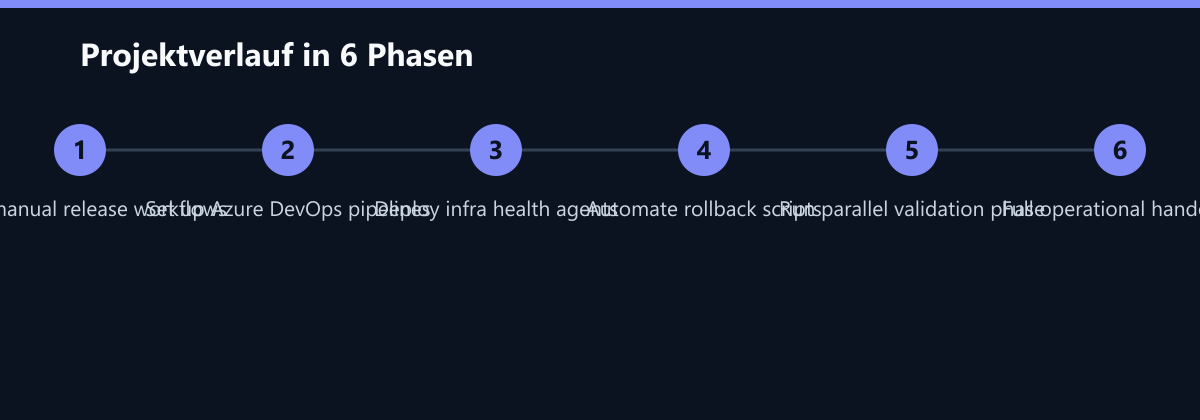
The core of the implementation was the construction of a robust CI/CD pipeline using Azure DevOps. We configured distinct stages for build, unit testing, integration testing, and deployment. Each stage included automated gates that would halt the pipeline if quality thresholds were not met. This eliminated the need for manual intervention in the release process, ensuring that only tested and verified code reached production.
Simultaneously, we deployed an integrated infrastructure health check system. This tool continuously monitors server load, network latency, and disk usage across all production servers. By setting aggressive alert thresholds, the system triggers warnings before critical failures occur. This proactive approach was crucial for a manufacturing environment where a single server failure could halt an entire production line.
Key steps included:
- Pipeline Setup: Configured build, test, and deploy stages in Azure DevOps with parallel execution to reduce cycle time.
- Infrastructure Integration: Connected monitoring agents to all production servers, ensuring full visibility into the physical and virtual infrastructure.
- Automation Scripts: Created scripts for automated rollback on failed deployments, ensuring that any issues could be reverted within minutes.
The entire implementation took eight weeks, with full operational handover in month three. We ran the new and old systems in parallel for two weeks to validate the stability of the new pipelines before decommissioning the manual processes.
How We Measured It
To ensure the success of the project, we established a baseline of key performance indicators (KPIs) before implementation. We tracked deployment time from the moment code was committed to the moment it was live in production. We also monitored the frequency of downtime incidents and the percentage of IT time spent on reactive tasks. These metrics were collected automatically through Azure Monitor and time-tracking software, providing an objective and unbiased view of the improvements.
Results: Faster Releases & Higher Stability
The impact of the transformation was immediate and measurable. Post-implementation, the client saw a 70% reduction in deployment time, bringing release cycles down to four days. This allowed the development team to release features more frequently and respond to business needs with greater agility.
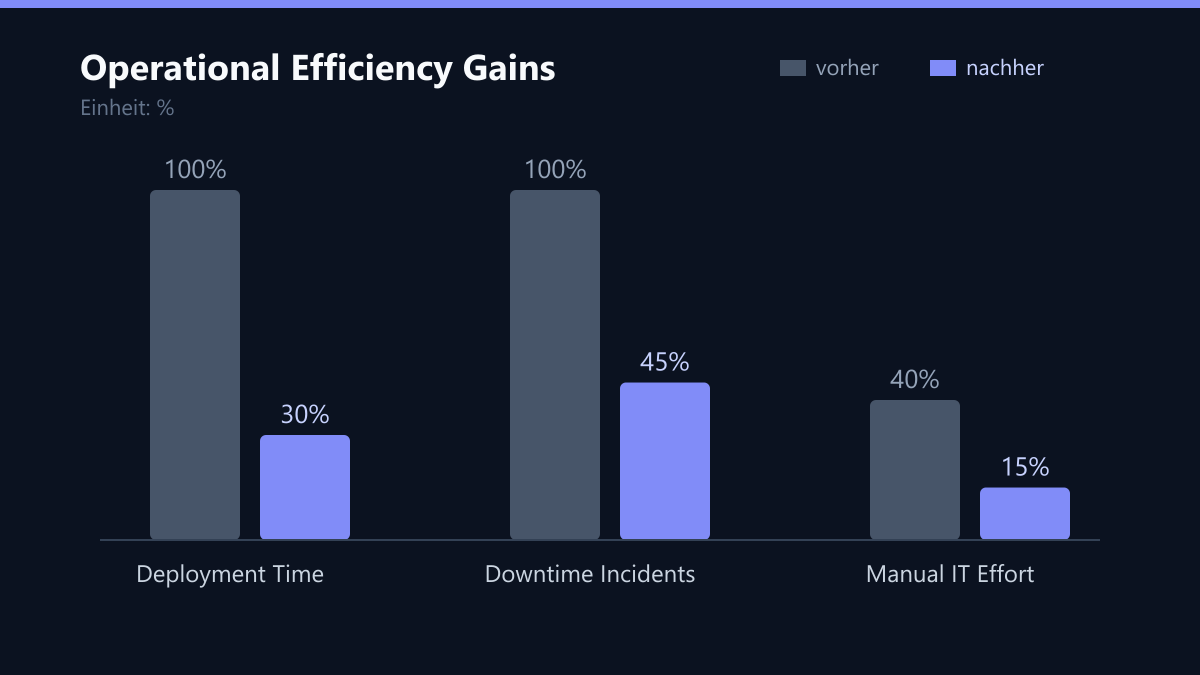
Automated health checks reduced unexpected downtime by 55%. By identifying potential issues before they became critical, the IT team was able to resolve problems proactively, preventing production disruptions. The reduction in downtime directly translated to higher production efficiency and lower operational costs.
| Metric | Before | After |
|---|---|---|
| Deployment Time | 3 Weeks | 4 Days |
| Downtime Incidents | 12/month | 5/month |
| IT Manual Effort | 40% | 15% |
Developers reported higher satisfaction due to predictable release windows. The IT team shifted focus from reactive fixes to proactive optimization, allowing them to contribute more strategically to the business. The ability to deploy changes in days rather than weeks empowered the company to iterate on their digital products faster, gaining a competitive edge in the market.
Lessons Learned: Proactive Monitoring is Key
The most significant insight from this project was that infrastructure health is as critical as code quality. Without real-time monitoring, even the best CI/CD pipeline can fail due to underlying hardware or network issues. We learned that integrating infrastructure checks directly into the CI/CD workflow is essential. This ensures that deployments are not only code-stable but also environment-ready.
For manufacturing businesses, this approach minimizes production risk and accelerates digital transformation efforts. It demonstrates that IT modernization is not just about software; it is about creating a resilient and efficient foundation for the entire business.
What We Would Do Differently Today
Looking back, there are a few areas where we would refine our approach:
- Earlier Stakeholder Involvement: We would have engaged production managers earlier in the process to better align deployment windows with production schedules.
- More Granular Alerting: We would have tuned the alert thresholds more aggressively in the initial phase to reduce false positives and build trust in the system.
- Documentation First: We would have prioritized documenting the legacy scripts more thoroughly before rewriting them, to ensure no edge cases were missed.