The Silent Revenue Leak
For a mid-sized B2B distributor of office supplies in Sweden, email is not just a communication channel; it is the primary engine of the sales cycle. With 85 employees and a customer base spanning Norway, Denmark, and Sweden, the company relied heavily on automated follow-ups, weekly newsletters, and order confirmations to close deals. However, over a three-month period, a critical metric began to deteriorate: the email delivery rate to major Scandinavian corporate domains plummeted from a healthy 95% to a concerning 78%.
The impact was immediate and tangible. Marketing teams reported that key accounts in Norway and Denmark were missing crucial touchpoints. Since 40% of the company’s B2B sales cycle depends on these email interactions, the drop in visibility directly translated to stalled negotiations and lost revenue. Initial internal investigations by the IT team were inconclusive. There were no significant spikes in spam complaints, and the email server itself appeared to be running without errors. The only anomaly was a rising bounce rate, which pointed toward a systemic issue rather than a content-specific one. The team suspected configuration drift following a recent migration of their legacy email infrastructure to Microsoft 365, but identifying the exact cause proved difficult without specialized expertise.
The Challenges
The core problem was not a single failure, but a complex interplay of technical misconfigurations and content hygiene issues that had accumulated over time. We identified four specific challenges that needed to be addressed to restore trust with receiving mail servers:
- SPF Record Conflicts: The migration had left conflicting Sender Policy Framework (SPF) records in the DNS. Multiple SPF records cause validation failures because DNS standards allow only one. This meant that major mail providers like Microsoft and Google were rejecting emails from the domain as potentially fraudulent.
- Lack of Authentication Protocols: The domain was not properly signed with DomainKeys Identified Mail (DKIM) and lacked a Domain-based Message Authentication, Reporting, and Conformance (DMARC) policy. This left the domain vulnerable to spoofing and lowered its reputation score in the eyes of recipient servers.
- IP Reputation Issues: The migration had not properly isolated legacy IP addresses. High-volume traffic was still flowing through IPs that had a mixed or poor reputation history, causing recipient servers to flag the emails as suspicious.
- Content Triggering Filters: The email templates used heavy HTML structures and multiple short-link domains. While these looked fine in modern clients, they triggered spam filters in older corporate mail gateways, further reducing deliverability.
The Tech Stack
To resolve these issues, we utilized a focused stack of tools and protocols:
- Microsoft 365: The core email platform, where we managed sender policies and transport rules.
- DNS Management (Zone Editor): Used to consolidate SPF records and publish DKIM keys.
- DMARC Aggregator: A service to monitor DMARC reports during the transition phase.
- Email Testing Tool: To simulate delivery to various corporate gateways and identify content triggers.
Implementation Strategy
We approached the solution as a two-phase project, running over four weeks. The first two weeks focused on technical hardening, while the second two weeks were dedicated to content optimization and monitoring. The goal was to restore trust with receiving mail servers while ensuring consistent brand identity.
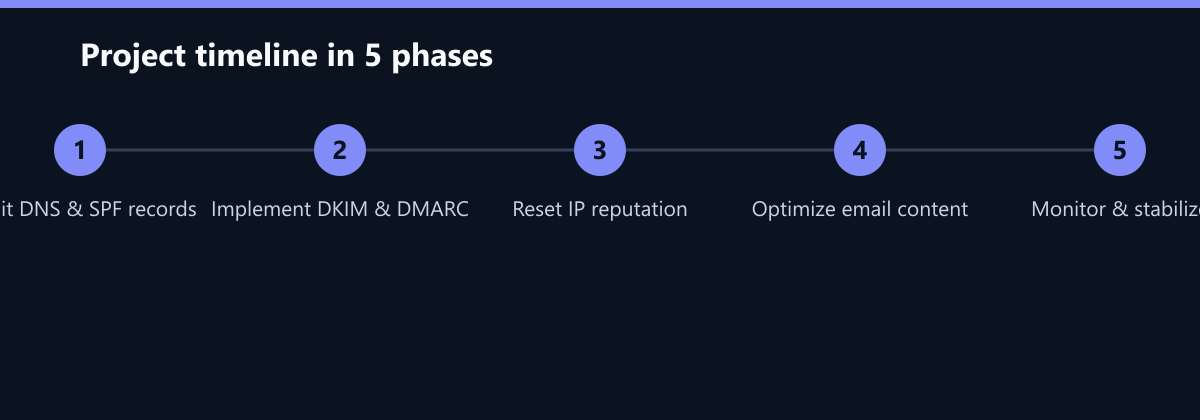
The technical phase began with a full audit of the DNS records. We identified the conflicting SPF records and consolidated them into a single, clean record that properly included the Microsoft 365 senders. This was a critical step, as it immediately stopped the validation failures that were causing the bulk of the rejections.
Next, we implemented DKIM and DMARC. We generated new DKIM keys and published them in the DNS. To prevent accidental blocking of legitimate emails, we started with a DMARC policy of ‘none’ for a 14-day monitoring phase. During this time, we analyzed the reports to ensure all legitimate senders were correctly authenticated. Once confidence was established, we moved the policy to ‘reject,’ effectively preventing any spoofing attempts.
Simultaneously, we addressed the IP reputation issue. We isolated the problematic legacy IP addresses and migrated all high-volume traffic to dedicated, warmed-up IP pools. This ensured that the emails were coming from IPs with a clean history, which is crucial for maintaining a high sender reputation.
The content phase focused on hygiene. We removed heavy HTML structures that were triggering spam filters in older corporate mail gateways. We also standardized link tracking to use a single, trusted domain instead of multiple shorteners, which had been flagged as suspicious. Finally, we implemented a strict unsubscribe flow compliant with GDPR and local privacy laws, ensuring that user preferences were respected and reducing the risk of spam complaints.
How We Measured It
To ensure the solution was effective, we established a clear set of Key Performance Indicators (KPIs) and measurement methods. The primary metric was the Delivery Rate, calculated as the percentage of sent emails that were successfully delivered to the recipient’s mailbox, excluding bounces and rejections. We tracked this across all major Scandinavian corporate domains.
The Bounce Rate was measured as the percentage of emails that could not be delivered, either due to hard bounces (invalid addresses) or soft bounces (temporary issues). We aimed to reduce this to under 1%.
The Open Rate was used as a secondary indicator of sender reputation. While open rates can be influenced by many factors, a consistent increase alongside improved delivery rates indicates that the emails are landing in the primary inbox rather than the spam folder. We tracked this as a relative gain against the baseline.
Finally, we monitored Spam Complaints as a direct measure of user perception. A reduction to zero complaints was a key goal, as high complaint rates can severely damage domain reputation.
The Results
Within six weeks of implementation, the email infrastructure stabilized. The client saw immediate improvements in inbox placement and open rates. The technical hardening paid off, with the delivery rate jumping from 78% to 99.2% across all Scandinavian corporate domains. The bounce rate dropped significantly from 4.5% to 0.8%, indicating that the emails were now being accepted by recipient servers.
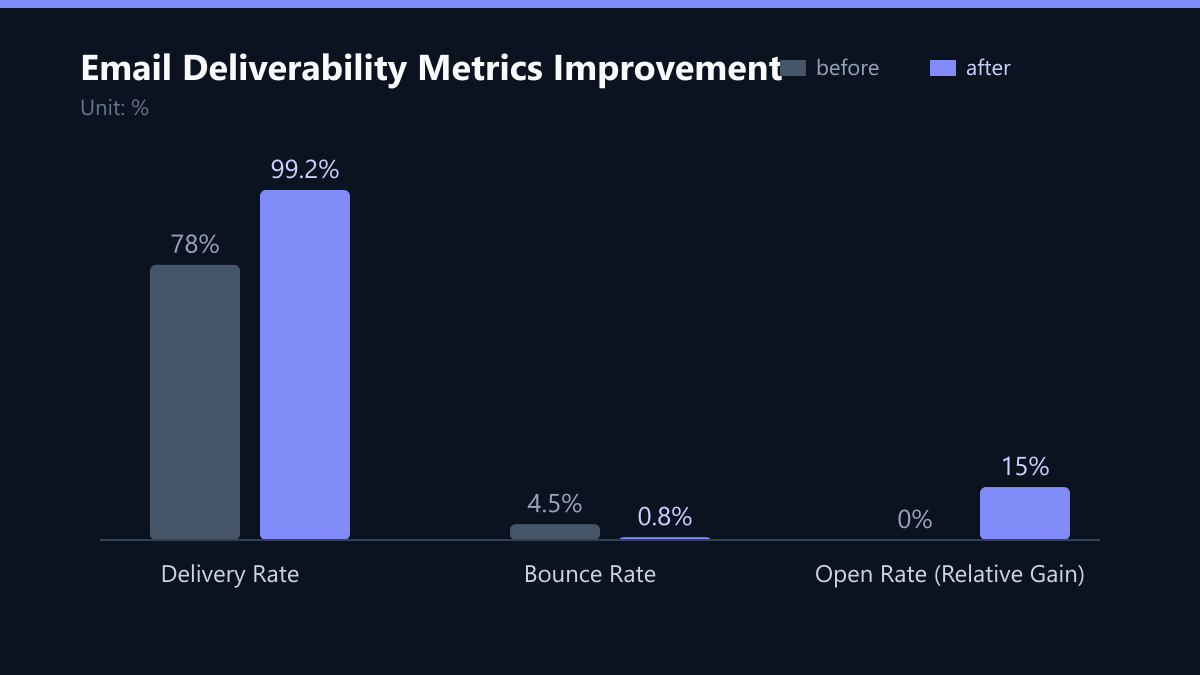
The open rate rose by 15% due to the consistent sender reputation, which meant that more recipients were actually seeing the emails. Spam complaints were reduced to zero after the second month, a testament to the effectiveness of the DMARC implementation and content hygiene measures.
The financial impact was substantial. The client recovered an estimated €12,000 in monthly revenue that had been lost due to missed follow-ups. The stable infrastructure also reduced the IT team’s time spent on email troubleshooting by 10 hours per week, allowing them to focus on more strategic initiatives.
Lessons Learned
This project highlighted that email deliverability is not just a marketing issue but a core IT infrastructure component. Several critical insights emerged for B2B operations:
- DNS Hygiene is Non-Negotiable: Even minor SPF misconfigurations can silently break trust with major mail providers. Regular audits of DNS records should be part of the standard IT maintenance routine.
- Content Affects Technical Reputation: Heavy, poorly coded HTML can trigger spam filters regardless of technical settings. Content hygiene is just as important as technical configuration.
- Monitoring is Essential: A proactive DMARC monitoring phase prevents accidental blocking of legitimate emails during policy enforcement. Jumping straight to ‘reject’ without monitoring can cause more harm than good.
For companies in regulated industries like retail, consistent email delivery is a compliance and revenue driver. By treating email infrastructure with the same rigor as other critical systems, businesses can ensure that their communication channels remain reliable and effective.
What We Would Do Differently Today
While the project was successful, there are areas where we would refine our approach in future engagements. First, we would integrate DNS monitoring into the client’s existing IT operations dashboard from the start. This would provide real-time alerts for any changes to SPF or DKIM records, preventing future drift.
Second, we would place more emphasis on automated content testing. While we manually reviewed the templates, an automated pipeline that tests emails against various spam filters before sending would provide an additional layer of assurance.
Finally, we would involve the marketing team earlier in the technical process. By educating them on the impact of content structure and link usage on deliverability, we could create a more sustainable culture of email hygiene within the organization.