The Hidden Cost of Permissive Defaults
Most mid-market IT leaders believe their firewall is a solid perimeter defense. Yet, a deep dive into configuration often reveals a landscape of shared credentials, outdated firmware, and overly permissive rules. These are not minor oversights; they are structural weaknesses that attackers actively exploit. The result is a fragile security posture that fails under pressure, leading to delayed detection and significant compliance risks under standards like ISO 27001 and NIS2.
This guide breaks down the five most critical gaps in typical firewall configurations. We will move beyond theoretical risks to provide concrete, actionable steps to harden your infrastructure. By addressing these specific areas, you can significantly reduce your attack surface and improve your incident response capabilities.
Gap 1: The Shared Administrator Account
A single, shared administrator account is perhaps the most common yet dangerous configuration error. It creates a single point of failure and renders audit trails useless. If an admin credential is compromised, attackers gain full, untraceable control over network policies. You cannot distinguish between a legitimate change and a malicious one, which is a direct violation of accountability requirements.
The Risk:
- Inability to trace specific actions to individual users.
- Increased likelihood of accidental or malicious policy changes.
- Non-compliance with ISO 27001 and NIS2 accountability requirements.
How to Close It:
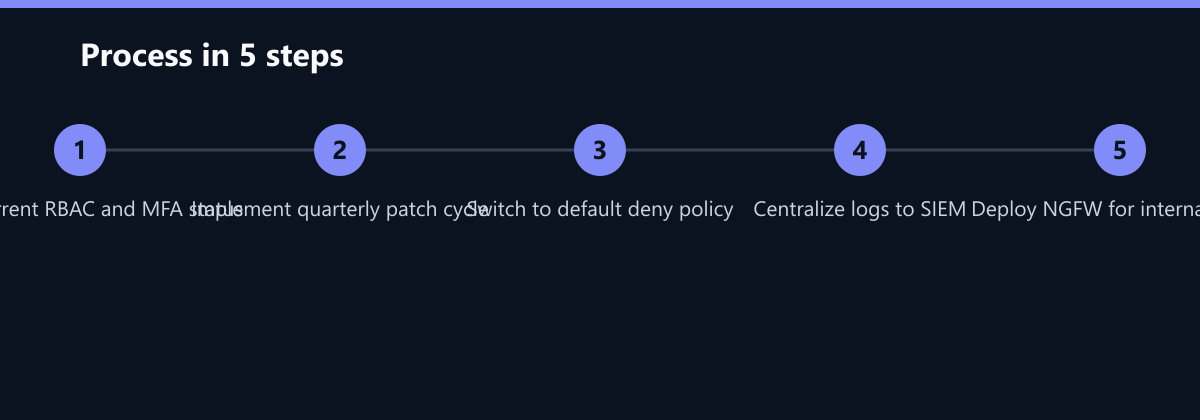
- Implement Role-Based Access Control (RBAC) to assign specific permissions to individual user accounts.
- Enforce Multi-Factor Authentication (MFA) for all administrative access.
- Enable granular audit logging for every configuration change.
Gap 2: Stagnant Firmware and Known CVEs
Firewall vendors release security patches regularly, yet many organizations delay updates due to a fear of downtime. This hesitation leaves critical vulnerabilities exposed for months. Attackers actively scan for known exploits in outdated firmware versions, making unpatched devices easy targets. A quarterly patching cycle is not just a best practice; it is a necessity for maintaining a secure perimeter.
The Risk:
- Exploitation of known CVEs (Common Vulnerabilities and Exposures).
- Potential bypass of firewall rules through software bugs.
- Failure to meet regulatory patch management standards.
How to Close It:
- Establish a quarterly patching cycle with defined rollback procedures.
- Use staging environments to test updates before production deployment.
- Automate vulnerability scanning to detect unpatched versions early.
Gap 3: Default Allow vs. Default Deny
Many firewalls operate with default rules that allow all traffic unless explicitly blocked. This ‘default allow’ stance is inherently unsafe for business environments. It permits unnecessary data flows and increases the attack surface. By defaulting to deny, you force the organization to explicitly justify every permitted connection, significantly reducing the risk of unauthorized data exfiltration.
The Risk:
- Unauthorized internal lateral movement by attackers.
- Data exfiltration through unmonitored ports.
- Difficulty in isolating compromised segments.
How to Close It:
- Switch to a default deny policy.
- Review and remove unused rules quarterly.
- Segment networks into VLANs with strict inter-VLAN traffic controls.
Gap 4: Local Logs and Blind Spots
Firewalls generate vast amounts of log data, but without centralization, this data is useless for detection. Logs stored locally on the device are vulnerable to deletion by attackers. They also make incident response slow and inefficient because analysts cannot correlate events across different security tools. Centralized logging is the foundation of modern threat detection.
The Risk:
- Delayed detection of breaches.
- Loss of forensic evidence during an incident.
- Inability to correlate events across different security tools.
How to Close It:
- Forward logs to a centralized SIEM (Security Information and Event Management) system.
- Implement real-time alerting for suspicious patterns.
- Retain logs for at least 12 months to support compliance audits.
Gap 5: Ignoring Internal Threats and Shadow IT
Traditional firewalls focus primarily on perimeter defense. They often fail to monitor traffic between internal devices. Shadow IT applications and unmanaged endpoints can bypass security controls entirely. This creates blind spots where malware can spread internally without detection, or where unauthorized devices access sensitive data.
The Risk:
- Malware spreading internally without detection.
- Unauthorized access to sensitive data via rogue devices.
- Blind spots in network visibility.
How to Close It:
- Deploy Next-Generation Firewall (NGFW) features for deep packet inspection.
- Integrate endpoint detection and response (EDR) tools.
- Conduct regular internal network scans to identify unauthorized devices.
Measuring Success: KPIs and Metrics
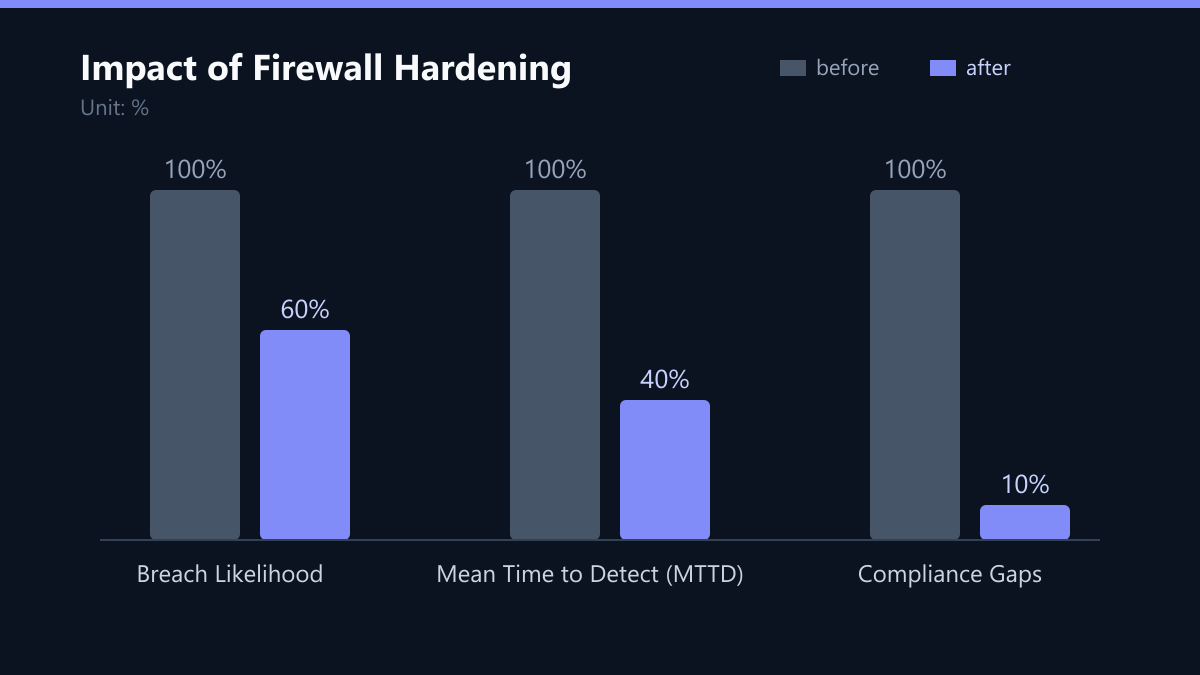
How do you know if these changes are working? You need concrete metrics to track improvement over time. Here are three key performance indicators (KPIs) to monitor:
- Mean Time to Detect (MTTD): With centralized logging and NGFW, your MTTD should drop significantly. A baseline of 24 hours for a mid-market organization is typical; aim for under 4 hours after implementation.
- Patch Compliance Rate: Track the percentage of firewalls running the latest stable firmware. A target of 100% within 30 days of release is standard for critical assets.
- Rule Utilization Rate: Monitor the percentage of firewall rules that are actively used. A high number of unused rules indicates bloat and potential risk. Aim for less than 10% unused rules.
Typical Mistakes to Avoid
Even with the best intentions, teams often make these specific errors during the hardening process:
- Breaking Business Processes: Switching to default deny without mapping all required traffic first can disrupt critical business applications. Always test in a staging environment.
- Over-Reliance on Automation: While automated patching is good, it should not replace manual review of critical changes. Automation can propagate errors if the base configuration is flawed.
- Ignoring Log Volume Costs: Centralizing logs can lead to massive storage costs if not managed. Implement log retention policies and filter out low-value noise before sending to the SIEM.
- Lack of User Training: If staff are not trained on the new RBAC and MFA processes, they will find workarounds, defeating the purpose of the controls.
Checklist for Implementation
Use this checklist to guide your team through the hardening process:
- Audit current admin accounts and remove shared credentials.
- Implement RBAC and MFA for all admin access.
- Establish a quarterly patching schedule with rollback plans.
- Switch default policy to deny and document exceptions.
- Configure log forwarding to a central SIEM.
- Enable NGFW features for internal traffic inspection.
- Conduct a baseline MTTD and patch compliance measurement.
- Review and remove unused firewall rules.
Final Thoughts
Closing these five gaps is not a one-time task but a continuous process. By implementing RBAC, regular patching, default deny policies, centralized logging, and NGFW capabilities, you create a robust security posture that can withstand modern threats. Start with an audit of your current configuration, prioritize the most critical gaps, and measure your progress with concrete KPIs. Your infrastructure will be more secure, and your compliance posture will be significantly stronger.
Passend dazu
- Cloud Services & Cloud Migration
- IT Compliance & Data Protection
- IT & Data Recovery (Disaster Recovery)
- 5 Critical Security Measures for Your Managed Server Infrastructure
- The 5-Step IT Audit: Identifying Gaps Before Scaling Your Business
- Test Your Backups: 5 Critical Steps to Verify Data Integrity Without Production Impact
- Why Your IT Monitoring Tools Are Missing Critical Failures and How to Fix It