The Strategic Weight of Server Location
In the digital economy, the physical location of your servers is no longer just an IT detail—it is a strategic compliance decision. For mid-market companies in the DACH region, the choice between EU and US hosting directly impacts your legal exposure, operational performance, and customer trust. The EU General Data Protection Regulation (GDPR) establishes a binding framework that prioritizes data sovereignty: you must control who accesses your data and exactly where it resides.
When you host in the USA, the CLOUD Act introduces a significant variable. This legislation grants US authorities broad powers to access data stored on US servers, regardless of the company’s headquarters or the nationality of the data subjects. For many organizations, this represents an unacceptable compliance risk. The uncertainty of whether data might be subject to extraterritorial jurisdiction creates legal gray areas that are difficult to manage in a proactive risk management strategy.
Navigating the Legal Landscape: GDPR vs. US Frameworks
The GDPR is a comprehensive regulation that defines strict rules for processing personal data. Core principles include purpose limitation, data minimization, and the right to erasure. The stakes are high: violations can lead to fines of up to 4 percent of global annual turnover. This financial exposure makes compliance a board-level issue, not just an IT task.
In contrast, the USA lacks a uniform federal data protection law. Instead, a patchwork of sector-specific rules and national security laws applies. Transferring EU data to the US requires specific protective mechanisms, such as Standard Contractual Clauses (SCCs), which are complex to enforce in practice. Many companies therefore choose EU hosting to eliminate these legal ambiguities. By keeping data within the EU, you align your infrastructure with the primary regulatory framework, reducing the need for complex cross-border transfer documentation.
Technical Safeguards: Beyond Geographical Separation
Choosing an EU location is necessary but not sufficient. Technical safeguards are essential to secure data sovereignty. Pure geographical separation does not protect against internal threats or provider negligence. You need a robust technical architecture that ensures confidentiality and integrity.
Key technical components include:
- End-to-End Encryption: All data streams, both in transit and at rest, must be encrypted. Crucially, the encryption keys must remain in the hands of the customer, not the provider. This ensures that even the hosting provider cannot access the raw data.
- Access Controls: Implement the principle of least privilege. Administrative access should be strictly limited, logged, and reviewed regularly.
- Resilient Backups: Regular backups are mandatory, and these backup copies must also remain within EU jurisdictions to maintain sovereignty.
- Compliant Logging: Monitoring logs are vital for security but must be carefully configured to ensure they do not contain sensitive personal data, thereby avoiding new compliance liabilities.
Comparative Analysis: Mid-Market Decision Matrix
The decision between EU and US hosting depends on your specific business processes and risk profile. Below is a summary of the critical differences that influence the total cost of ownership and risk profile.
| Criterion | EU Hosting | US Hosting |
|---|---|---|
| Legal Framework | GDPR, BDSG | CLOUD Act, Sectoral Laws |
| Data Access by Authorities | Limited, judicial control | Extensive, preventive |
| Standard Encryption | Often standard | Often optional |
| Transfer Costs (Latency) | Low in DACH/EU | Higher for EU customers |
| Compliance Effort | Lower with EU focus | Higher (contracts, SCCs) |
For companies headquartered in Germany, Austria, or Switzerland, EU hosting is usually the safer and more efficient choice. US hosting becomes worthwhile only if your customer base is primarily located in North America and you process no personal data from the EU. In these specific cases, lower latency times may justify the infrastructure choice, provided that strict contractual boundaries are maintained.
Implementation Roadmap: From Audit to Migration
Migrating to or selecting the right hosting provider requires a structured, phased approach. Start with a comprehensive inventory of your data flows. Identify which data sets are personal, where they are currently located, and who has access to them. This baseline is critical for assessing the current risk posture.
- Provider Audit: Verify that the provider operates data centers exclusively in the EU. Scrutinize the list of subcontractors to ensure no data leaves the EU jurisdiction. Request documentation of their security certifications (e.g., ISO 27001, SOC 2).
- Contract Design: Negotiate a Data Processing Agreement (DPA) that meets all GDPR requirements. Ensure that the contract clearly defines the roles of controller and processor and includes clauses on breach notification and audit rights.
- Technical Configuration: Enable encrypted backups and restrict administrative access. Implement multi-factor authentication for all administrative portals. Configure logging to exclude sensitive data fields.
- Documentation: Create a detailed record of processing activities in accordance with Art. 30 GDPR. This document should map every data flow, purpose, and retention period. It is your primary evidence of compliance in the event of an audit.
- Migration and Testing: Execute the migration in phases. Monitor latency and performance closely during the transition. Conduct penetration testing to validate the new security configurations.
- Continuous Monitoring: Establish a routine for reviewing access logs and compliance metrics. Update the record of processing activities whenever new data types or processing purposes are introduced.
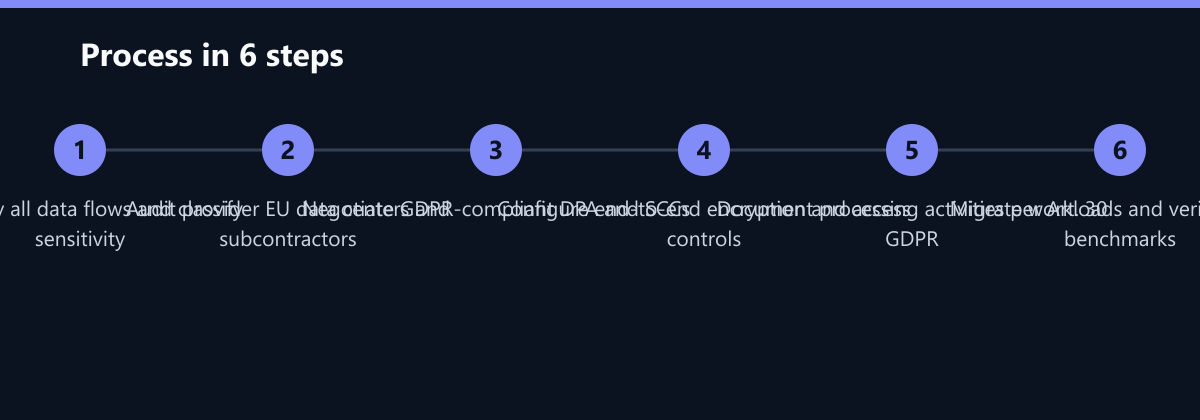
This structured approach minimizes operational disruption and creates a transparent trail for supervisory authorities. It also provides a clear narrative for your customers, demonstrating your commitment to data protection.
Measuring Success: KPIs for Data Sovereignty
How do you know if your strategy is working? Define concrete Key Performance Indicators (KPIs) to track the effectiveness of your data sovereignty measures.
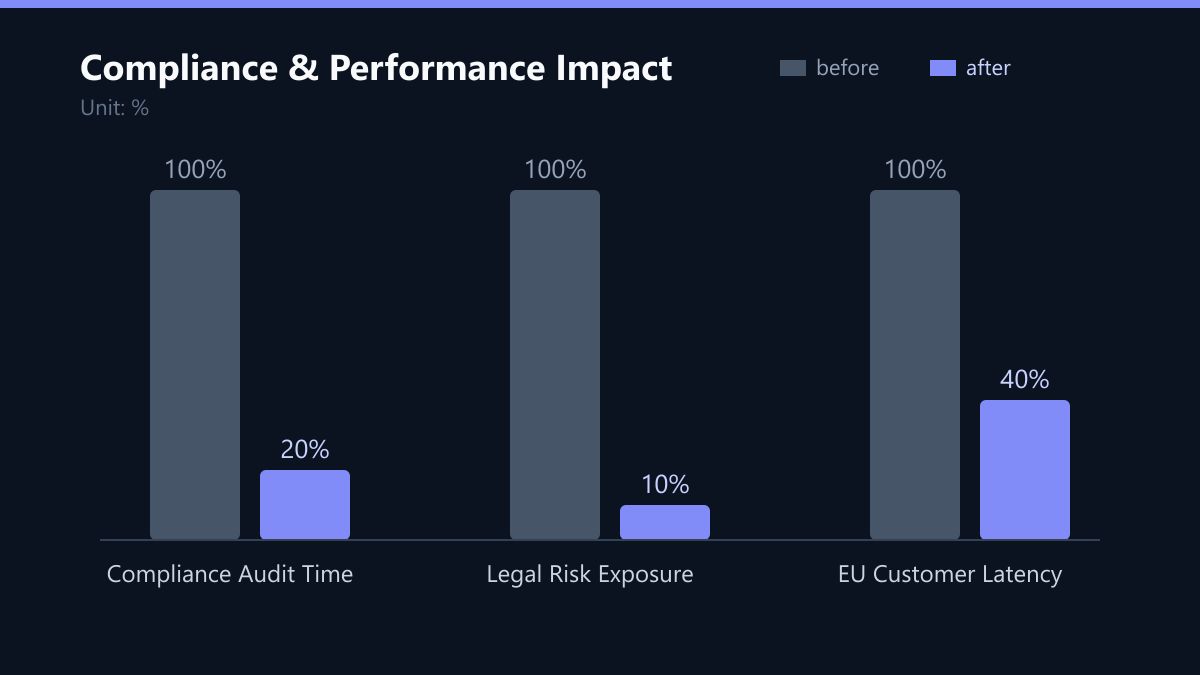
- Audit Readiness Score: Measure the time required to compile a complete compliance report. A target of less than 48 hours indicates a well-documented and automated system.
- Latency Baseline: Monitor average response times for EU-based users. A reduction in latency compared to US-hosted services is a tangible benefit of EU hosting. Aim for sub-50ms round-trip times for core applications.
- Access Violation Rate: Track the number of unauthorized access attempts or misconfigured permissions. This should trend toward zero as access controls are refined.
- Compliance Cost Ratio: Calculate the total cost of compliance (including legal, technical, and administrative efforts) as a percentage of IT spend. EU hosting typically reduces this ratio over time due to simplified contractual and technical requirements.
Typical Mistakes to Avoid
Even with a solid strategy, organizations often fall into common traps that undermine their compliance efforts.
- Assuming Provider Certification is Enough: A provider’s ISO 27001 certification is a good start, but it does not guarantee GDPR compliance. You must verify that their specific data processing practices align with your requirements.
- Ignoring Subcontractor Locations: Many providers use subcontractors for maintenance or support. If these subcontractors are based in the US, your data sovereignty is compromised. Always demand a list of subcontractors and their locations.
- Neglecting Backup Locations: It is common for primary data to be in the EU, while backups are stored in a cheaper, non-EU location. This is a significant compliance gap. Ensure that all data copies, including backups, remain within the EU.
- Lack of Key Management Control: If the provider holds the encryption keys, you do not have true data sovereignty. Implement a customer-managed key service to ensure that only you can decrypt your data.
Checklist for Data Sovereignty Verification
Use this checklist to verify your current infrastructure and ensure full compliance.
- All personal data is stored in EU data centers.
- A valid Data Processing Agreement (DPA) is signed and up to date.
- Encryption keys are managed by the customer, not the provider.
- Subcontractor list is reviewed and includes only EU-based entities.
- Record of processing activities (Art. 30 GDPR) is current and accurate.
- Access controls follow the principle of least privilege.
- Backups are encrypted and stored within the EU.
- Monitoring logs are configured to exclude sensitive data.
- Incident response plan includes specific steps for data breaches.
- Regular audits are scheduled and documented.
Conclusion: Sovereignty as a Competitive Edge
GDPR compliance is not a bureaucratic hurdle; it is a marker of professionalism and trust. In the B2B sector, customers increasingly value data protection as a key differentiator. A demonstrably secure hosting location in the EU strengthens your brand reputation and reduces legal risks.
Critically evaluate your current infrastructure. If data is located in the USA, assess whether this is strictly necessary. In most cases, the infrastructure can be relocated to EU data centers with moderate effort. This shift secures not only compliance but also the long-term stability and performance of your IT infrastructure. By taking control of your data sovereignty, you position your company as a reliable partner in an increasingly regulated digital landscape.