The Hidden Costs of In-House IT Teams
Many mid-market executives underestimate the true cost of maintaining an internal IT department. While salary lines are visible, indirect costs often double the actual expenditure. For a company with 200 employees, a dedicated IT manager and two technicians can easily exceed €150,000 annually in direct costs alone. This does not include software licenses or hardware maintenance.
The hidden burdens are significant. Recruitment and training for specialized IT talent in the DACH region is expensive and time-consuming. Small in-house teams face high pressure, leading to unplanned overtime costs and burnout. Furthermore, technology obsolescence is a constant risk; in-house teams often lag in adopting new tools, reducing overall efficiency. These factors create a volatile cost structure that is difficult to predict and manage.
Understanding Total Cost of Ownership (TCO)
TCO includes all direct and indirect costs associated with acquiring, operating, and maintaining IT infrastructure. It is the most accurate metric for comparing service models. A proper TCO analysis reveals that in-house IT often carries higher risk costs due to limited expertise in cybersecurity and disaster recovery.
Key components of IT TCO include:
- Personnel: Salaries, social contributions, and training.
- Hardware and Software: Licenses, servers, endpoints, and cloud subscriptions.
- Operational Expenses: Electricity, cooling, and physical space.
- Risk Costs: Downtime losses, security breaches, and compliance fines.
Managed services providers (MSPs) distribute these risks across their client base, offering broader expertise at a predictable cost. This shifts the financial risk from the company’s balance sheet to the service provider’s operational model.
Comparative TCO Breakdown: A 200-Employee Company
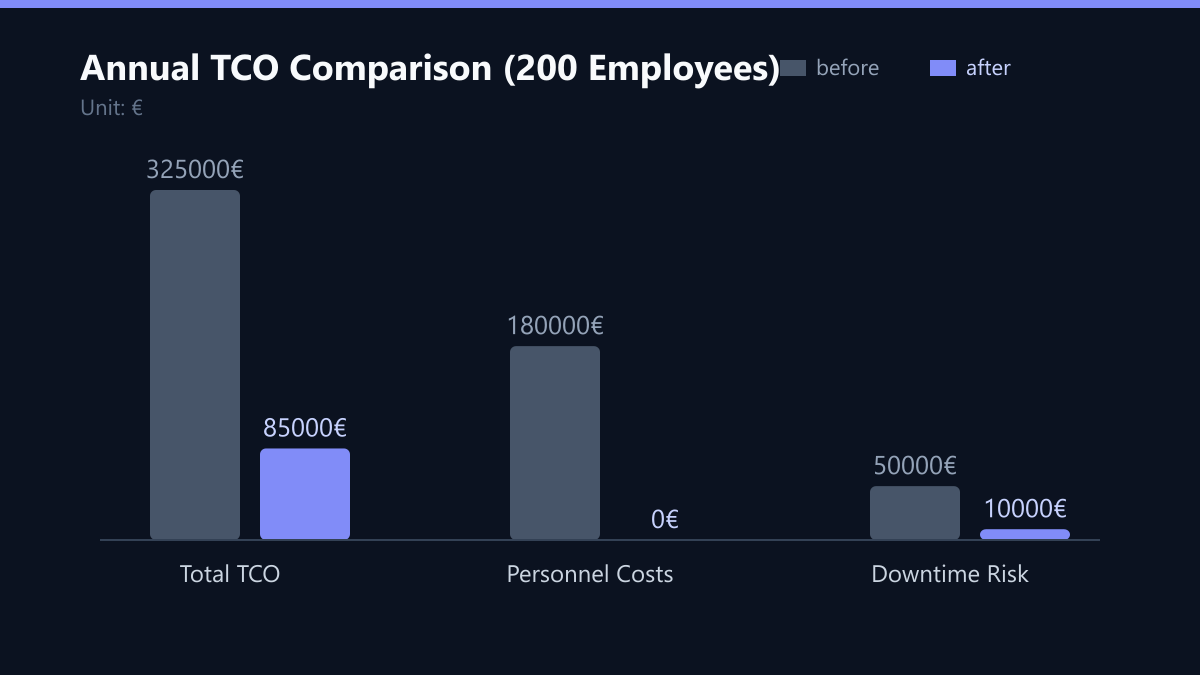
The following table illustrates a typical TCO comparison for a mid-sized enterprise with 200 employees. Figures are estimates based on average DACH market rates. The significant difference in personnel and risk costs drives the total savings. Companies often see a 30-40% reduction in total IT costs when switching to managed services, but in this specific scenario, the savings are even more pronounced due to the elimination of fixed personnel costs.
| Cost Category | In-House IT (Annual) | Managed Services (Annual) |
|---|---|---|
| Personnel | €180,000 | €0 |
| Licenses & Tools | €45,000 | €35,000 |
| Hardware Maintenance | €20,000 | €15,000 |
| Security & Compliance | €30,000 | €25,000 |
| Downtime Risk (Est.) | €50,000 | €10,000 |
| Total TCO | €325,000 | €85,000 |
Note: Managed services fees are typically included in the service contract. The €240,000 annual savings represent a 74% reduction in total IT ownership costs. This allows capital to be redirected toward revenue-generating activities rather than overhead.
Managed Services: Predictability and Scalability
Managed services convert variable IT costs into fixed monthly fees. This model offers several strategic advantages for growing companies. Predictable budgeting is a key benefit; fixed monthly invoices simplify financial planning and cash flow management. Unlike in-house teams where overtime and emergency hiring can spike costs, MSPs provide a steady state of expenditure.
24/7 monitoring is another critical feature. Automated tools detect issues before they impact business operations, reducing downtime significantly. Scalability is also a major advantage; resources can be adjusted quickly as the company grows or contracts. For DACH companies, MSPs also provide compliance support for GDPR and NIS2. This reduces legal risks and ensures that IT processes meet regulatory requirements without requiring dedicated internal compliance staff.
Strategic Benefits Beyond Cost Savings
Cost reduction is only one benefit of managed services. Strategic advantages often have a greater long-term impact. Management can focus on revenue-generating activities instead of IT infrastructure, freeing up leadership time for core business strategy. Access to expertise is another key benefit; MSPs employ specialists in cloud, security, and AI, which are difficult and expensive to hire in-house.
Faster innovation is a direct result of this access. Managed providers regularly update systems and introduce new technologies, keeping the company competitive. For DACH companies, this means access to advanced AI tools and cloud migration expertise without building an internal team. This accelerates digital transformation and improves operational efficiency. The ability to leverage cutting-edge technology without the burden of hiring and training specialized staff is a significant competitive advantage.
Implementation Roadmap
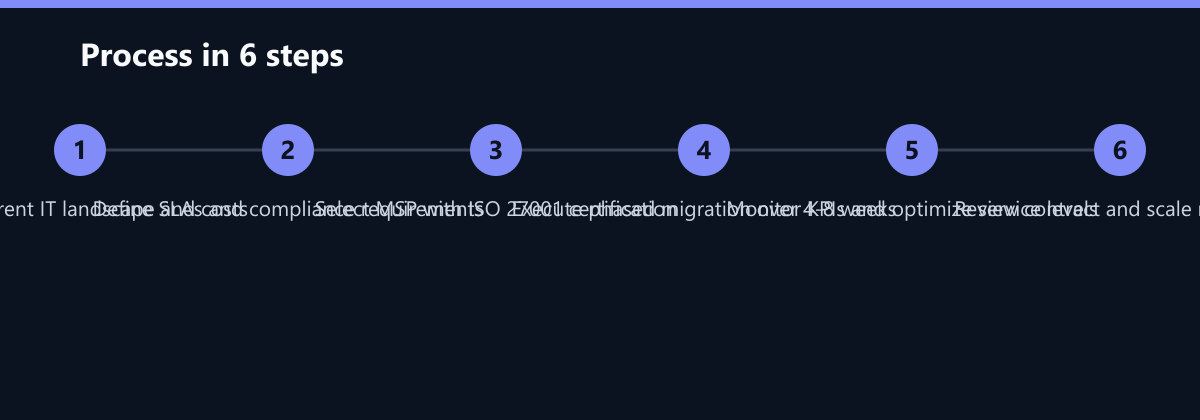
Transitioning to managed services requires a structured approach to minimize risk and ensure a smooth handover. The process typically involves a detailed audit of the current IT landscape, followed by the definition of service levels and compliance requirements. Selecting the right provider is critical; look for industry experience, clear SLAs, and security certifications like ISO 27001. The migration itself is usually phased over 4 to 8 weeks, allowing for parallel running of systems and gradual cutover. Finally, continuous monitoring and optimization of service levels ensure that the new model delivers the expected benefits.
Typical Mistakes to Avoid
- Underestimating the Audit Phase: Skipping a thorough audit of the current IT landscape leads to gaps in coverage and unexpected costs during migration. Always map all assets, licenses, and dependencies before signing a contract.
- Ignoring SLA Details: Vague service level agreements can lead to disputes and poor service quality. Ensure response times, uptime guarantees, and penalty clauses are clearly defined and measurable.
- Neglecting Staff Communication: Failing to communicate the transition to internal staff and end-users can lead to resistance and confusion. Clear communication about the benefits and changes in support processes is essential.
- Choosing the Cheapest Provider: Low cost often comes at the expense of quality and expertise. Evaluate providers based on industry experience, security certifications, and transparency, not just price.
How You Measure Success
To ensure the managed services model delivers value, track specific KPIs. Mean Time to Resolution (MTTR) should decrease significantly, indicating faster issue handling. Uptime Percentage should meet or exceed the SLA guarantees, typically 99.9% or higher. Cost Variance should remain low, confirming the predictability of the budget. Additionally, track User Satisfaction through regular surveys to ensure that the quality of support is meeting internal expectations. These metrics provide a clear view of the operational and financial benefits of the new model.
Checklist for MSP Selection
- Audit Current IT: Map all assets, licenses, and dependencies.
- Define Requirements: List critical business processes and compliance needs.
- Evaluate Vendors: Check industry experience, ISO 27001, and GDPR compliance.
- Review SLAs: Ensure clear response times, uptime guarantees, and penalties.
- Plan Migration: Develop a phased transition plan over 4-8 weeks.
- Monitor KPIs: Track MTTR, uptime, and cost variance post-implementation.