The Operational Bottleneck
For many mid-sized e-commerce businesses, the growth of online sales often outpaces the capacity of the human support team. This was exactly the situation facing our client, a UK-based e-commerce retailer with 85 employees. Despite a successful sales trajectory, their customer service operations were reaching a breaking point. The core issue was not a lack of effort from the 12-person support team, but rather a fundamental mismatch in workload distribution.
Upon auditing the incoming inquiries, we found that 70% of all inbound tickets were repetitive, low-complexity questions. These included order status checks, return policy inquiries, and basic product specifications. These routine tasks consumed the majority of the agents’ time, leaving them with insufficient bandwidth for high-value interactions such as B2B negotiations, complex retention strategies, or handling escalated complaints. Consequently, average response times began to creep beyond the 24-hour SLA, and Customer Satisfaction (CSAT) scores started to dip. Management needed a scalable solution that could absorb the peak volume of routine inquiries without the cost and delay of hiring additional staff.
The Challenges
Implementing an AI solution in a live e-commerce environment is not simply a matter of buying a software license. We identified three specific challenges that had to be addressed before any code was written:
- Data Fragmentation: Historical support data was scattered across multiple legacy systems and email inboxes. It was unstructured, containing typos, inconsistent formatting, and duplicate entries. This “dirty data” posed a significant risk to the accuracy of any machine learning model.
- Integration Complexity: The client used a specific Order Management System (OMS) for real-time order tracking. The AI bot needed to query this system securely and instantly to provide accurate status updates, rather than generic answers. Additionally, the client was a heavy user of Microsoft 365, meaning the solution had to fit seamlessly into their existing ecosystem.
- Customer Trust and Handoff: There was a valid concern that customers might become frustrated if they felt trapped in a “bot loop.” We needed to design a transparent escalation path that allowed users to switch to a human agent instantly and seamlessly, preserving the human touch for sensitive issues.
The Tech Stack
To address these challenges, we curated a lean and effective technology stack:
- AI Engine: A custom-trained Large Language Model (LLM) fine-tuned on the client’s specific product catalog and support history.
- Microsoft 365 Integration: Deep integration with Outlook and Teams to ensure agents receive context-rich alerts and that bot interactions are logged in the central CRM.
- OMS API Connector: A secure, low-latency bridge to the Order Management System for real-time data retrieval.
- Helpdesk Middleware: A custom middleware layer that routes tickets based on sentiment analysis and keyword complexity.
Implementation: From Data to Deployment
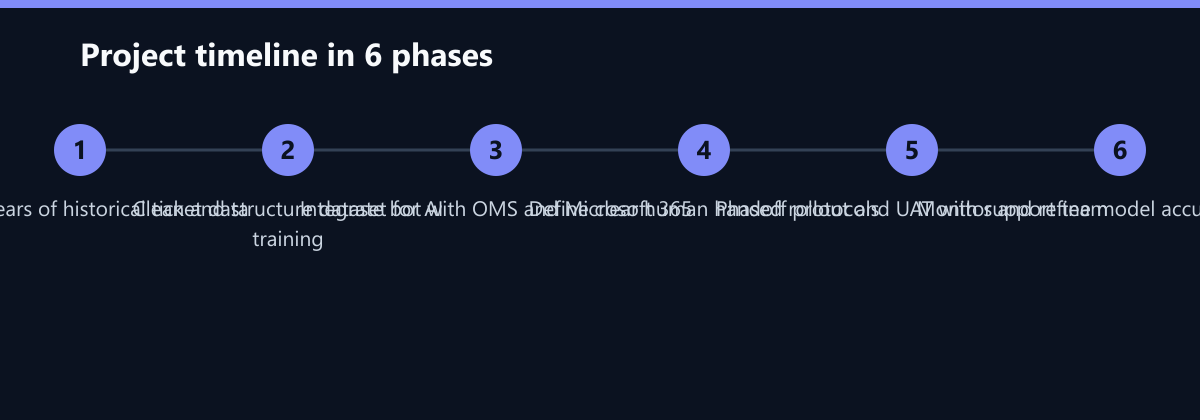
The project was executed over a tight 8-week timeline, divided into three distinct phases: Data Preparation, Integration, and Phased Rollout.
Phase 1: Data Preparation and Cleansing
The foundation of a successful AI chatbot is its training data. We began by extracting 5 years of historical support tickets. This raw dataset was massive and noisy. Our data engineering team spent the first two weeks cleaning this data. We removed duplicates, standardized timestamps, and categorized tickets into intent clusters (e.g., “Order Status,” “Returns,” “Product Info”). This structured dataset became the ground truth for the AI model, ensuring it learned the correct answers to the client’s specific business rules.
Phase 2: Integration and Development
With the data ready, we moved to the technical integration. We developed the AI chatbot interface, embedding it directly into the client’s website footer and help center. Crucially, we built the API connections to the OMS. This allowed the bot to answer “Where is my order?” with a live tracking link and estimated delivery date, rather than a generic template. We also integrated with Microsoft 365 so that when a ticket was escalated, the agent could see the full conversation history and the specific order context within their Teams or Outlook view, eliminating the need for customers to repeat themselves.
Phase 3: Human Handoff Design and Testing
We designed a “confidence score” mechanism. If the AI’s confidence in its answer dropped below a certain threshold, or if the customer used keywords indicating frustration (e.g., “agent,” “human,” “call”), the system would automatically hand off the conversation to a human agent. We conducted extensive User Acceptance Testing (UAT) with the support team to ensure the handoff was seamless and that the agents had the tools to pick up the conversation instantly.
How We Measured It
To ensure the solution delivered real value, we established a baseline before launch and tracked four key performance indicators (KPIs) over the first three months of full deployment. We used the helpdesk platform’s native analytics for volume and response times, and the CRM for CSAT scores. Financial savings were calculated by comparing the cost per ticket handled by humans versus the marginal cost of the AI platform, multiplied by the volume of deflected tickets.
Results: Significant Efficiency Gains
Within three months of full deployment, the impact on operational metrics was measurable and positive. The data showed a clear shift in the support workflow.
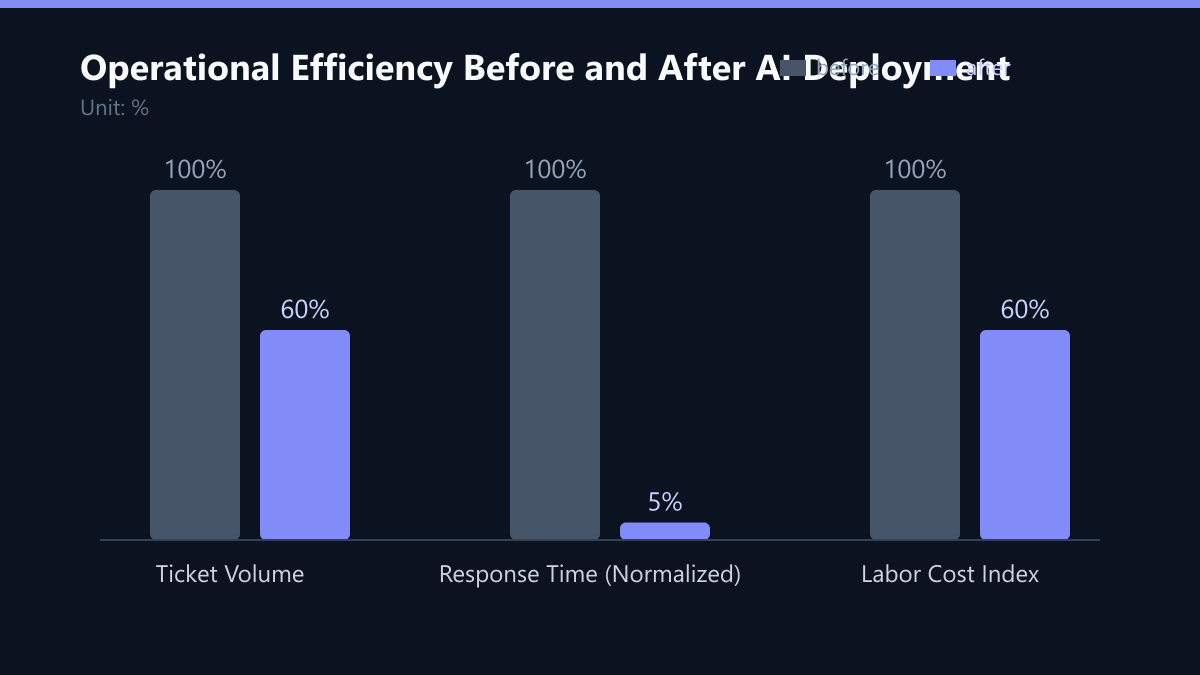
- Ticket Volume: Inbound tickets to human agents decreased by 40%. The AI successfully deflected the bulk of routine inquiries.
- Response Time: Average first response time for automated queries dropped from the previous 18-hour average for human-handled tickets to under 5 minutes. Customers received instant answers for their most common questions.
- Cost Savings: The client saved approximately £12,000 per month in support labor costs. This figure represents the reduction in hours spent on low-value tasks, allowing the team to focus on high-impact activities without hiring new staff.
- Customer Satisfaction: Contrary to fears that automation might lower satisfaction, CSAT for automated interactions remained stable at 4.6/5.0. Customers valued the speed and accuracy of the information provided.
The support team was able to redirect their efforts toward complex B2B inquiries and proactive retention strategies, which had previously been neglected due to the volume of routine tickets. This shift not only improved operational efficiency but also enhanced the strategic value of the customer service department.
What We Would Do Differently Today
While the project was a success, reflecting on the process highlights areas for improvement in future deployments.
- Earlier Stakeholder Involvement: We involved the support team more heavily in the UAT phase, but earlier involvement in the data labeling phase would have improved the initial accuracy of the bot. Agents have an intuitive understanding of what constitutes a “tricky” question, which would have refined the confidence score thresholds sooner.
- Modular Rollout: We attempted to launch all features simultaneously. A more modular approach, launching order status first and adding returns handling two weeks later, might have reduced the initial learning curve for both the AI and the customers.
- Continuous Feedback Loop: We implemented monthly updates, but a real-time feedback loop where agents could easily flag incorrect bot answers within their workflow would have accelerated the model’s refinement in the first month.
Lessons Learned
This case study underscores several critical factors for successful AI implementation in customer service.
Data Quality is Paramount: The accuracy of the bot was directly correlated with the cleanliness of the historical ticket data. Investing time in data preparation is not an overhead; it is a core component of the AI strategy.
Seamless Escalation is Non-Negotiable: Customers appreciated the quick bot response but needed a frictionless switch to a human for sensitive issues. The ease of handoff was a key driver of the stable CSAT scores.
Continuous Training is Required: AI models are not static. The client’s product range and policies evolve, meaning the AI model required monthly updates with new FAQs and policy changes to maintain high accuracy rates. Automation is a continuous process, not a one-time project.
For mid-sized e-commerce businesses, AI automation is not just a cost-saving tool but a strategic lever for improving customer experience. By handling the repetitive 70%, the human team can focus on the 30% that truly builds customer loyalty.
Passend dazu
- The 7 Key Metrics to Prevent E-Commerce Outages During Peak Season
- Core Web Vitals im E-Commerce: Conversion-Rate durch technische Optimierung steigern
- Adobe Commerce Licensing Costs: The Real Financial Impact
- E-Commerce Development
- IT Automation & Process Automation
- Magento / Adobe Commerce
- Logistikdienstleister in Hamburg senkt Ticket-Volumen um 40 Prozent durch KI-gestützten First-Level-Support
- Verhinderung eines kritischen Datenlecks in der Produktion durch segmentiertes Netzwerk-Monitoring in einem Pharma-Hersteller in Singapur
- Mittelständiger Maschinenbauer in Österreich: Transparente Kostenkontrolle der Azure-Umgebung durch granulares Monitoring
- Compliance-automatisierung: Ein Finanzdienstleister in London erfüllt NIS2-Anforderungen in 8 Wochen durch zentralisiertes Risiko-Management
- Intelligent Customer Support Triage: A UK Retailer Reduces Response Times by 60% with AI-Powered Chatbots
- SaaS Startup Scales Support Capacity Without Hiring by Integrating AI Chatbots into Helpdesk
- PCI-DSS Compliance and Security Standards for E-Commerce
- Vendor Risk Management: 5 Questions to Ask Before Signing an IT Service Agreement
- B2B E-Commerce Features Checklist for Wholesale Portals
- Konsolidierung der IT-Infrastruktur im Gesundheitswesen: Senkung der Betriebskosten um 35 Prozent bei gleichzeitiger NIS2-Konformität
- Mitigating AI Hallucinations in Customer Support
- Multi-Currency and Multi-Language Setup for European E-Commerce
- The ROI of AI Agents: Calculating Savings in Customer Service and Back-Office
- Migrating from Legacy PHP to Modern E-Commerce Stacks
- Retail: E-Commerce Fraud Prevention Training Lowered Chargeback Ratio by 25% for DACH Fashion Brand
- Logistik-Dienstleister in Deutschland reduziert Lieferscheinerstellung von 45 auf 4 Minuten durch RPA-Anbindung an SAP
- API-First Development for Scalable E-Commerce Microservices