The Strategic Bottleneck in Finance Operations
For many mid-sized B2B software providers, the finance department often operates as a hidden bottleneck. Our client, a US-based software company with 150 employees, was no exception. Despite a robust digital product portfolio, their internal financial processes remained heavily reliant on manual labor. Accountants spent approximately 40% of their working week manually extracting data from invoices, receipts, and other financial documents. This labor-intensive approach not only consumed valuable human capital but also introduced a high error rate into the system.
The consequences were tangible: month-end closing processes were delayed by an average of five days, creating friction in financial reporting and cash flow management. As the company scaled, the volume of digital transactions grew exponentially, rendering the existing spreadsheet-based workflow unsustainable. The leadership recognized that simply hiring more accountants would not solve the root cause; they needed a fundamental shift in how data was captured and processed.
The Core Challenges
Before deploying any technology, we identified three specific hurdles that had to be addressed to ensure a successful rollout:
- Data Heterogeneity: The client received invoices from a wide variety of vendors, each with different layouts, languages, and data structures. A simple rule-based automation would have failed immediately.
- ERP Integration Constraints: The existing ERP system had limited API capabilities, requiring a robust middleware solution to ensure seamless data flow without disrupting live operations.
- Change Management: The finance team was accustomed to manual checks. There was a natural resistance to trusting an AI model with critical financial data, necessitating a strong trust-building phase.
How We Measured It
To ensure the project delivered on its promises, we established a rigorous measurement framework before the first line of code was written. We defined three Key Performance Indicators (KPIs) with baseline values derived from a four-week audit of historical data:
- Processing Time: Measured as the average time from document receipt to entry into the ERP system. Baseline: 3 days per batch.
- Error Rate: Defined as the percentage of entries requiring correction after initial input. Baseline: 4%.
- Automation Rate: The percentage of documents processed without any human intervention. Baseline: 0% (fully manual).
We used automated logging within the new pipeline to track these metrics in real-time, allowing for immediate feedback loops during the pilot phase.
The Tech Stack
The solution was built on a modern, scalable architecture designed for accuracy and speed:
- OCR Engine: High-precision Optical Character Recognition for accurate text extraction from scanned and digital documents.
- NLP Module: Natural Language Processing to classify documents, identify key data fields, and understand context.
- Middleware: A custom API layer to bridge the gap between the AI pipeline and the client’s ERP system.
- Cloud Infrastructure: Hosted on a secure cloud environment to ensure scalability and compliance with data protection standards.
- Dashboard: A custom-built user interface for the finance team to review exceptions and monitor KPIs.
Implementation: A Phased Approach to AI Integration
The project was executed in three distinct phases over eight weeks, ensuring minimal disruption to daily operations.
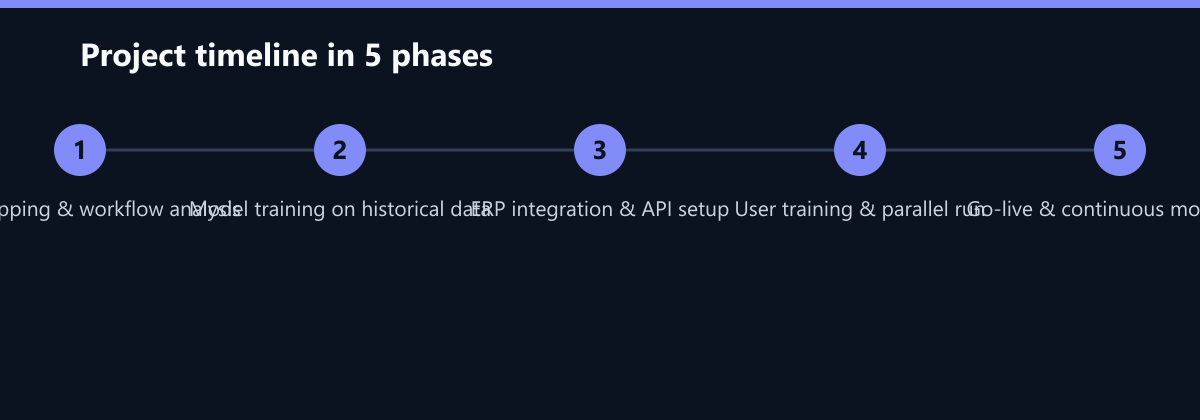
Phase 1: Data Mapping and Workflow Analysis (Weeks 1-2) We began by auditing the existing workflow. Our team mapped every touchpoint in the document processing lifecycle, identifying where delays and errors occurred. We collected a sample of 5,000 historical invoices to understand the variance in formats. This phase was crucial for defining the scope of the AI model and setting realistic expectations for the automation rate.
Phase 2: Model Training and Development (Weeks 3-5) Using the historical data, we trained the OCR and NLP models. This involved iterative testing and refinement. We focused on improving the model’s ability to handle edge cases, such as multi-page invoices and non-standard layouts. The goal was to achieve an accuracy rate of over 98% on the training set.
Phase 3: Integration and User Training (Weeks 6-8) With the model validated, we integrated it with the client’s ERP system. We developed a middleware layer to ensure smooth data transfer. Simultaneously, we trained the finance team on the new dashboard, focusing on how to review exceptions and provide feedback to the system. A parallel run was conducted for one week, where the AI processed documents in the background, and its outputs were compared against manual entries to verify accuracy.
Results: Transforming Efficiency and Accuracy
The impact of the AI-driven document processing pipeline was immediate and significant. The system successfully processed 95% of all incoming documents without any human intervention. The remaining 5% were flagged for manual review, allowing accountants to focus on complex cases rather than routine data entry.
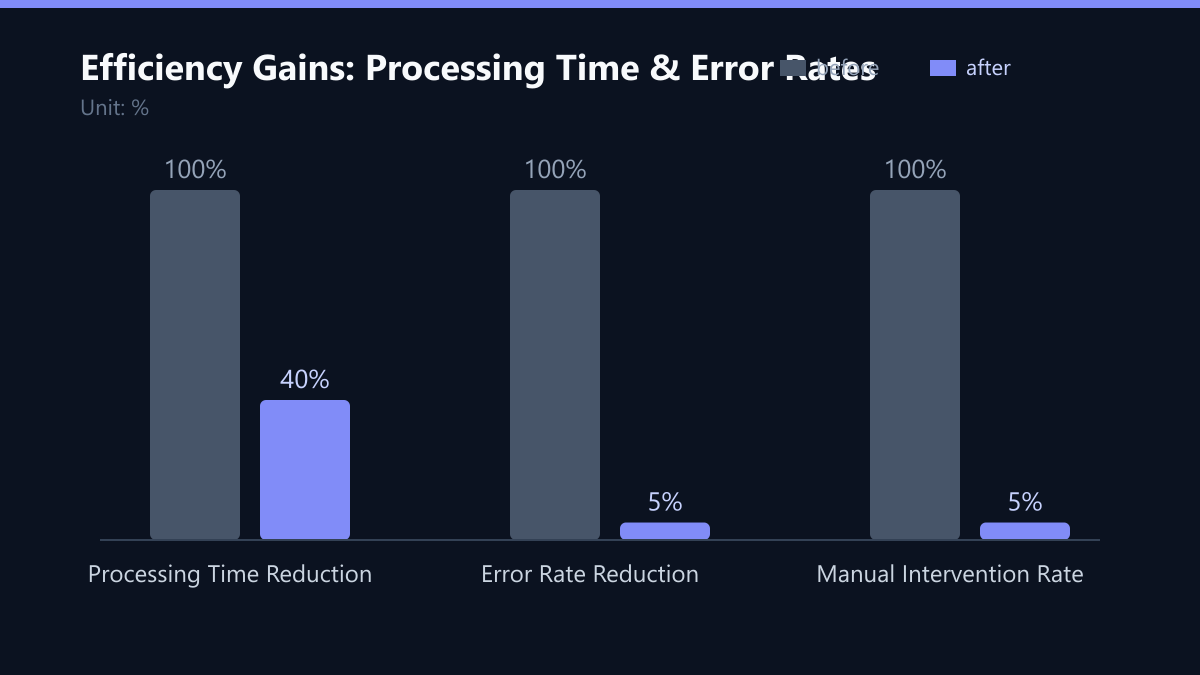
The key results, measured against our established KPIs, were as follows:
- Processing Time: Reduced from 3 days to 1 day per batch, a 60% decrease in manual processing time. This accelerated the month-end closing process, eliminating the previous five-day delay.
- Error Rate: Dropped from 4% to 0.2%. This 95% reduction in errors significantly improved the reliability of financial data and reduced the time spent on corrections.
- Cost Savings: An estimated 15% reduction in operational finance costs was achieved within the first quarter, primarily due to reduced manual labor and lower error-related costs.
The finance team reported a significant improvement in job satisfaction, as they were freed from repetitive tasks and could focus on strategic analysis, budgeting, and financial planning. The speed and accuracy of the new system also enhanced the company’s ability to respond to market changes and make data-driven decisions.
What We Would Do Differently Today
While the project was a success, we identified areas for improvement that we would address in future deployments:
- Earlier Vendor Communication: We would engage key vendors earlier in the process to encourage the use of standardized digital invoice formats (e.g., XML or PDF/A). This would further increase the automation rate and reduce the need for OCR.
- Continuous Feedback Loop Integration: We would build a more robust mechanism for the finance team to provide feedback on misclassified documents directly within the dashboard, accelerating the model retraining cycle.
- Staggered Rollout: Instead of a single go-live, we would consider a staggered rollout by document type or vendor group, allowing for more granular tuning and risk mitigation.
Lessons Learned: Automation as a Continuous Process
The most critical insight from this project was that automation is not a one-time fix. As the client expanded into new markets, invoice formats varied significantly, and the AI model required regular retraining to maintain its high accuracy. We established a quarterly review process where new data samples were used to refine the model, ensuring long-term performance.
Close collaboration between the IT and finance teams was essential for sustained success. The finance team’s domain knowledge was invaluable in identifying edge cases and providing context for model improvements. This case study demonstrates that AI-driven document processing can deliver substantial efficiency gains, but only when implemented as a continuous optimization process rather than a static solution. For B2B software providers and other mid-sized companies facing similar bottlenecks, the potential for transforming finance operations is both significant and achievable.
Passend dazu
- Web & Software Development
- Cloud Services & Cloud Migration
- IT Compliance & Data Protection
- Automatisierung der Kreditorenbuchhaltung bei einem deutschen Maschinenbauer: Reduktion der Durchlaufzeit um 60 Prozent
- KI-Suchmaschinen-Ranking für eine spanische Logistik-Software: Steigerung der organischen Klicks um 40%
- Automated NIS2 Readiness Checks Cut Audit Time by 40 Percent
- Automated Ransomware Detection and Recovery: 48-Hour Backup Cycle for a 200-Employee DACH Logistics Firm
- AI-Driven Document Processing: Comparing OCR Accuracy and Cost for Invoice Automation