The Starting Point: A Bottleneck in Bavaria
In the heart of Bavaria, a mid-sized machinery manufacturer with 120 employees faced a growing operational crisis in their finance department. Despite a robust production floor, the back office was struggling to keep pace with the company’s growth. The finance team, consisting of only five dedicated staff members, was drowning in a monthly volume of over 800 invoices.
The process was almost entirely manual. Invoices arrived via email, were printed, scanned, and then keyed into the on-premise SAP Business One system by hand. This traditional approach led to an average processing time of 4.5 days per invoice. In an industry where cash flow is king, this delay was not just an inconvenience; it was a strategic risk. The company was missing out on early payment discounts and facing compliance risks due to the high volume of manual data entry errors, which stood at a worrying 12%.
The Challenges
Before we could propose a solution, we had to dissect the specific hurdles that made automation difficult for this client. It wasn’t just about “doing it faster”; it was about overcoming structural and technical barriers.
- Legacy ERP Limitations: The client’s SAP Business One instance was on-premise and lacked modern, native API capabilities for real-time, two-way data exchange. This meant that any automation had to bridge a significant technological gap without disrupting the core production data.
- Data Hygiene Issues: The vendor master data in the ERP was outdated. Inconsistent naming conventions and missing bank details meant that even a perfect OCR engine would fail to match invoices to the correct vendor records automatically.
- Data Sovereignty Concerns: As a German manufacturer, the client was extremely cautious about sending sensitive financial data to third-party cloud providers outside the EU. They required a solution that guaranteed data residency within European borders.
- Change Management Resistance: The finance team was used to the manual process. There was a natural fear that automation would make their roles redundant or, worse, introduce new, harder-to-debug errors.
The Tech Stack
To address these challenges, we assembled a robust, cloud-native stack designed for security and integration:
- Azure Logic Apps: Served as the orchestration layer, managing the workflow from email ingestion to ERP posting.
- Azure Virtual Machines (EU Region): Hosted the dedicated OCR engine to ensure data sovereignty and low latency.
- AI-Powered OCR Engine: A custom-tuned model for recognizing complex machinery invoices, including line-item details and tax codes.
- SAP Business One Middleware: A secure, custom-built connector to facilitate API communication with the legacy ERP.
- Power BI Dashboard: Provided real-time visibility into processing status, error rates, and team workload.
How We Measured It
To ensure the project’s success was objective, we established a baseline before any code was written. We sampled 500 historical invoices from the previous quarter to calculate the true average processing time (4.5 days) and error rate (12%).
Post-implementation, we tracked every single invoice through the new workflow. The “processing time” was measured from the moment the email hit the server to the moment the document was fully posted in SAP. The “error rate” was defined as the percentage of invoices that required manual correction after the initial AI extraction. We also tracked the “capture rate” of early payment discounts to validate the cash flow impact. This rigorous measurement protocol allowed us to attribute the improvements directly to the automation workflow.
Implementation: From Chaos to Cloud-Native Flow
The implementation phase was structured into six distinct weeks, moving from data preparation to full go-live. We prioritized a “clean data, clean code” approach, recognizing that automation amplifies existing data quality issues.
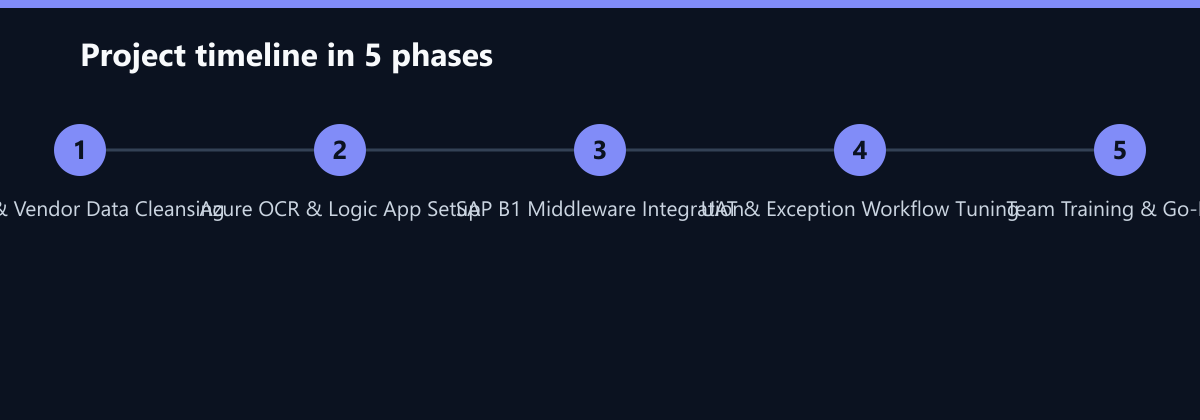
Weeks 1-2: Data Cleansing & Foundation Before touching the automation, we spent the first two weeks cleansing the vendor master data in SAP. We standardized vendor names, validated IBANs, and mapped PO numbers. Simultaneously, we provisioned the Azure environment, setting up the dedicated VMs for the OCR engine within the EU region to satisfy sovereignty requirements.
Weeks 3-4: Integration & AI Tuning We developed the middleware to connect Azure Logic Apps with SAP Business One. The AI engine was fed with historical invoice samples to fine-tune its recognition of the client’s specific vendor formats. We implemented end-to-end encryption and role-based access controls compliant with ISO 27001 to address security concerns.
Weeks 5-6: UAT, Training & Go-Live The final phase focused on User Acceptance Testing (UAT) and change management. We trained the finance team on the new exception dashboard, emphasizing that their role was shifting from data entry to exception handling and strategic analysis. The system went live with a parallel run for one week to ensure confidence.
The workflow operated as follows: Emails were automatically monitored, and PDFs were extracted and parsed by the AI. The system then cross-checked vendor details, tax rates, and PO numbers against the ERP. If a match was found, the invoice was automatically posted. If not, it was routed to a dashboard for human review. Automated email notifications triggered approval chains based on amount thresholds, ensuring that high-value invoices received the necessary scrutiny without slowing down the rest of the queue.
Results: The Impact on Efficiency
Within three months of go-live, the transformation was evident. The finance team reported a significant reduction in daily stress and a shift in focus toward strategic tasks. The automation eliminated 90% of manual data entry tasks, freeing up the team to engage in financial analysis and vendor relationship management.
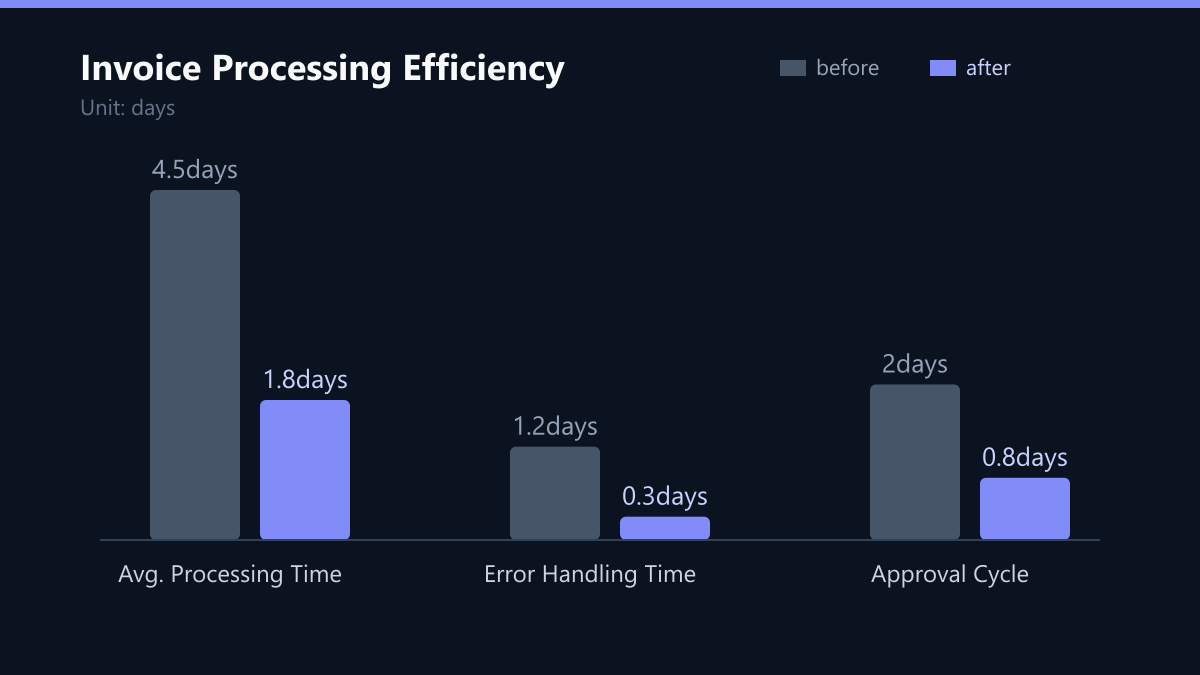
The key performance indicators achieved were substantial:
- Processing Time: Reduced from 4.5 days to 1.8 days per invoice, a 60% reduction.
- Error Rate: Dropped from 12% to under 1%, drastically reducing rework costs.
- Cost Savings: Estimated €18,000 annually in labor costs saved, allowing the company to reallocate resources.
- Cash Flow: Early payment discounts were captured in 85% of eligible cases, directly improving the bottom line.
The team now spends 70% less time on data entry. This shift has not only improved operational efficiency but has also enhanced the company’s compliance posture, as the audit trail is now digital, immutable, and complete.
What We Would Do Differently Today
Despite the success, every project offers lessons for future iterations. If we were to undertake this project again, we would make two specific adjustments.
First, we would allocate more time to the initial data cleansing phase. While we managed to complete it in two weeks, the pressure of the timeline meant that some edge cases in vendor data required manual intervention during the first month of go-live. A three-week preparation phase would have resulted in a smoother launch.
Second, we would introduce a “shadow mode” for the AI engine earlier in the process. Running the AI in parallel with the manual process for a longer duration before switching to fully automated posting would have built even more confidence among the finance team and allowed for more granular tuning of the exception rules.
Lessons Learned
This project highlighted that automation is not just a technical exercise; it is a data and people exercise. The hybrid approach of combining cloud AI with on-premise ERP security proved to be the most balanced solution for this industry, offering the agility of the cloud with the control of the on-premise core.
For mid-sized manufacturers, the key takeaway is that clean data is the prerequisite for successful AI. Without it, even the most advanced OCR engines will fail. Furthermore, change management is critical. By training the team on the new exception dashboard and positioning automation as a tool for empowerment rather than replacement, we ensured smooth adoption and long-term sustainability of the solution.
The result is a finance department that is not only faster and more accurate but also more strategic, contributing directly to the company’s overall competitiveness in the DACH region.
Passend dazu
- IT Consulting & IT Strategy
- Backup Automation: How AI-Powered Orchestration Replaces Manual Processes
- AI Agents for the Mid-Market: Automating Complex Decisions in Sales and Purchasing
- IT Automation & Process Automation
- Cloud Services & Cloud Migration
- IT Compliance & Data Protection
- Custom ERP-Integration: Fertigungsdurchlaufzeit um 15 Prozent senken
- Entwicklung einer IoT-Steuerungsplattform für einen Fertigungsautomatisierer: 25 Prozent Reduktion der Stillstandzeiten in der Produktion
- Migration von 200 SAP-Servern auf Azure Hybrid: 40 % Senkung der IT-Kosten bei einem deutschen Logistikunternehmen
- SIEM-Automatisierung bei einem Frankfurter Finanzdienstleister
- Medizintechnik-Hersteller in München: NIS2-Vorbereitung und IT-Sicherheitslücken-Schließung in 6 Wochen mit 35 Prozent Reduktion der Reaktionszeit auf Bedrohungen
- Konsolidierung der IT-Infrastruktur im Gesundheitswesen: Senkung der Betriebskosten um 35 Prozent bei gleichzeitiger NIS2-Konformität
- 5 Common Process Bottlenecks: How to Identify Automation Candidates in Finance and Operations
- The ROI of AI Automation: How to Calculate Payback Periods for Generative AI Projects
- Zero-Day Patch Deployment in Under 24 Hours for a Frankfurt Pharma Manufacturer Amidst NIS2 Audit Pressure
- RPA vs. AI Automation: Economic Value for the Mid-Market
- The Role of AI in Modern MSPs: How Automation Reduces Response Times by 50%
- Automatisierte Dokumentenverarbeitung: Beschleunigung der Buchhaltungsprozesse um 60 Prozent in einem US-amerikanischen Software-Unternehmen
- Phishing-Reduktion um 78 Prozent: Security-Awareness-Programm für einen 400-köpfigen Maschinenbauer im DACH-Raum
- Top 5 Automation Gaps in Finance
- CRA Compliance Roadmap for a Hamburg Machinery Manufacturer
- RPA Roadmap: Planning Backoffice Automation in 90 Days