The Visibility Gap in an AI-First Search Landscape
The client, a mid-sized logistics software provider based in Madrid with 85 employees, found itself in a precarious position despite a robust product portfolio. Their technology was competitive, but their digital visibility was failing to keep pace with the evolving search landscape. For six months, the marketing team observed a troubling trend: a 30% drop in qualified inbound leads directly correlated with a significant decline in organic traffic.
The root cause was not a lack of effort, but a lack of adaptation. Traditional SEO strategies, which had previously served the company well, had plateaued. Competitors were rapidly adopting AI-generated content frameworks and structured data implementations, allowing them to dominate not only traditional search engine results pages (SERPs) but also the emerging AI answer engines that are becoming the primary research tool for B2B buyers. The client’s website, while informative, was invisible to these new retrieval patterns. It lacked the semantic depth and entity clarity required for large language models (LLMs) to cite and recommend their solutions.
The Challenges
Before implementing the solution, we identified three specific hurdles that were blocking organic growth:
- Semantic Fragmentation: Content was written for human skimming rather than machine parsing. Key concepts were scattered across pages without clear entity relationships, making it difficult for AI engines to understand the context of their logistics software.
- Technical Crawlability Issues: Several core service pages were blocked by accidental
noindextags or slow rendering times, preventing search crawlers from fully indexing the site’s depth. - Lack of Structured Data: The absence of JSON-LD schema for software applications meant that the site was not eligible for rich snippets or AI-driven knowledge graph integrations.
The Tech Stack
To address these issues, we deployed a focused stack of tools designed for technical precision and content intelligence:
- Google Search Console: For monitoring indexing status and identifying crawl errors.
- Screaming Frog: For deep technical audits to uncover crawlability and link structure issues.
- Schema.org Validator: To ensure JSON-LD implementation met strict standards.
- SEMrush: For competitor gap analysis and keyword intent mapping.
- Internal CMS Custom Fields: To enforce consistent heading structures and FAQ formats across all new content.
Implementation: Aligning Content with AI Retrieval Patterns
We initiated a 90-day project with a clear mandate: shift from keyword-centric content to entity-centric, AI-optimized content. The strategy moved beyond simple keyword stuffing to focus on semantic relevance, clear entity mapping, and structural clarity that mirrors how LLMs process and retrieve information.
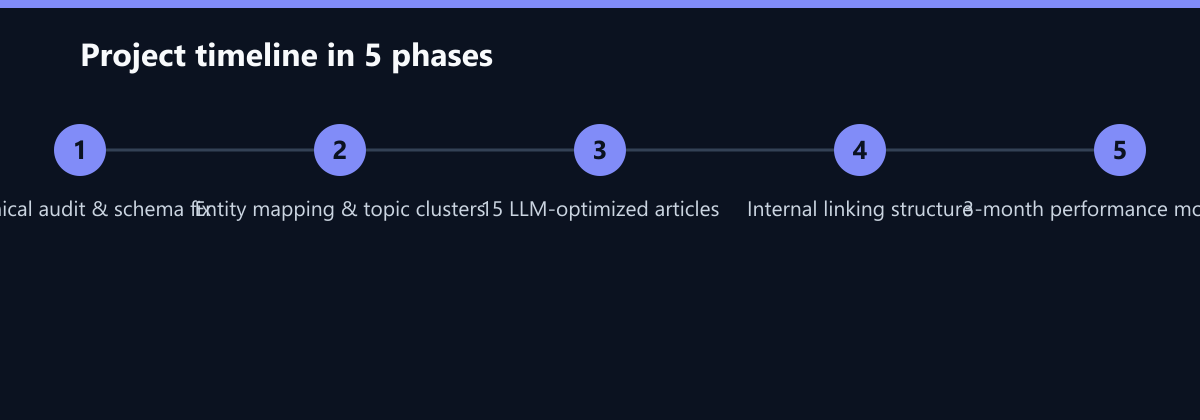
The first phase focused on technical hygiene. We conducted a comprehensive technical audit using Screaming Frog, which revealed several critical crawlability issues. We fixed broken internal links, resolved redirect chains, and implemented JSON-LD schema for software applications. This schema explicitly defined the product, its features, and its target audience, providing a machine-readable blueprint for AI engines.
Simultaneously, we overhauled the content strategy. Instead of creating generic blog posts, we developed 15 in-depth articles addressing specific, high-intent logistics pain points. Topics included “Route Optimization for Cold Chain” and “Real-Time Fleet Tracking in Urban Logistics.” Each article was structured with clear H2 and H3 headers, concise answer paragraphs (under 50 words), and dedicated FAQ sections. This structure is designed to match the retrieval patterns of AI engines, which often pull direct answers from well-structured, factual content.
We also implemented a topic cluster strategy. By creating pillar pages for core services and linking them to supporting cluster posts via internal links, we strengthened the authority signals for key service pages. This not only helped traditional search engines understand the site hierarchy but also provided AI models with a clear context for when to cite specific solutions.
How We Measured It
To ensure the changes were effective, we established a rigorous measurement framework. We used Google Search Console to track impressions, clicks, and average position for non-branded keywords. We monitored dwell time via analytics to gauge content relevance and user engagement. Additionally, we tagged all demo request forms with UTM parameters to attribute conversions directly to organic search channels. This allowed us to isolate the impact of our SEO efforts from other marketing activities.
Results: Significant Growth in Organic Visibility and Leads
Within three months, the website’s visibility in both traditional and AI-driven search results improved significantly. The focus on high-quality, entity-rich content paid off, demonstrating that AI optimization is not just a trend but a necessity for B2B software providers.
Key metrics achieved:
- +40% increase in organic clicks from non-branded keywords.
- +25% rise in dwell time, indicating higher content relevance.
- Top 3 rankings for 12 high-value B2B logistics terms.
- +18% growth in demo requests attributed to organic search.
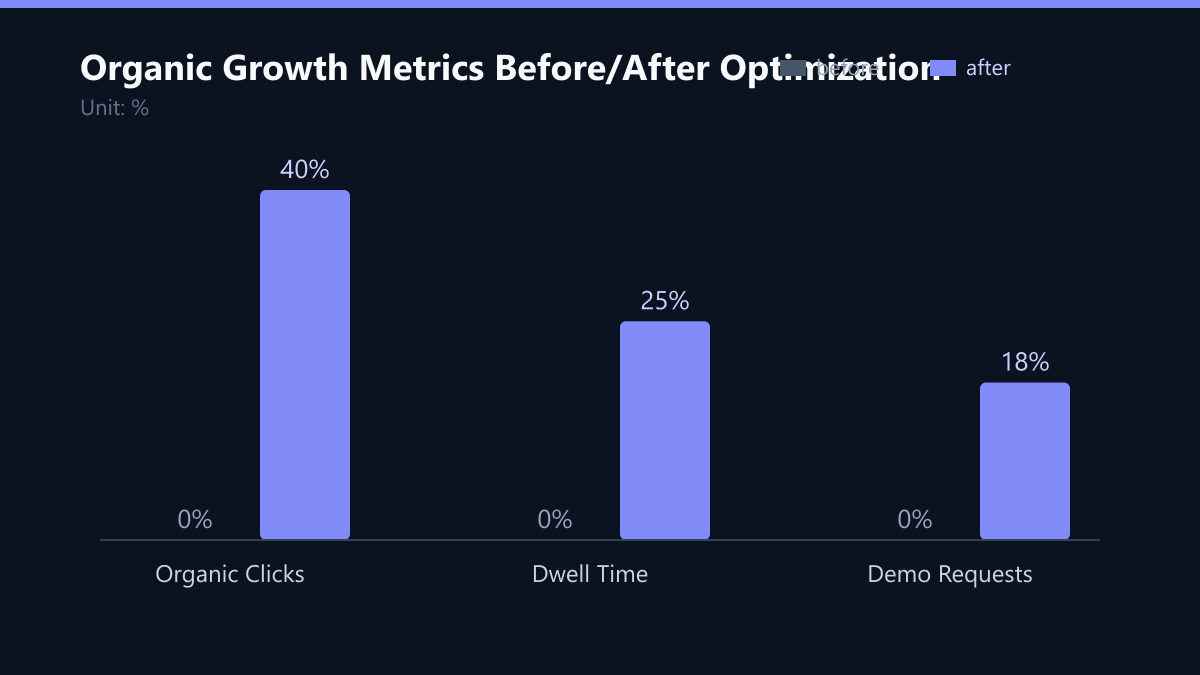
The most notable outcome was the increase in demo requests. This metric directly correlates with revenue potential, proving that the AI-optimized content not only attracted traffic but also converted it into qualified leads. The rise in dwell time further confirmed that users found the content valuable and engaging, reducing bounce rates and improving overall site quality signals.
What We Would Do Differently Today
Reflecting on the project, there are a few areas where we would refine our approach:
- Earlier Integration of AI Monitoring Tools: We would have implemented dedicated AI search visibility tracking tools from day one. While we monitored traditional SERPs, tracking how often the client was cited in AI answers (e.g., ChatGPT, Perplexity) would have provided a more complete picture of the impact.
- More Aggressive Internal Linking: While the topic cluster strategy was effective, we would have been more aggressive in cross-linking between related articles to further reinforce entity relationships and internal authority flow.
- Continuous Content Updates: We would have established a more formal process for updating existing content to keep it aligned with the latest AI search trends and algorithm updates, rather than focusing primarily on new content creation.
Lessons Learned: Adapting to the New Search Paradigm
This project highlighted a fundamental shift in user behavior. B2B buyers increasingly rely on AI summaries for initial research, making concise, factual, and well-structured answers crucial for visibility. Traditional SEO tactics alone are no longer sufficient to maintain a competitive edge.
For B2B software providers, the key takeaway is that technical SEO and content strategy must be integrated. Integrating AI-friendly content structures ensures that your brand is cited in AI-generated recommendations, which are becoming a primary source of information for decision-makers. Continuous monitoring of search algorithm updates and AI engine behaviors remains essential to maintain these gains and stay ahead of competitors who are still relying on outdated SEO practices.
Passend dazu
- IT Consulting & IT Strategy
- 5 Common Errors in Legacy Software Cloud Migration and How to Avoid Them
- Custom Software vs. Off-the-Shelf: Economic Analysis for the Mittelstand
- Web & Software Development
- Cloud Services & Cloud Migration
- IT Compliance & Data Protection
- Automated NIS2 Readiness Checks Cut Audit Time by 40 Percent
- Reducing RTO to 4 Hours with Hybrid Cloud Backup in Logistics
- Reducing Mean Time to Recovery by 65 Percent for a DACH Logistics Provider through Correlative APM Monitoring
- Logistics Provider in DACH: Scaling from 3 to 15 Servers for TMS Integration with 99.95% Uptime
- Logistics Hub in Frankfurt: Cutting Phishing Success Rates by 92% with AI-Driven Email Security
- Südeuropa: Setup von Cookieless-Attribution in Klaviyo für einen spanischen D2C-Kosmetikhersteller zur Steigerung der Wiederkäufe um 18 %
- Magento 2 Search Optimization: Elasticsearch vs. Solr Performance Benchmarks
- Logistik-Dienstleister in Deutschland reduziert Lieferscheinerstellung von 45 auf 4 Minuten durch RPA-Anbindung an SAP
- Cutting Document Search Time by 60% for a Singaporean Legal Practice
- Automatisierte Dokumentenverarbeitung: Beschleunigung der Buchhaltungsprozesse um 60 Prozent in einem US-amerikanischen Software-Unternehmen