The Operational Reality: When Nights Become Vulnerabilities
For a Tier-1 automotive supplier operating in Bavaria, the concept of “business hours” is a fiction. With 450 employees and three production sites running continuous manufacturing lines, the factory never truly sleeps. However, the IT security posture of many industrial enterprises often mirrors the office culture: active during the day, dormant at night. This client, like many in the automotive sector, faced a critical disconnect. Their internal IT team provided robust security monitoring during standard working hours, but coverage vanished after 6 PM and on weekends.
This gap created a dangerous blind spot. Analysis of historical alert data revealed that 70% of high-severity security alerts were generated during these uncovered periods. Without immediate human intervention, threats could persist unnoticed for hours. The consequence was a mean dwell time—the duration between a threat’s introduction and its detection or removal—exceeding 48 hours for high-severity incidents. In an industry where supply chain resilience is paramount, this latency represented not just a technical risk, but a significant operational and reputational liability. Pressure from OEM customers to demonstrate robust cybersecurity compliance was mounting, making the status quo unsustainable.
The Challenges: Navigating Industrial Complexity
Implementing a solution in this environment was not straightforward. The client faced three distinct hurdles that complicated the deployment of a Managed Security Service Provider (MSSP).
First, data fragmentation was severe. Logs were scattered across disparate firewalls, endpoint protection platforms, and cloud workloads, with no centralized visibility. Second, alert fatigue had already eroded the internal team’s capacity to respond effectively during the day, making the addition of more data streams risky without automation. Third, integration constraints were tight. The security solution had to integrate seamlessly with the existing ITSM ticketing system to ensure that security incidents followed the same workflow as IT service requests, without disrupting the production floor’s operational rhythm.
The Tech Stack: Tools for Continuous Visibility
To address these challenges, we deployed a tailored stack focused on centralization and automation.
- SIEM Platform: A centralized log aggregation engine to consolidate data from all network and endpoint sources.
- SOAR Engine: A Security Orchestration, Automation, and Response platform to execute automated playbooks.
- ITSM Integration Middleware: Custom connectors to link security alerts directly to the internal ticketing system.
- Cloud Security Posture Management: Modules to monitor the client’s Azure infrastructure for misconfigurations and threats.
Implementation: From Blind Spots to 24/7 Coverage
The deployment was executed within a strict six-week timeline, prioritizing stability and minimal disruption to production. We began with a comprehensive baseline audit to map the existing security landscape and identify the highest-risk assets. This phase involved detailed interviews with site managers and IT staff to understand the specific threat vectors relevant to their manufacturing processes.
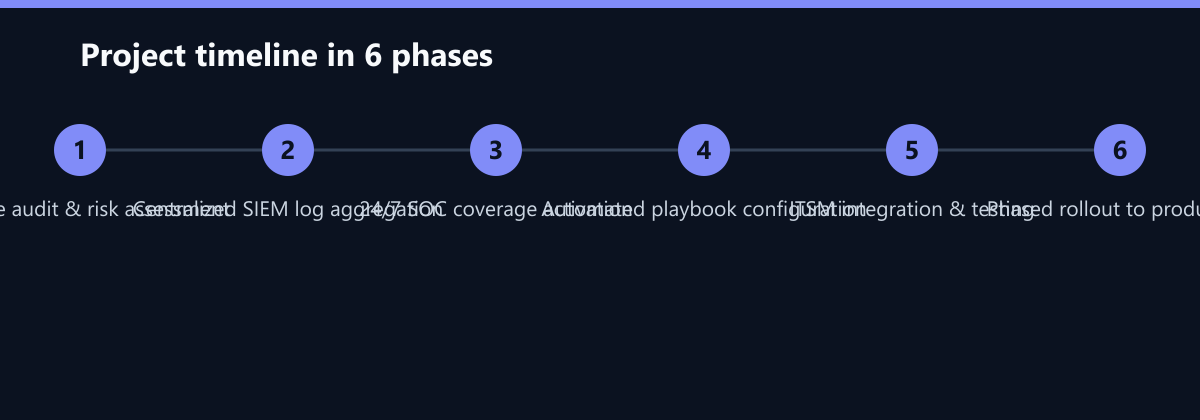
Following the audit, we moved to the technical build. The first major milestone was the centralization of log data. We consolidated streams from firewalls, endpoints, and cloud workloads into the SIEM platform. This step alone revealed a volume of data that was previously invisible, providing a complete picture of network activity. Next, we established the 24/7 SOC coverage. Certified security analysts were assigned to monitor the platform in rotating shifts, ensuring that no alert went unacknowledged regardless of the time of day.
Simultaneously, we configured automated playbooks for common threat types. For instance, brute-force attacks triggered immediate account lockouts and IP bans, while malware detections initiated isolation of affected endpoints. These automations were designed to handle the high-volume, low-severity noise that had previously overwhelmed the internal team. Finally, we integrated the security platform with the client’s ITSM system. This ensured that every security alert, whether automated or manually handled, generated a corresponding ticket, creating a single source of truth for incident management.
The rollout was phased. We started with the most critical production servers, monitoring the system for two weeks to tune detection rules and ensure no false positives impacted manufacturing. Once stability was confirmed, we expanded coverage to the entire network, including office environments and cloud resources.
How We Measured It: Defining Success
To ensure the solution delivered tangible value, we defined clear Key Performance Indicators (KPIs) before deployment. The primary metric was Mean Dwell Time, calculated as the average time from threat detection to resolution. We also tracked Uptime specifically attributable to security incidents, Automated Resolution Rate (the percentage of alerts resolved by playbooks without human intervention), and Compliance Reporting Coverage (the percentage of audit requirements automatically satisfied).
These metrics were measured using the SIEM platform’s built-in analytics and cross-referenced with ITSM ticket data. Baseline figures were established during the initial audit, providing a clear benchmark against which to measure post-implementation performance.
Results: Measurable Gains in Security Posture
Within three months of full deployment, the impact was evident. The most significant improvement was in incident handling speed. Mean dwell time dropped from 48 hours to 19 hours, representing a 60% reduction. This meant that threats were contained within a fraction of the previous timeframe, significantly reducing the potential for damage.
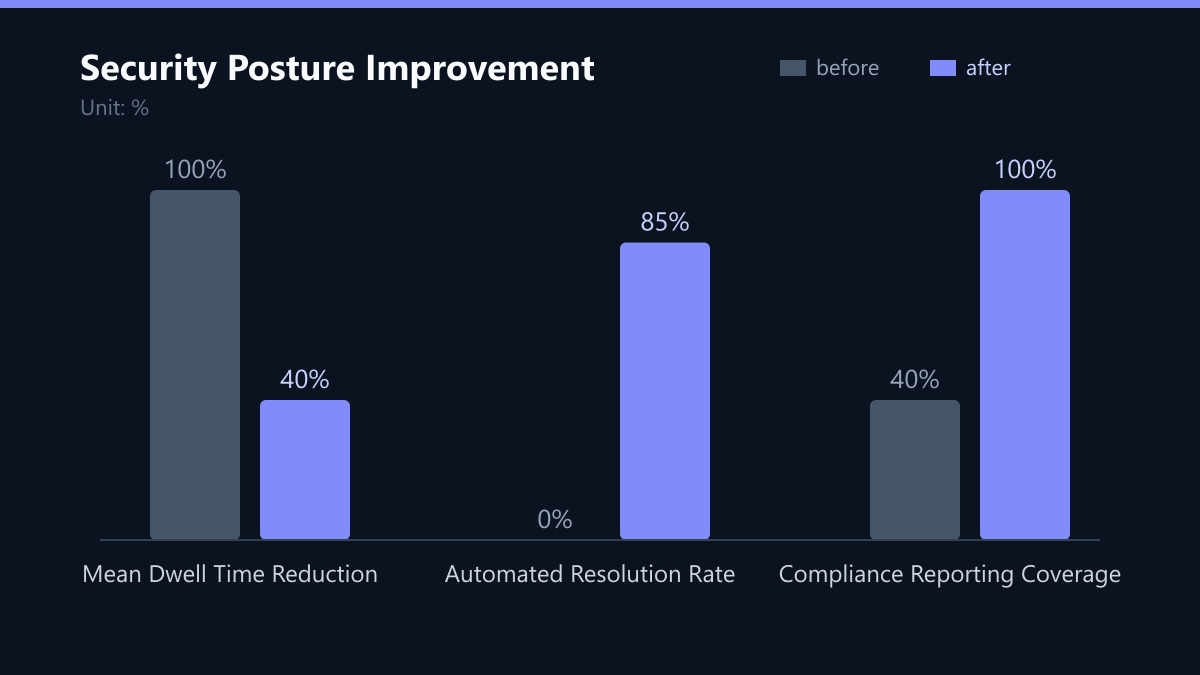
Beyond speed, the system delivered high availability and efficiency. The client achieved 99.9% uptime with zero unplanned downtime attributable to security incidents. Furthermore, 85% of high-volume, low-severity alerts were resolved automatically, freeing up internal IT staff to focus on strategic initiatives rather than routine triage. Compliance reporting became a non-issue, with 100% of ISO 27001 and NIS2 audit-ready reports generated automatically, saving dozens of hours of manual preparation for each audit cycle.
Lessons Learned: The Value of Proactive Defense
This project underscored that in 24/7 industrial environments, reactive defense is insufficient. Continuous visibility is non-negotiable. The success of the implementation hinged on three key factors. First, automation was critical in reducing alert fatigue. By handling the majority of low-severity alerts, the playbooks allowed human analysts to focus on complex, high-impact threats. Second, integration was essential. The seamless connection between security tools and ITSM workflows ensured that no alert was lost in translation, creating a cohesive operational picture. Third, continuous improvement was vital. Monthly tuning of detection rules based on incident data improved accuracy over time, reducing false positives and enhancing the system’s effectiveness.
What We Would Do Differently Today
While the outcome was successful, the process highlighted areas for refinement. First, we would have invested more time in stakeholder training during the initial phase. Some internal staff were initially skeptical of the automated playbooks, and more hands-on workshops could have accelerated buy-in. Second, we would have started cloud security monitoring concurrently with the on-premises deployment. The client later extended the MSSP scope to include Azure infrastructure, but integrating this earlier could have provided a more holistic security view from day one. Finally, we would have established a more granular feedback loop with the SOC team. While monthly tuning was effective, bi-weekly reviews could have accelerated the refinement of detection rules, particularly in the early weeks of operation.
The Path Forward
The client has since extended the MSSP scope to include comprehensive cloud security monitoring for their Azure infrastructure. This expansion reflects a growing recognition that security is a continuous, evolving discipline, not a one-time project. By leveraging 24/7 monitoring and automated response, the client has transformed its security posture from a reactive liability to a proactive asset, ensuring that their production lines remain secure and compliant in an increasingly complex threat landscape.
Passend dazu
- IT Monitoring & Observability
- Managed Security (MSSP)
- Cloud Services & Cloud Migration
- Berlin Fintech Cuts Audit Prep Time by 65% with Continuous Compliance
- Retail Chain in Berlin: Centralized Network Monitoring Reduces Incident Resolution Time from 4 Hours to 15 Minutes Across 12 Stores
- Trading Conglomerate Reduces Server Fault Response Time to 15 Minutes with AIOps
- Intelligent Customer Support Triage: A UK Retailer Reduces Response Times by 60% with AI-Powered Chatbots
- How to Reduce False Positives in IT Monitoring
- Gamification vs. Traditional Drills: Which Approach Reduces Human Error Faster