The Hidden Cost of Reactive Compliance
For many mid-sized fintechs, the annual audit is not just a regulatory checkbox; it is a operational earthquake. At this Berlin-based fintech, home to 150 employees, the ISO 27001 and GDPR audit cycle had become a critical bottleneck. The team was operating in a reactive mode, where security evidence was only gathered when the auditors arrived. This retrospective approach created a fragile ecosystem where gaps went unnoticed until it was too late, and the pressure to produce documentation was immense.
The core issue was visibility. The IT and compliance teams lacked a real-time window into their security controls. Evidence was scattered across various systems, requiring manual aggregation. This process was not only time-consuming but also error-prone. The stress levels within the compliance officer’s team were high, as any inconsistency in the data could lead to audit findings that required immediate remediation. The company needed to shift from a “firefighting” posture to a proactive, continuous compliance model.
The Challenges
Before deploying a solution, we identified three specific hurdles that had to be overcome to ensure the project’s success:
- Data Fragmentation: Security logs and access records were siloed across AWS, Azure, and Microsoft 365. There was no central source of truth for audit evidence.
- Manual Mapping: Mapping technical configurations to specific ISO 27001 controls was done manually via spreadsheets, a process that was both slow and prone to human error.
- Resource Drain: Senior engineers were being pulled away from product development to handle audit prep, directly impacting the company’s time-to-market and innovation capacity.
How We Measured It
To ensure the project delivered tangible value, we established clear KPIs before implementation began. We defined “Audit Preparation Time” as the total number of person-hours spent by the IT and compliance teams from the moment the audit notice was received until the final evidence pack was submitted. We also tracked “Evidence Automation Rate,” defined as the percentage of technical evidence items that were auto-generated by the system versus manually entered. Finally, we measured “Engineer Time Saved” by logging the hours previously spent on manual data collection and comparing them to the post-implementation effort. These baselines were established during the first week of the project, ensuring that the results were comparable and verifiable.
The Tech Stack
We selected a lightweight, cloud-native stack that integrated seamlessly with the client’s existing infrastructure. Here are the key tools we deployed:
- AWS CloudTrail & Azure Activity Log: Used as the primary sources for configuration changes and access logs, ensuring comprehensive data capture.
- Okta API: Integrated to track identity lifecycle events, including MFA adoption, permission changes, and offboarding processes.
- Microsoft 365 Graph API: Leveraged to monitor email security policies and data access patterns for GDPR compliance.
- Custom Compliance Engine: A lightweight, serverless application that ingests data from the above sources, maps it to ISO 27001 controls, and generates real-time reports.
- Grafana Dashboard: Used as the frontend for the compliance team, providing a visual, 24/7 view of the security posture.
Implementation: From Manual to Automated
The implementation was structured into six distinct phases, ensuring a smooth transition without disrupting the ongoing business operations. We started with a deep-dive assessment of the current state, identifying exactly which controls were most difficult to evidence manually. This allowed us to prioritize the integration of high-impact data sources first.
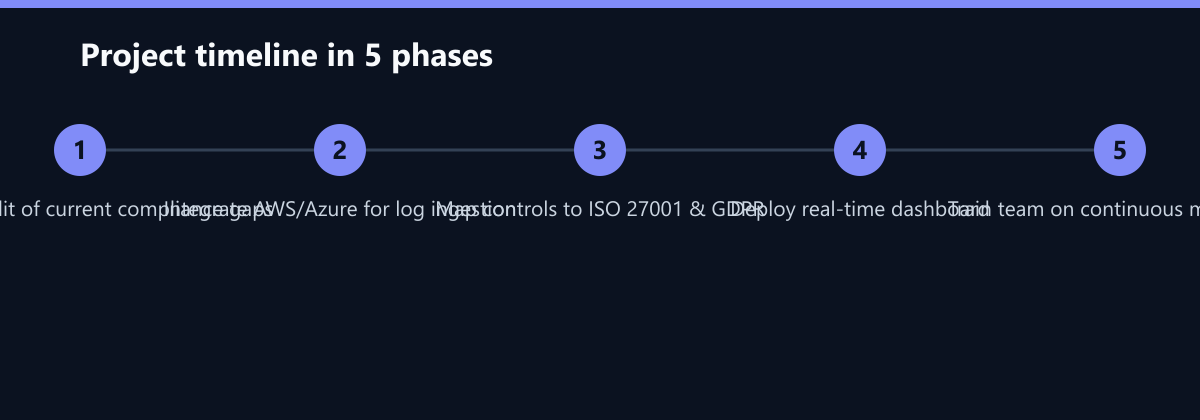
The core of the project was the integration layer. We connected the AWS and Azure environments to the custom compliance engine. This allowed the system to automatically capture configuration changes, access logs, and security policy updates in real time. For identity management, we integrated with Microsoft 365 and Okta. This was crucial for tracking user permissions, MFA adoption rates, and offboarding processes, which are often the most scrutinized areas during GDPR audits.
Once the data was flowing, we focused on policy mapping. This was the most complex part of the project. We mapped each technical control to the corresponding ISO 27001 and GDPR requirements. This created a live dashboard that showed the compliance status of each control in real time. If a control deviated from the baseline, the dashboard would immediately flag it, allowing the team to address the issue before it became an audit finding.
The final phase involved automated reporting. We configured the system to generate pre-audit reports instantly. These reports were not just static PDFs but dynamic documents that highlighted any deviations from baseline security standards. The deployment took six weeks in total, including initial assessment, tool integration, and team training. No new hardware was required; we leveraged existing cloud resources for data processing, keeping the cost of ownership low.
Results: From Weeks to Days
The shift to continuous monitoring transformed the client’s audit process. The results were evident in the first full audit cycle after the implementation. The most significant change was in the time required for audit preparation. Previously, this process took four weeks of intensive work. With the new system, it was reduced to just five days. This represented a 65% decrease in manual effort, freeing up the team to focus on other strategic initiatives.
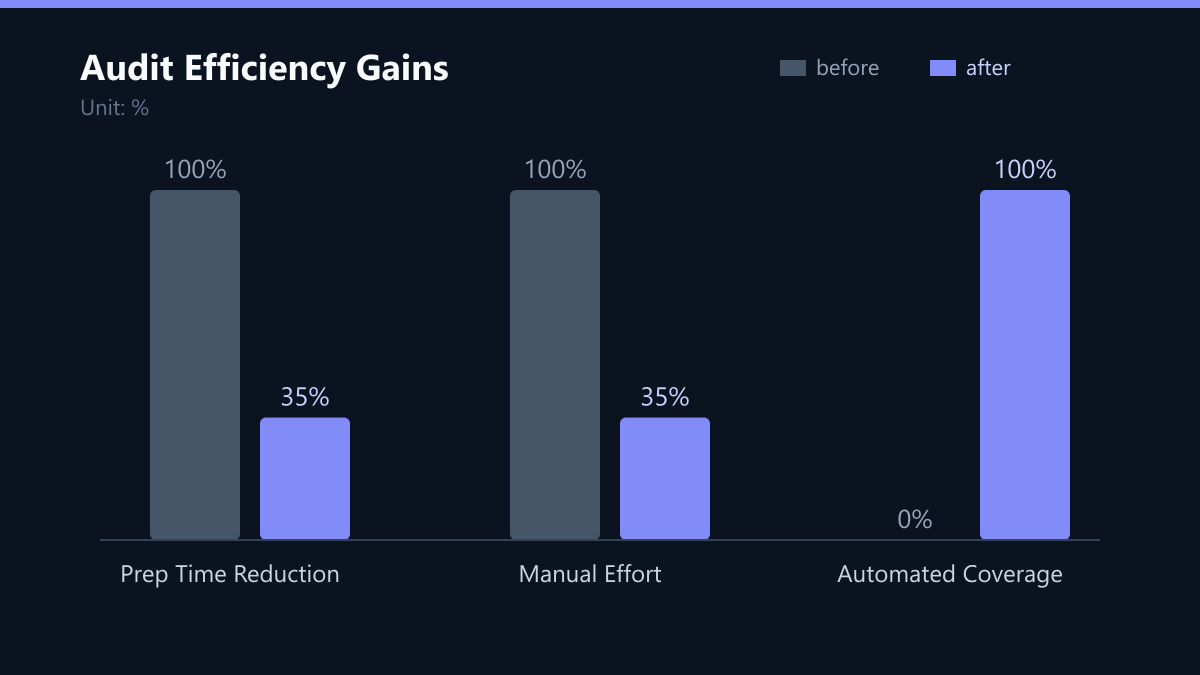
The quality of the evidence also improved dramatically. 100% of technical evidence is now auto-generated and timestamped. This eliminated manual data entry errors, which were a common source of audit findings in the past. The compliance team now has real-time visibility into their security posture, allowing them to address issues before they become audit findings. This proactive approach has significantly reduced the internal audit risk score.
The financial impact was also substantial. We estimated that 120 hours of senior engineer time were saved per year. These hours were redirected to product innovation, directly benefiting the company’s bottom line. The compliance team now spends 80% of their time on strategic risk management rather than data collection. This shift has not only improved efficiency but also empowered the team to focus on high-value tasks that drive business value.
What We Would Do Differently Today
While the project was a success, there are a few areas where we would refine our approach if we were to do it again. First, we would have invested more time in the initial policy mapping phase. While we achieved a high level of accuracy, there were a few controls that required manual adjustment after the initial deployment. A more rigorous mapping process upfront could have reduced the need for post-implementation tuning.
Second, we would have provided more training for the compliance team on how to interpret the real-time dashboard. While the dashboard was intuitive, some team members initially struggled to identify which alerts were most critical. A more comprehensive training program could have accelerated their adoption of the new tool.
Finally, we would have considered a phased rollout of the automated reporting feature. By starting with a subset of controls and gradually expanding the scope, we could have reduced the risk of data overload and allowed the team to become more comfortable with the system before it was fully operational.
Lessons Learned: Proactive Compliance is a Competitive Advantage
This project highlighted that compliance is not just a regulatory hurdle but a strategic asset. For mid-sized companies in regulated industries, investing in continuous compliance monitoring pays for itself through reduced audit costs, faster time-to-market, and enhanced customer trust. The key takeaway is that automation is essential for scaling fintechs. Manual evidence collection is unsustainable in the long run. By automating the data flow from IT systems to compliance tools, companies can achieve a higher level of security and compliance with less effort.
Real-time visibility is another critical factor. Continuous monitoring allows for immediate remediation of security gaps, reducing the risk of non-compliance and potential fines. This proactive approach not only protects the company from regulatory penalties but also enhances its reputation as a trustworthy partner. Finally, team empowerment is a often overlooked benefit. By handling routine data collection, the system empowers the compliance team to focus on high-value strategic tasks, driving innovation and growth.
In conclusion, the shift from reactive to proactive compliance is not just an operational improvement but a strategic necessity. By leveraging technology to automate evidence collection and provide real-time visibility, companies can reduce audit preparation time, improve the quality of their evidence, and free up their teams to focus on what truly matters: building better products and serving their customers.
Passend dazu
- IT Consulting & IT Strategy
- Automated Compliance Reporting: Saving Time with AI in IT Audits
- Reducing First Response Time in IT Support with RPA
- IT Compliance & Data Protection
- Cloud Services & Cloud Migration
- E-Commerce Development
- Accelerating Compliance Audits in the Financial Sector
- Automated NIS2 Readiness Checks Cut Audit Time by 40 Percent
- Cross-Regional Data Sync for Asian Retail: Eliminating Stock Discrepancies with Real-Time API Orchestration
- Fintech Startup in Berlin: Multi-Cloud Strategy Reduces Vendor Lock-In Risks
- Monitoring KPIs for CIOs: The 5 Metrics That Directly Impact Business Revenue and SLA Compliance
- AI-Driven Customer Onboarding: Halving Setup Time for a London-Based Fintech Scale-Up
- Insurance Broker Digitizes Claims with OCR
- AI in IT Operations: How Predictive Maintenance Cuts Incident Response
- Shopify App Fatigue: How to Audit and Remove Bloatware to Improve Page Speed by 30%
- Automotive Tier-1 Supplier in Bavaria Reduces Dwell Time by 60% with 24/7 MSSP Monitoring
- Digitizing Contract Management for a Real Estate Portfolio in New York: Reducing Compliance Risks and Retrieval Time by 75%
- Scaling a UK Fintech Platform: From 5,000 to 50,000 Daily Users with Managed AWS Infrastructure
- NIS2 Compliance for a Frankfurt FinTech in Six Months
- Healthcare Clinic in Berlin: Meeting GDPR Requirements with Encrypted Backup Isolation and Audit Logs
- Kollaborations-Setup für Kanzlei in London: Compliance-orientierte SharePoint-Architektur und Dokumentenkontrolle mit 100 Prozent Audit-Trail