The Operational Bottleneck
For a wholesale trading group operating across Germany and Austria, IT stability is not just a technical metric; it is the backbone of their daily sales operations. With 450 employees relying on a complex mix of on-premise servers and Azure cloud services, the organization faced a growing crisis of visibility. Their legacy monitoring system, built on static thresholds, was generating thousands of false alarms every day.
This noise had a tangible cost. IT staff reported spending up to 40% of their working hours simply filtering out irrelevant alerts, leaving them with less time for strategic improvements or proactive maintenance. The Mean Time to Detect (MTTD) for critical server faults averaged 45 minutes. In a trading environment where data integrity is paramount, these delays often led to cascading failures in the ERP system, impacting customer orders and internal reporting. Business leaders were increasingly concerned, demanding a solution that could protect sales processes and ensure data integrity without consuming the entire IT team’s bandwidth.
The Challenges
Before deploying any new technology, we had to address three specific hurdles that had plagued previous automation attempts:
- Data Noise: The sheer volume of logs from mixed environments made it difficult to establish a reliable baseline for “normal” behavior.
- Alert Fatigue: The team had become desensitized to alerts, leading to slower reaction times for genuine critical issues.
- Skill Gap: While the team was proficient in traditional monitoring, they lacked experience in interpreting probabilistic AI models and confidence scores.
The Tech Stack
We selected a modern AIOps platform that could integrate seamlessly with the existing hybrid infrastructure. The core components included:
- AIOps Core Engine: For anomaly detection and correlation.
- Azure Monitor Integration: To ingest cloud-native metrics.
- Log Analytics: For processing on-premise server logs.
- Automation Orchestrator: To trigger remediation scripts based on predefined runbooks.
Implementation: A Phased Approach
We structured the project over 12 weeks, ensuring minimal disruption to daily operations. The rollout was divided into three distinct phases, each with specific goals and validation checkpoints.
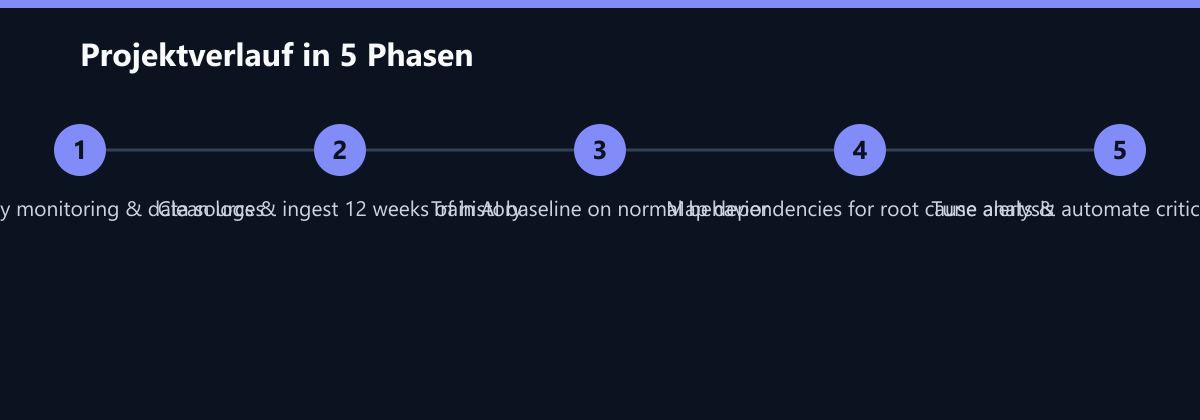
Phase 1: Data Ingestion and Baseline Learning (Weeks 1-4) The first priority was establishing a trusted source of truth. We connected the AIOps platform to both Azure and on-premise servers. During this phase, the AI model analyzed historical logs, metrics, and events to learn the normal behavior patterns of the infrastructure. This included identifying seasonal trends, such as peak trading hours and monthly batch processing windows. We spent significant effort cleaning log sources, ensuring that malformed data did not skew the baseline. By the end of week 4, the system had processed enough data to begin distinguishing between normal fluctuations and genuine anomalies.
Phase 2: Correlation Engine Configuration (Weeks 5-8) With a solid baseline in place, we moved to the correlation engine. This was the most complex phase, as it required mapping dependencies between network, server, and application layers. We identified that many server alerts were actually symptoms of upstream network issues or application errors. By configuring the correlation rules, the system could now group related events into a single incident and identify the root cause automatically. This reduced the need for manual investigation in early stages.
Phase 3: Alert Tuning and Runbook Automation (Weeks 9-12) The final phase focused on usability and automation. We suppressed non-critical alerts that did not require immediate human intervention. For critical incidents, we implemented automated remediation scripts. For example, if a specific server disk usage exceeded 90%, the system would automatically clear temporary files and notify the on-call engineer, rather than waiting for a human to log in and perform the task. This phase also involved extensive testing with the IT team to ensure the alerts were actionable and clear.
By the end of the 12-week project, the system was processing 2 million data points per day, identifying anomalies before they impacted users.
How We Measured It
To ensure the results were objective and reproducible, we defined a strict measurement protocol.
- MTTD: Measured from the moment an anomaly was detected by the AIOps engine to the moment it was acknowledged by an IT engineer. We used timestamped logs from the monitoring platform to calculate this average over a 30-day period.
- False Positives: Defined as alerts that were acknowledged but resulted in no action or were marked as “false alarm” by the engineer. We tracked this ratio against total alerts.
- MTTR: Measured from the moment an incident was opened to the moment it was resolved and closed. This included time spent on diagnosis, remediation, and verification.
We compared these metrics against the 3-month average from the legacy system to establish the “before” baseline.
Results and Impact
After three months of full operation, the improvements were significant and measurable. The AIOps platform transformed the IT team’s workflow from reactive to proactive.
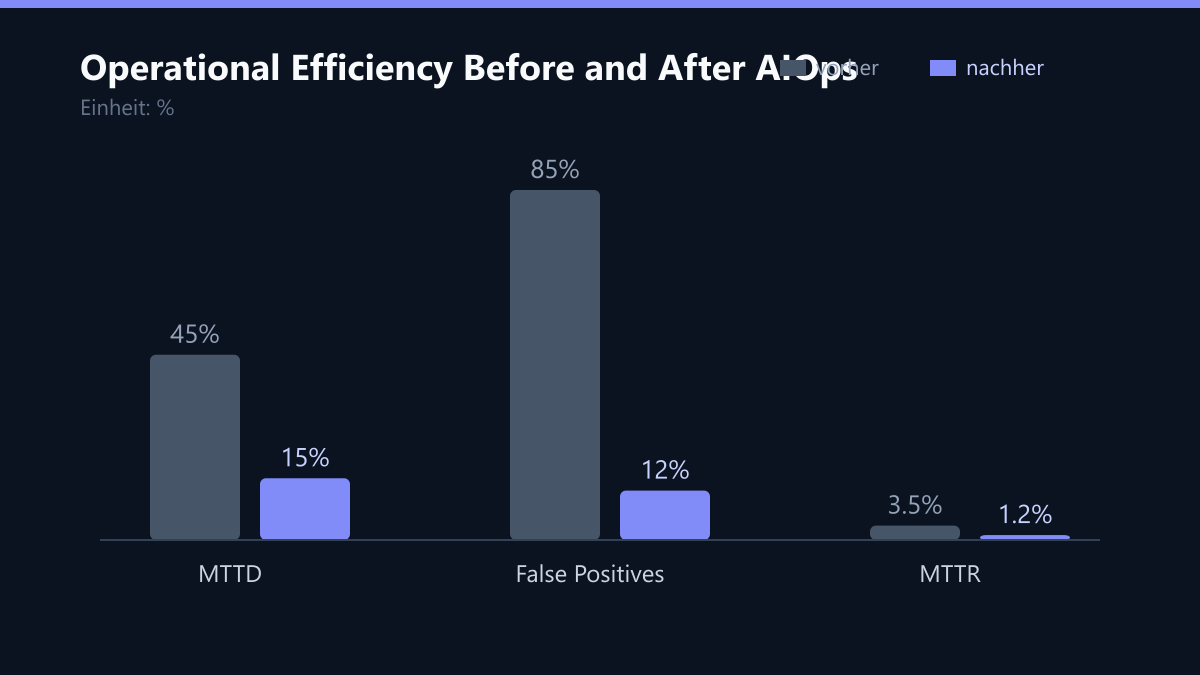
The Mean Time to Detect (MTTD) dropped from 45 minutes to just 15 minutes. This 67% reduction allowed IT to act proactively, often resolving issues before they escalated into critical outages. The reduction in false positives was even more dramatic, falling from 85% to 12%. This 73% decrease freed up approximately 15 hours per week of analyst time, which the team redirected toward infrastructure optimization and new project initiatives.
Furthermore, the Mean Time to Resolve (MTTR) decreased by 66%, from 3.5 hours to 1.2 hours. This was largely due to the automated root cause analysis, which eliminated the time spent diagnosing the issue. As a result, critical server outages decreased by 40% year-over-year, directly contributing to improved customer satisfaction and sales continuity.
Lessons Learned
While the results were positive, the project also highlighted several important lessons for future AIOps deployments.
Data Quality is Critical Garbage in, garbage out. We spent two weeks cleaning log sources to ensure accurate baseline learning. If the input data is noisy or inconsistent, the AI model will produce unreliable results. Establishing data hygiene standards early in the project is essential.
Change Management is Key IT staff initially resisted AI-driven alerts, fearing they would be overwhelmed by new types of notifications. We addressed this by conducting training sessions on interpreting AI confidence scores. By explaining how the model works and why certain alerts were prioritized, we increased adoption rates and trust in the system. It is crucial to involve the IT team from the beginning, rather than just deploying the tool for them.
Continuous Tuning is Required AIOps is not a set-and-forget tool. The model requires monthly review to adapt to new workloads and infrastructure changes. As the trading group expanded its services, we had to retrain the baseline to account for new data patterns. This ongoing maintenance ensures that the system remains accurate and relevant over time.
What We Would Do Differently Today
Looking back, there are two areas where we would refine our approach in a similar engagement.
First, we would involve the business stakeholders earlier in the process. While IT was the primary user, the business leaders were the ones who felt the impact of downtime. By including them in the initial workshops, we could have better aligned the alert priorities with business criticality, ensuring that the most important issues were flagged first.
Second, we would invest more time in the initial data ingestion phase. While we cleaned the logs, we could have automated this process more effectively. Developing a more robust data pipeline from the start would have reduced the manual effort required in Phase 1 and allowed us to focus more on correlation and automation.
This project demonstrates that AIOps is a dynamic component of modern IT operations. It requires careful planning, clear ownership, and continuous tuning to deliver its full potential. For organizations looking to reduce downtime and improve operational efficiency, AIOps offers a proven path forward.
Passend dazu
- IT Consulting & IT Strategy
- Managed Hosting & Server Hosting
- Cloud Services & Cloud Migration
- IT Compliance & Data Protection
- 40 Percent Less Processing Time in Credit Checks via LLM Workflows
- Intelligent Customer Support Triage: A UK Retailer Reduces Response Times by 60% with AI-Powered Chatbots
- The Role of AI in Modern MSPs: How Automation Reduces Response Times by 50%