The Starting Point: Hitting the Ceiling
The client, a specialized machine builder with 120 employees operating in the DACH region, had reached the functional limits of its existing e-commerce platform. The legacy system, built on an obsolete version of its previous CMS, could no longer support the complexity of modern B2B sales. Specifically, the platform offered no mechanism for customers to individually configure complex systems, forcing a reliance on manual intervention for nearly every order. This bottleneck was not just a technical annoyance; it was a significant drag on revenue and operational efficiency.
The sales team was particularly impacted, spending up to 30% of their working hours manually clarifying configuration details via email and phone. This manual process not only slowed down order fulfillment but also introduced a high risk of errors. Consequently, the company faced a high return rate due to incorrect orders, a direct financial loss that eroded margins. Furthermore, the lack of personalization for recurring B2B customers meant that the platform failed to recognize returning buyers, treating them like first-time visitors and missing opportunities for upselling or streamlined re-ordering. Finally, slow loading times suppressed the conversion rate, as potential customers abandoned their carts when the site felt unresponsive.
The Challenges
To understand the scope of the project, we identified four concrete challenges that needed to be addressed:
- Complex Product Logic: Machine building involves intricate technical dependencies. A simple dropdown menu was insufficient; the system needed to understand which components could not be combined due to physical or technical constraints.
- Data Quality: The legacy system contained fragmented and often inconsistent product data. Before any new interface could be built, the underlying data structure had to be cleaned and standardized to support a reliable configurator.
- User Adoption: Sales teams were accustomed to manual processes. There was a risk of resistance to a new digital workflow if it did not integrate seamlessly into their existing daily routines.
- Performance at Scale: The new platform had to handle seasonal load peaks without degradation, ensuring that global customers experienced consistent speed, a critical factor for conversion.
The Implementation
We began the project with a comprehensive technical audit to establish a baseline for performance and data quality. The first phase involved migrating the infrastructure to a cloud-based environment, providing the scalability required for the new features. The core of the project was the development of a modular product configurator designed specifically for the complex product logic of machine building.
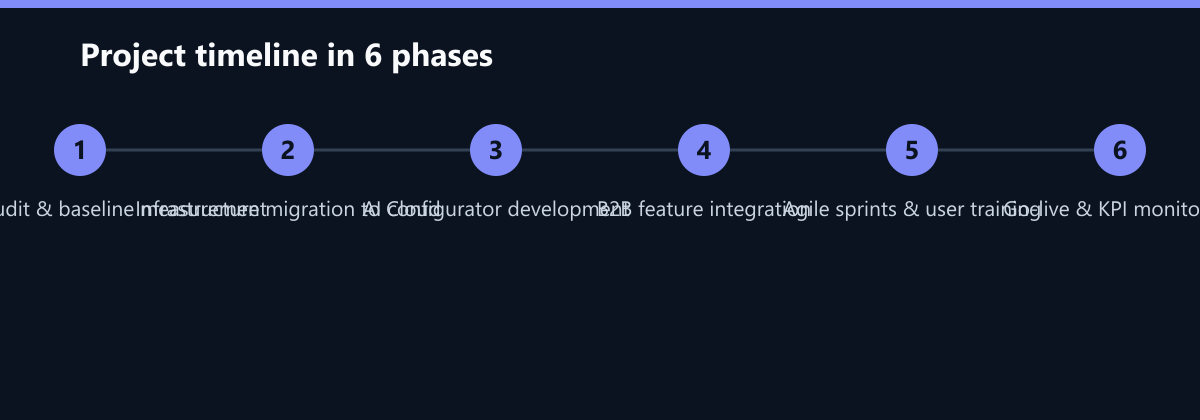
The development process was executed in agile sprints over a period of 8 months. This iterative approach allowed us to validate features with stakeholders early and often. The key modules developed during this phase included:
- AI-Powered Configurator: We implemented a rule-based system that validates technical dependencies in real-time. If a user selects a component that is incompatible with their current selection, the system automatically hides non-configurable combinations. This prevents invalid orders at the source, rather than catching them after checkout.
- B2B-Specific Features: We built individual price lists for different customer tiers, multi-stage approval processes for large orders, and a central customer overview that allows sales representatives to view all open and historical orders in one place.
- Performance Optimization: To address the slow loading times, we implemented Varnish caching and integrated a Content Delivery Network (CDN). This ensured that static assets were delivered from servers geographically close to the user, significantly reducing latency.
In parallel with development, the marketing team was trained on the new CMS structure. This was crucial for ensuring that content updates could be made efficiently without requiring developer intervention for every change.
How We Measured It
To ensure that the project delivered tangible value, we established a rigorous measurement framework before go-live. We defined four primary KPIs:
- B2B Online Revenue: Tracked monthly against the same period in the previous year to account for seasonality.
- Support Ticket Volume: Specifically filtered for tickets related to product configuration to isolate the impact of the configurator.
- Conversion Rate: Measured as the percentage of sessions that resulted in a completed order, compared to the legacy platform’s baseline.
- Page Load Time: Measured at the 95th percentile (P95) to ensure that even the slowest 5% of users experienced acceptable performance.
We used server-side analytics and third-party monitoring tools to capture this data. Baseline numbers were recorded for three months prior to the migration to ensure a stable comparison point.
The Results
Six months after go-live, the KPIs showed a significant increase in efficiency and revenue. The digital self-service capabilities drastically reduced the burden on the support team, allowing them to focus on complex issues rather than basic configuration queries.
The most striking result was the +40% revenue growth in the B2B online channel within one year. This growth was driven not just by more traffic, but by higher order values and increased frequency. Personalization through the configurator led to customers choosing an average of 20% more add-on components per order, as the system intelligently suggested compatible upgrades.
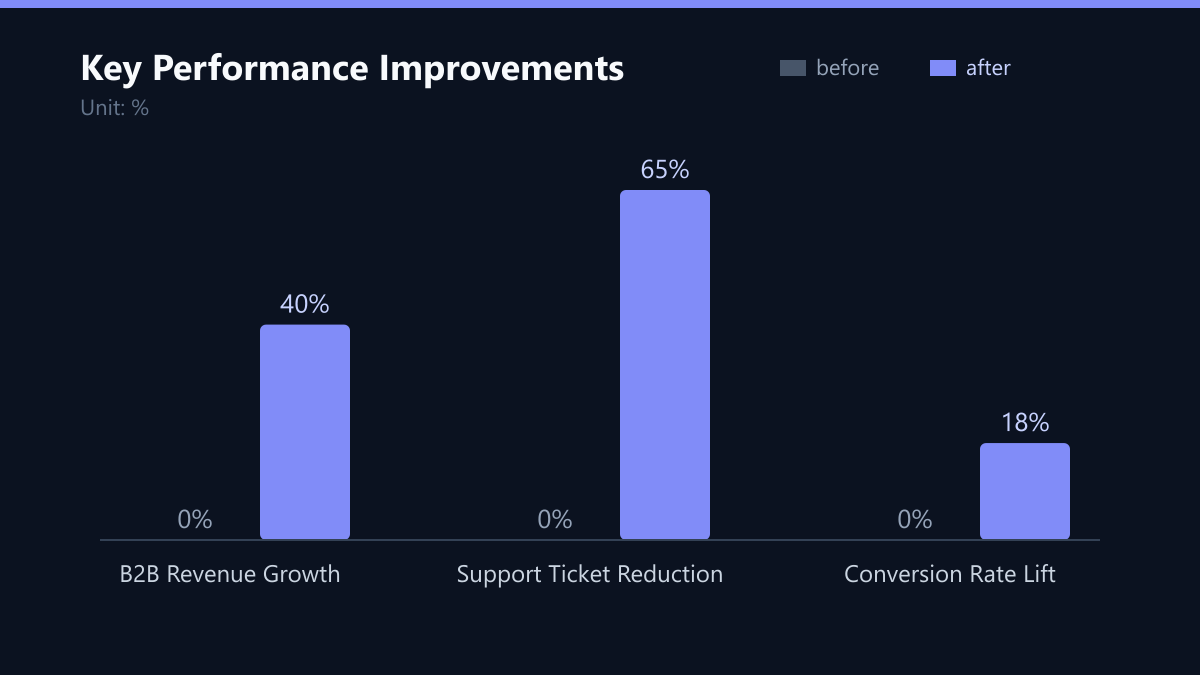
Additionally, support tickets regarding product configuration dropped by 65%. This reduction freed up valuable hours for the support and sales teams, who could then engage in proactive customer management rather than reactive problem solving. The conversion rate increased by 18% compared to the old shop, a direct result of the improved user experience and faster loading times. Finally, the load time on the product overview page was reduced to less than 2 seconds (P95), ensuring a smooth experience for users even during peak traffic periods.
Lessons Learned
The success of this project lay not only in the technology but in the precise mapping of business processes. A technical relaunch without process optimization would have merely shifted the problems from one platform to another. We learned three core lessons from this engagement:
- Data Quality is Critical: Clean product data is the foundation for a functioning configurator. We spent significant time in the early phases cleaning and structuring data. This investment paid off by ensuring the AI rules had accurate information to work with.
- Early Adoption is Key: Involving sales staff in the testing phase was crucial. By having them use the system before launch, we identified friction points and gathered feedback that improved the final product. This buy-in reduced resistance at launch and accelerated the adoption curve.
- Scalability Matters: The cloud architecture enabled the platform to handle seasonal load peaks without performance loss. This resilience was tested during the year-end rush, where traffic increased by 300% over several days. The system handled the load seamlessly, protecting revenue and customer trust.
The Tech Stack
To achieve these results, we utilized the following technology stack:
- Magento 2: The core e-commerce platform, chosen for its flexibility and robust B2B capabilities.
- AWS Cloud: The infrastructure provider, offering scalable compute and storage resources.
- Varnish Cache: A high-performance HTTP accelerator to speed up page delivery.
- Cloudflare CDN: For global content delivery and security.
- Elasticsearch: For fast and flexible product search and filtering.
- Custom AI Module: A proprietary rule-based engine developed to handle technical dependencies.
What We Would Do Differently Today
While the project was a success, there are areas where we would refine our approach in future engagements:
- Data Migration Earlier: We would start data cleaning and migration earlier in the project timeline. In this case, some data inconsistencies were discovered late, causing minor delays in the configurator testing phase.
- More Extensive User Acceptance Testing: We would allocate more time for user acceptance testing with a broader group of end-users, not just the sales team. This would help identify usability issues that might only be apparent to non-technical customers.
- Phased Rollout: Instead of a big-bang launch, we would consider a phased rollout, starting with a subset of customers or products. This would allow for further fine-tuning of the configurator rules before exposing the full catalog to the market.
This case study demonstrates that a well-executed Magento 2 relaunch, combined with intelligent AI features, can transform a B2B e-commerce channel from a bottleneck into a growth engine. By focusing on process optimization and data quality, the client achieved significant improvements in revenue, efficiency, and customer satisfaction.
Passend dazu
- 5 Critical Performance Bottlenecks in Magento Stores and How to Fix Them
- Headless Magento: When Decoupling the Frontend Is Worth the Investment
- IT Consulting & IT Strategy
- AI in Cybersecurity: How Machine Learning Detects and Blocks Phishing Attacks in Real Time
- Magento 2 vs. Shopify Plus: Cost-Benefit Analysis for Mid-Market E-Commerce
- Magento / Adobe Commerce
- Cloud Services & Cloud Migration
- IT Compliance & Data Protection
- Scaling a Berlin E-Commerce Startup to 50,000 Monthly Orders
- Reducing helpdesk ticket load by 40 percent for a German machine builder through root-cause analysis instead of reactive fault resolution
- Reducing support workload by 40 percent: AI triage in e-commerce for a German Magento retailer
- Migration eines PHP-Systems auf Laravel und PHP 8.3
- Magento Security: Identifying Vulnerabilities in Third-Party Extensions
- Avoiding Common Pitfalls in Magento 2 to 2.4 Upgrade