The Starting Point: Growth Strained by Legacy Infrastructure
When a D2C brand in Berlin reaches a certain scale, the limitations of its underlying technology become impossible to ignore. Our client, a consumer goods e-commerce company with 45 employees operating in the DACH region, had built a successful brand through strong marketing and product quality. However, by the time they approached us, their legacy platform had become a bottleneck rather than an enabler. They were processing approximately 5,000 orders per month, but the infrastructure was struggling to keep pace with demand, particularly during sales events.
The pain points were acute and directly impacting revenue. During peak traffic periods, the site experienced significant slowdowns, leading to a cart abandonment rate of 12%. This was not just a technical issue; it was a customer experience failure. Furthermore, their inventory management was reactive rather than proactive. Sync errors between their ERP system and the storefront were causing overselling incidents. Each oversell resulted in manual refunds, angry customer service tickets, and ultimately, churn. The business needed a robust, scalable infrastructure that could support rapid growth without sacrificing the user experience that had built their brand.
The Challenges: Breaking Down the Monolith
The core issue was architectural. The client was running on a monolithic setup where the frontend and backend were tightly coupled. This slowed down development cycles, as any change to the site required full-stack coordination. It also hampered performance, as the server had to render entire pages before delivering them to the user. The client required a headless setup to decouple the frontend from the backend. This separation would allow for a faster, mobile-first checkout experience while maintaining the complex inventory logic required for their operations.
The project came with specific constraints that added to the complexity. We had to integrate their existing ERP system with Shopify Plus within a tight six-month timeline. This meant we could not simply rip and replace everything; we had to build a bridge between the old and the new. The challenges we identified were:
- Performance Latency: The legacy system could not deliver sub-second load times on mobile devices, which was critical for their target demographic.
- Inventory Inconsistency: Real-time sync between the ERP and the storefront was missing, leading to data drift and overselling.
- Logistics Fragmentation: Orders were not being routed automatically to the three different 3PL warehouses, causing manual intervention and shipping delays.
- Development Velocity: The monolithic architecture prevented the engineering team from iterating quickly on new features or marketing campaigns.
Implementation: Building a Headless Foundation
We began the project with a comprehensive audit of the existing system to map out all data flows and dependencies. This allowed us to design a target architecture that was both scalable and maintainable. We chose Shopify Plus as the commerce backbone for its robust API capabilities and reliability at scale. For the frontend, we built a custom Next.js application. This allowed us to leverage server-side rendering for SEO benefits while using client-side hydration for a dynamic, app-like user experience.
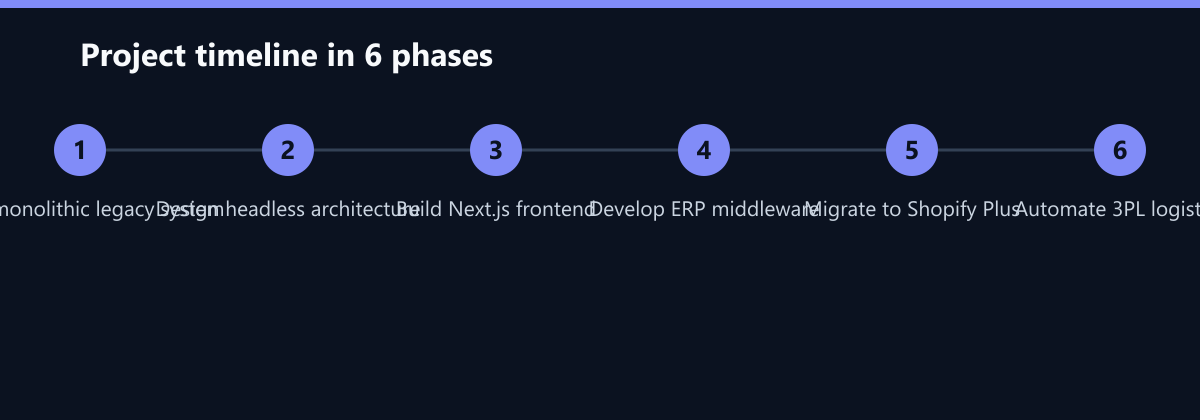
The most critical component of the solution was the middleware layer. We developed a custom Node.js API to act as the bridge between the client’s ERP and Shopify. This middleware handled real-time inventory synchronization, ensuring that stock levels in the storefront were always accurate. We used webhooks to trigger updates instantly whenever stock changed in the ERP, eliminating the lag that had previously caused overselling.
We also automated the logistics integration. Using the same middleware, we implemented logic to route orders to one of three 3PL warehouses based on stock availability and proximity to the customer. This reduced shipping times and costs while ensuring that orders were picked and packed automatically without manual intervention. The project ran over four months with weekly sprints, allowing us to deliver incremental value and adjust the architecture based on testing results.
The Tech Stack
- Shopify Plus: The core commerce platform, providing the checkout, payment, and product management infrastructure.
- Next.js: The React framework used to build the high-performance, headless frontend.
- Node.js API: A custom middleware layer for ERP integration and logistics automation.
- AWS Cloud: The hosting environment for the frontend and middleware, ensuring low latency and high availability.
- Data Lake: A centralized analytics repository for tracking customer lifetime value and behavioral data.
How We Measured It
To ensure the project was delivering the expected value, we established a rigorous measurement framework before development began. We used Google Analytics 4 and custom event tracking to monitor user behavior on the site. For performance, we relied on Core Web Vitals data from PageSpeed Insights and real-user monitoring (RUM) tools to track actual page load times on mobile devices. Inventory accuracy was measured by comparing ERP stock levels with Shopify stock levels at regular intervals, tracking the delta as a key metric. Finally, we tracked operational costs by monitoring the time spent by the operations team on manual inventory adjustments and refund processing.
Results: Scaling to 50,000 Orders
The new system delivered immediate and tangible improvements. The most significant result was the handling of a 10x increase in order volume without any downtime. The client achieved 50,000 orders per month within eight months of launch, a milestone that would have been impossible on the legacy infrastructure.
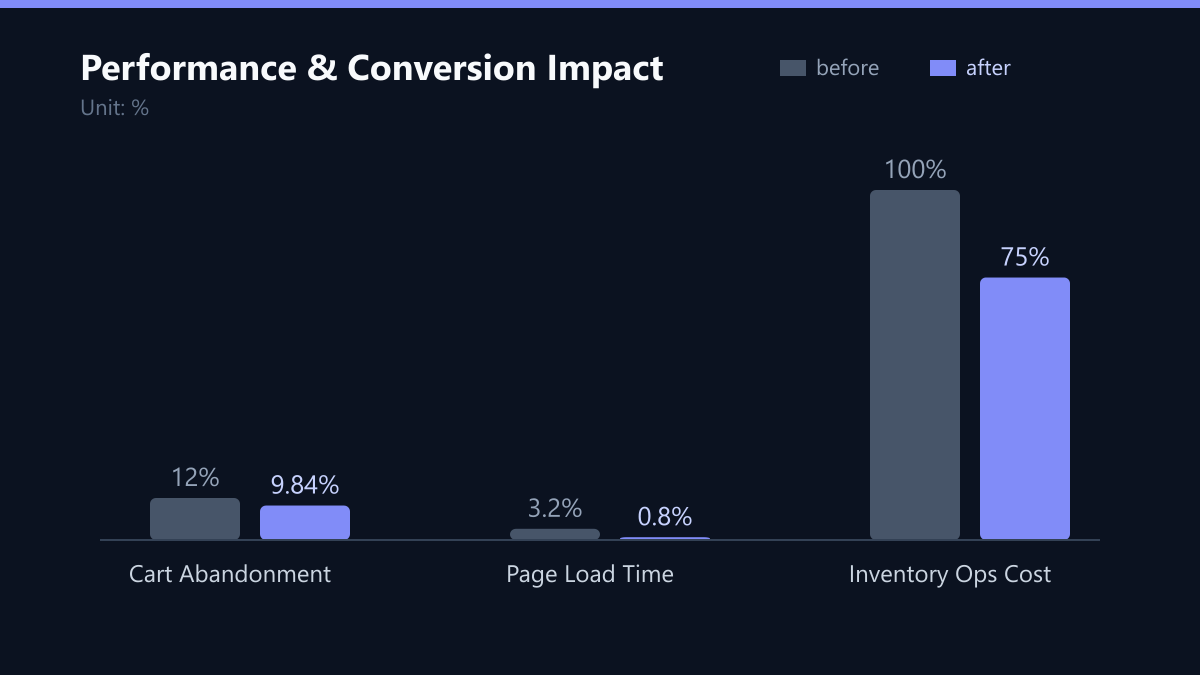
Performance metrics improved dramatically. Average page load time dropped from 3.2 seconds to 0.8 seconds, well within the sub-second target. This speed improvement directly impacted conversion, with cart abandonment decreasing by 18% due to the streamlined, faster checkout experience. The automation of inventory management and logistics routing reduced operational costs for inventory management by 25%. The team no longer had to spend hours manually resolving stock discrepancies or routing orders, freeing them up to focus on growth initiatives.
Lessons Learned: What We Would Do Differently
While the project was a success, there were areas where we could improve our approach in future engagements. First, we would invest more time in the discovery phase to map out all edge cases in the inventory sync logic. While the middleware worked well for standard scenarios, we encountered some complex edge cases during testing that required additional development time. A more thorough initial audit could have identified these earlier.
Second, we would recommend a more aggressive phased rollout of the logistics automation. While we did run in parallel for a period, a longer parallel run would have provided more confidence in the automated routing logic. This would have further reduced the risk of misrouted orders during the transition period.
Finally, we would place greater emphasis on data migration validation. While the core product data migrated smoothly, some historical order data required manual cleanup. Implementing a more robust data validation script before the migration could have saved time and reduced manual effort.
Conclusion
This case study demonstrates the power of headless commerce for high-growth e-commerce brands. By decoupling the frontend from the backend, we were able to deliver a faster, more flexible user experience while maintaining the complex business logic required for inventory and logistics. The result was a scalable infrastructure that supported a 10x increase in order volume while reducing operational costs and improving customer satisfaction. For any D2C brand looking to scale, investing in a headless architecture and robust middleware is not just a technical upgrade; it is a strategic necessity.
Passend dazu
- E-Commerce Development
- Magento / Adobe Commerce
- Cloud Services & Cloud Migration
- Boosting Conversion Rate by 18% Through AI-Powered Product Recommendations in a US B2B Industrial Trade Business
- Reducing RTO to 4 Hours with Hybrid Cloud Backup in Logistics
- SD-WAN Implementation Cuts Latency by 40% for Berlin Logistics Firm
- Scaling Magento Infrastructure by 200 Percent with Azure Optimization