The Pressure of Dual-Jurisdiction Reporting
For a mid-sized asset management firm operating in both London and Berlin, the end of each quarter used to be a period of intense, manual labor. The client, a 150-employee firm, faced escalating pressure from regulators in both jurisdictions. The primary pain point was not the complexity of the regulations themselves, but the inefficiency of the data handling required to meet them. Manual reporting processes consumed 40 hours per week of senior analyst time, a significant drain on resources that could have been spent on strategic portfolio analysis or client acquisition.
The core issue was a fragmented data landscape. Financial data was siloed across legacy ERP systems, local spreadsheets, and trading platforms. Because the Financial Conduct Authority (FCA) in the UK and the Federal Financial Supervisory Authority (BaFin) in Germany required different data structures and formats, analysts were forced into a repetitive cycle of manual reformatting. This not only slowed down the reporting cycle but introduced a high risk of human error. Approximately 5% of submissions required correction due to validation errors, leading to delayed filings and potential regulatory scrutiny.
The Challenges
Before any solution could be designed, we had to address four specific, concrete challenges that had previously stalled internal automation attempts:
- Legacy Integration Barriers: The existing ERP systems were on-premise and lacked modern APIs, making direct data extraction difficult and risky.
- Inconsistent Data Definitions: What was labeled as “Net Asset Value” in one system was defined slightly differently in another, causing discrepancies that failed regulatory checks.
- Lack of Audit Trail: Previous manual processes did not log who changed what data and when, a critical gap for audit readiness.
- Resistance to Change: Compliance teams were wary of AI-driven tools, fearing that automated checks might miss nuanced context that a human would catch.
The Tech Stack
To address these challenges, we deployed a modern, cloud-native stack focused on reliability and transparency:
- Azure Synapse Analytics: Serves as the central Data Lake, unifying data from all sources into a single, governed repository.
- Apache Airflow: Orchestrates the daily data extraction, transformation, and loading (ETL) jobs, ensuring data freshness.
- Python: Used for building the custom mapping scripts that translate internal data formats to FCA and BaFin specific templates.
- Power BI: Provides the visual interface for real-time compliance status and audit readiness dashboards.
- Version Control System: Integrated with the reporting pipeline to ensure every data change and submission is logged for audit trail integrity.
Implementation Strategy
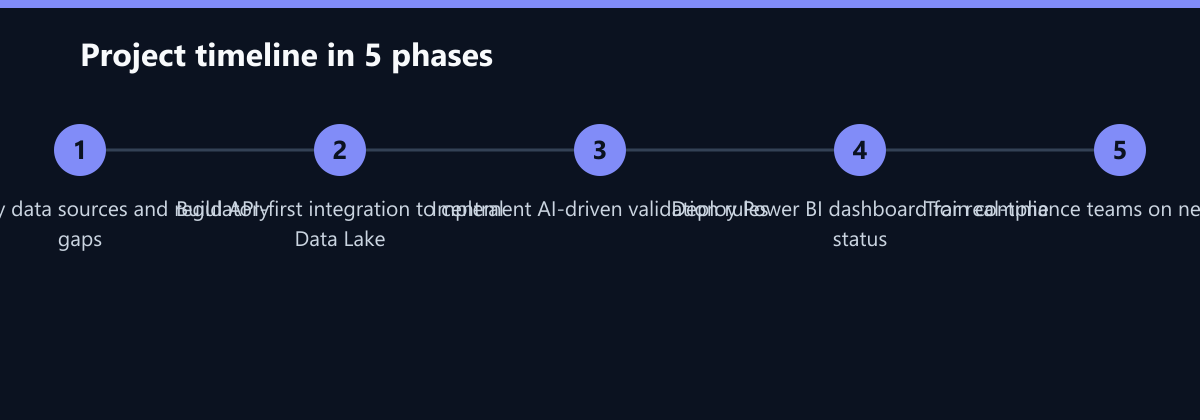
We designed a centralized compliance data platform to unify reporting workflows. The project ran over 12 weeks, divided into three distinct phases to manage risk and ensure stakeholder buy-in at each step.
Phase 1: Data Integration (Weeks 1-4)
The first four weeks were dedicated to establishing a trustworthy data foundation. We connected the legacy ERP, CRM, and trading platforms via an API-first architecture. Where APIs were not available, we implemented secure file-transfer protocols with strict validation gates. We used Apache Airflow to orchestrate daily data extraction jobs, ensuring that the Data Lake was updated in near real-time. All data was normalized and stored in a central Data Lake using Azure Synapse Analytics. This phase was critical for resolving the “inconsistent data definitions” challenge by creating a single source of truth.
Phase 2: Automation and Validation (Weeks 5-8)
With the data centralized, we built the intelligence layer. Python-based scripts were developed to map the normalized internal data to the specific templates required by FCA and BaFin. This eliminated the manual reformatting step entirely. Simultaneously, we deployed AI-driven validation rules. These rules were trained on historical submission data to detect anomalies, missing fields, or logical inconsistencies before the report was finalized. Automated alerts were created to notify the compliance team of any data quality issues immediately, rather than at the point of submission failure.
Phase 3: Dashboard and Audit Readiness (Weeks 9-12)
The final phase focused on visibility and adoption. We developed a Power BI dashboard that displayed the real-time status of all pending reports, highlighting any data quality issues or upcoming deadlines. Crucially, we integrated version control for all submitted reports. This ensured that a complete, immutable audit trail was maintained for every data change and submission. The phase concluded with comprehensive training sessions for the compliance teams, focusing on how to interpret the AI-driven alerts and how to manage the new automated workflow.
How We Measured It
To ensure the solution delivered tangible value, we established a rigorous measurement framework before the project began. We tracked three key performance indicators (KPIs) using a combination of system logs and user time-tracking surveys.
- Reporting Time: We measured the total hours spent on regulatory reporting by senior analysts. This was tracked via a time-logging tool integrated with the project management platform, comparing pre-implementation baseline (40 hours/week) against post-implementation actuals.
- First-Pass Success Rate: This metric was calculated by dividing the number of reports submitted without correction by the total number of reports submitted. This data was pulled directly from the regulatory submission portal logs and cross-referenced with our internal validation logs.
- Audit Preparation Time: We measured the duration from the receipt of an audit notice to the point where the firm was fully “audit-ready” (i.e., all data accessible, validated, and documented). This was tracked through project management tickets and internal audit checklists.
Results
After six months of operation, the new system delivered immediate and significant improvements in both efficiency and accuracy. The shift from manual to automated workflows transformed the compliance function from a reactive bottleneck into a proactive control mechanism.
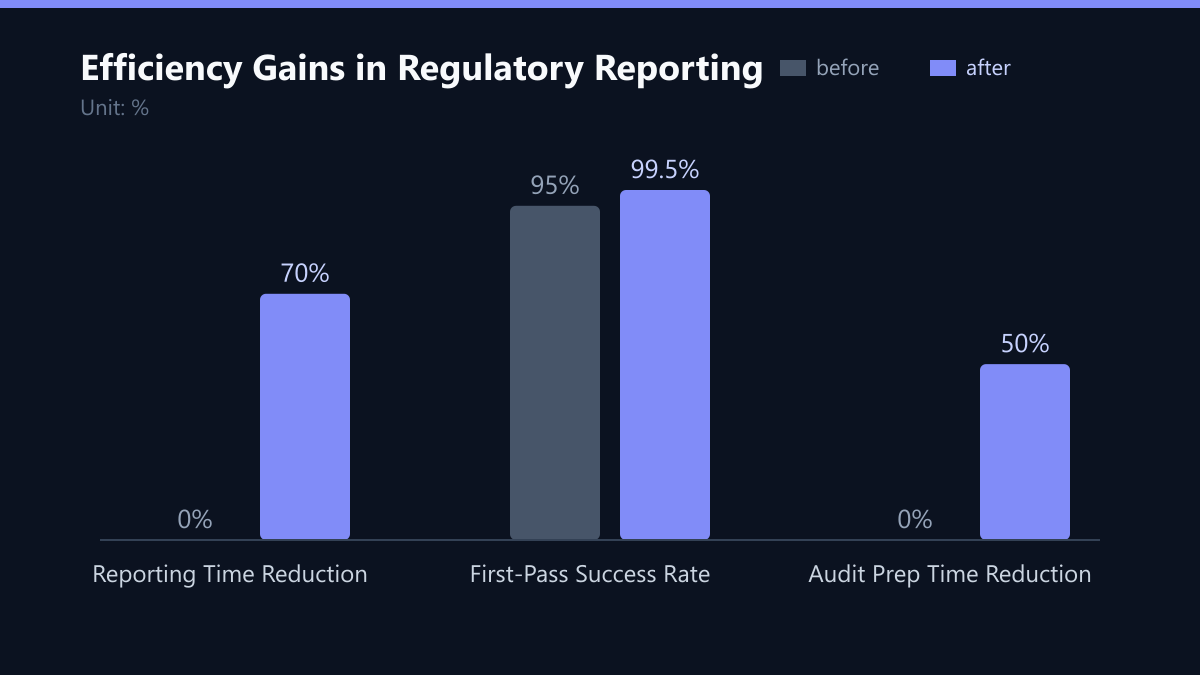
- 70% Reduction in Reporting Time: Manual effort dropped from 40 hours to 12 hours per week. This freed up senior analysts to focus on high-value strategic tasks.
- 99.5% First-Pass Success Rate: The error rate in regulatory submissions fell from 5% to 0.5%, significantly reducing the risk of regulatory penalties and reputational damage.
- 50% Faster Audit Preparation: Audit readiness time was reduced from three weeks to one week, allowing the firm to respond to regulator inquiries with speed and confidence.
- 100% Audit Trail Compliance: The implementation of version control ensured full traceability of all data changes and submissions, meeting the strictest audit requirements.
The firm now handles dual-jurisdiction reporting with a single, automated workflow. The ability to generate compliant reports for both FCA and BaFin from a single data source has eliminated the duplication of effort and reduced the risk of cross-jurisdictional inconsistencies.
Lessons Learned
This project highlighted several critical factors for successful compliance automation in financial services, particularly for firms operating across multiple regulatory borders.
- Data Quality First: Automation amplifies existing data issues. If the input data is inconsistent, the automated output will be consistently wrong. Investing in data cleansing and standardization before building workflows was essential to the project’s success.
- Regulatory Agility: Regulations are not static. Building a modular framework allowed us to adapt quickly to new FCA or BaFin requirements. When a new reporting template was introduced, we only had to update the specific mapping layer, rather than rebuilding the entire pipeline.
- Change Management: Technology alone does not drive adoption. Early involvement of compliance teams and transparent communication about how the AI-driven alerts worked were crucial. Training on the AI-driven alerts reduced resistance, as the team understood that the system was designed to assist, not replace, their judgment.
- Cross-Border Complexity: Handling UK and German regulatory differences required a unified data model with jurisdiction-specific mapping layers. This approach ensured that the core data remained consistent while allowing for the necessary variations in reporting format.
What We Would Do Differently Today
While the project was successful, there are areas where we would refine our approach in future implementations.
- Earlier AI Involvement: We would involve AI/ML specialists in the initial data assessment phase. Understanding the potential for anomaly detection earlier could have informed the data cleansing strategy more effectively.
- Phased Rollout of AI Alerts: We would start with a “shadow mode” for AI validation rules, where the system flags issues but does not block submission. This would allow the team to calibrate the sensitivity of the rules and build trust in the system before enforcing automated blocks.
- Enhanced User Feedback Loops: We would implement a more robust feedback mechanism within the dashboard, allowing compliance analysts to easily report false positives or missed issues. This data would be used to continuously retrain and improve the AI validation models.
Passend dazu
- IT Consulting & IT Strategy
- Automated Compliance Reporting: Saving Time with AI in IT Audits
- IT Compliance & Data Protection
- Cloud Services & Cloud Migration
- E-Commerce Development
- Reducing response time to critical security incidents in the Swiss financial sector to under 15 minutes
- GDPR Compliance and 45 Percent Latency Reduction in Hamburg E-Commerce Cloud Migration
- Accelerating HR Onboarding from 5 Days to 4 Hours via Workflow Automation
- NIS2 Compliance in the Machinery Industry: Avoiding Fines Through Proactive Vulnerability Management
- 7 Technical Measures for GDPR Compliance in IT Security Audits
- Compliance-automatisierung: Ein Finanzdienstleister in London erfüllt NIS2-Anforderungen in 8 Wochen durch zentralisiertes Risiko-Management
- Automated NIS2 Compliance and SIEM Integration for US Manufacturing
- Automated Clinical Data Extraction: Accelerating Trial Preparation by 30% for a Berlin-Based Biotech Startup
- Balancing Backup Retention, Compliance, and Storage Costs
- Automating IT Compliance Audits: Reduce Manual Effort by 60 Percent
- Wi-Fi 6 vs. Wi-Fi 6E: The Financial Case for Open-Plan Offices
- Scaling Monitoring for 500 Remote Employees at a London SaaS Company
- Berlin Fintech Cuts Audit Prep Time by 65% with Continuous Compliance
- Managed IT vs. In-House Teams: A Financial Breakdown
- IT Governance for Startups: Setting Up Compliance Before Series A
- Retail: Mitigating Insider Threats and Protecting PCI-DSS Compliance Across 50+ POS Terminals in Germany
- Accelerating E-Commerce Launch: Deploying Magento on Managed Kubernetes for a London Retailer
- Finance: Building a NIS2-Compliant IT-Governance Framework to Pass Audits and Reduce Risk Exposure in the EU
- Kollaborations-Setup für Kanzlei in London: Compliance-orientierte SharePoint-Architektur und Dokumentenkontrolle mit 100 Prozent Audit-Trail
- The Hidden Cost of Manual Compliance: Why Automated Audit Trails Save 20% in Audit Fees
- Why Generic Cybersecurity Courses Fail for Developers and Finance Teams