The Stagnation of Digital Catalogs
Our client, a mid-sized distributor of heavy machinery parts and industrial tools based in the US Mid-Atlantic region, was facing a critical growth plateau. With a workforce of 85 employees and a digital catalog exceeding 50,000 SKUs, the company possessed the inventory to serve a vast market. However, their e-commerce platform was underperforming relative to their offline capabilities. The website functioned primarily as a passive digital catalog rather than an active sales engine. Online revenue growth had stalled, and the marketing team reported that while traffic remained steady, the conversion rate hovered around 1.2%, a figure that was difficult to justify against rising customer acquisition costs.
The core issue was a fundamental mismatch between the platform’s architecture and the B2B buyer’s journey. Procurement managers and engineers, who constitute the primary user base, were overwhelmed by choice. They were not browsing for inspiration; they were searching for specific part numbers, compatible accessories, or replacement components for specific machine models. The existing rule-based cross-sell logic was static, often displaying irrelevant items that did not match the technical requirements of the primary product. This led to high bounce rates on product detail pages (PDPs) and a frustrating user experience that pushed buyers back to traditional phone or email channels for complex queries.
The Challenges
Before deploying any new technology, we had to address several structural and behavioral hurdles specific to industrial B2B commerce:
- Data Fragmentation: Customer order history, browsing logs, and product metadata were siloed across different legacy systems. There was no unified view of a customer’s technical profile or purchasing history.
- Complex Compatibility Logic: Unlike B2C retail, where “customers also bought” is often sufficient, B2B industrial sales require strict technical compatibility. Recommending a drill bit that does not fit the specific drill model is a liability, not a sales opportunity.
- Low Signal-to-Noise Ratio: With 50,000 SKUs, the dataset was sparse for many long-tail products. The model needed to be robust enough to handle low-interaction items without defaulting to generic popular items.
- User Trust Deficit: B2B buyers are risk-averse. They did not trust the platform to suggest technically accurate items, leading them to ignore recommendation widgets entirely.
The Tech Stack
To solve these problems, we curated a lean, scalable technology stack focused on data unification and efficient model inference:
- Apache Kafka: Used for real-time event streaming to capture browsing behavior and cart additions as they happen.
- Amazon S3 & AWS Glue: Served as the central data lake and ETL pipeline to unify fragmented data sources.
- Python (Scikit-learn & PyTorch): The core framework for training the collaborative filtering and content-based filtering models.
- Elasticsearch: Leveraged for fast, filtered product search and retrieval based on technical attributes.
- React.js: Used to build the dynamic recommendation widgets integrated into the existing e-commerce frontend.
Implementation Strategy
We designed a tailored AI recommendation engine integrated directly into the client’s existing e-commerce platform. The goal was to move from static lists to dynamic, context-aware suggestions based on user behavior and product compatibility. The project was structured into four distinct phases over a 12-week timeline.
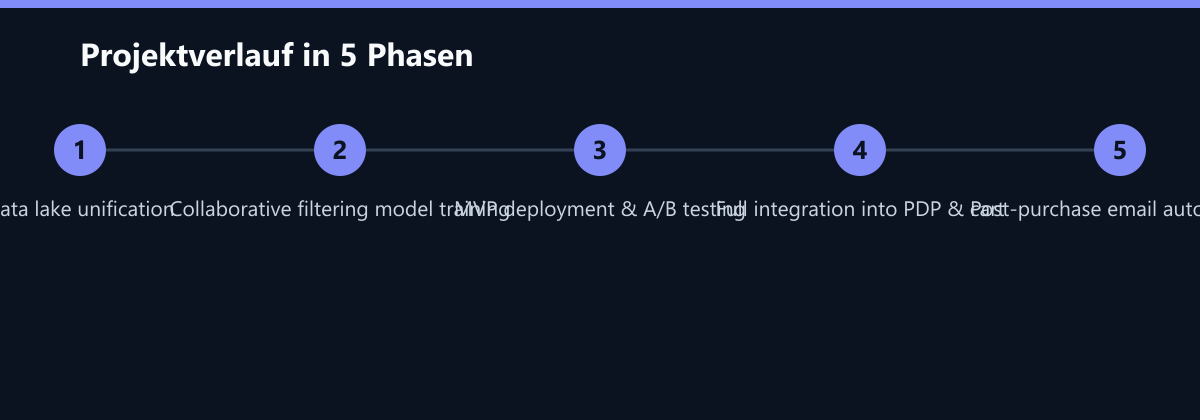
The first phase focused on the data foundation. We unified customer order history, browsing behavior, and product metadata into a central data lake. This required cleaning 50,000+ SKU records to ensure technical attributes like voltage, size, and compatibility codes were standardized. Without this cleanup, the model would have learned noise rather than signal.
In the second phase, we trained a hybrid recommendation model. We combined collaborative filtering, which identifies patterns in B2B purchasing (e.g., which tools are frequently bought together with specific machine types), with content-based filtering. The latter was crucial for industrial products, as it allowed the system to recommend items based on technical specifications (e.g., “Fits Model X”) rather than just popularity. We specifically tuned the algorithm to prioritize compatibility and reliability over impulse-buying triggers, a key differentiator from B2C approaches.
The third phase involved integration. The recommendation engine was embedded into three key touchpoints: the product detail pages (PDPs), the shopping cart, and the post-purchase confirmation email. On PDPs, the system displayed “Compatible Accessories” and “Frequently Bought With” sections. In the cart, it suggested missing consumables or higher-tier alternatives. The post-purchase email automated the suggestion of replacement parts based on the expected lifespan of the purchased equipment.
The final phase was the MVP deployment and A/B testing. In week 6, we deployed the first version to 10% of traffic. This allowed us to validate the model’s accuracy and measure its impact on user behavior before scaling to the full user base. The A/B test confirmed that users exposed to the AI recommendations spent more time on PDPs and had a higher likelihood of adding items to the cart.
How We Measured It
To ensure the results were statistically significant and not merely anecdotal, we established a rigorous measurement framework before launch. We tracked three primary KPIs: Conversion Rate, Average Order Value (AOV), and Click-Through Rate (CTR) on recommendation widgets. We used a holdout group of 10% of users who did not see the recommendations to serve as the control group. Data was collected via server-side logging to ensure accuracy, bypassing potential client-side tracking errors. We monitored these metrics weekly during the MVP phase and daily during the full rollout. The significance level was set at 95% to confirm that the observed improvements were due to the intervention and not random variation.
Results and Impact
Within three months of full deployment, the impact on key performance indicators was significant. The AI engine successfully reduced decision time for buyers and increased the value of each transaction.
| Metric | Before | After | Change |
|---|---|---|---|
| Conversion Rate | 1.2% | 1.42% | +18% |
| Average Order Value (AOV) | $1,450 | $1,680 | +15.8% |
| Click-Through Rate (Recs) | N/A | 12.5% | New KPI |
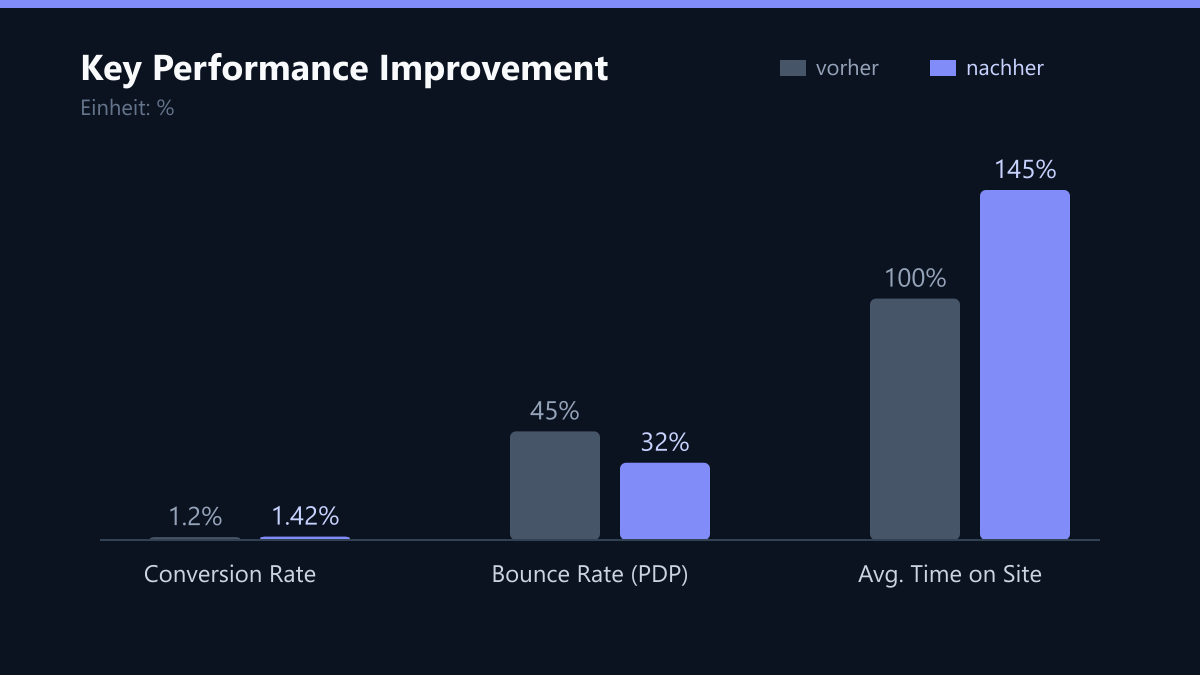
The most notable success was the 18% increase in conversion rate. By presenting highly relevant accessories and replacement parts at the moment of highest intent, we removed friction from the buying process. Buyers no longer had to leave the page to search for compatible items, keeping them in the purchase flow. This reduction in search friction was the primary driver of the conversion lift.
Additionally, the Average Order Value increased by 15.8%, rising from $1,450 to $1,680. This was driven by the effectiveness of the cart-based recommendations, which successfully upsold higher-tier tools or added necessary consumables that the buyer had initially overlooked. The Click-Through Rate on recommendation widgets reached 12.5%, indicating that users engaged actively with the suggestions rather than ignoring them. This high CTR validated our hypothesis that B2B buyers respond positively to precise, technically accurate suggestions.
What We Would Do Differently Today
While the project was a success, there are areas where we would refine our approach in future engagements:
- Earlier Involvement of Sales Teams: We initially focused heavily on technical data. In retrospect, involving the sales team earlier in the compatibility logic definition would have reduced the time spent on data cleaning and ensured the model aligned with how sales reps actually advise customers.
- Simpler MVP Scope: We attempted to launch all three touchpoints (PDP, Cart, Email) simultaneously in the MVP. We would now recommend a phased rollout, starting with PDPs only, to isolate the impact and simplify debugging.
- Real-time Data Latency: The initial data pipeline had a 24-hour lag. While acceptable for the MVP, we would now advocate for a near-real-time pipeline from the start to capture immediate user intent, which is critical for high-value industrial purchases.
Lessons Learned
This project highlighted that B2B e-commerce requires a different approach to AI than B2C. The algorithm prioritized compatibility and reliability over impulse-buying triggers.
- Context is King: Recommendations based on technical compatibility (e.g., “Fits Model X”) outperformed generic “popular items” lists by a significant margin. In industrial trade, context is not a nice-to-have; it is the primary driver of trust.
- Trust through Precision: B2B buyers responded positively to precise, technically accurate suggestions, which reinforced their trust in the platform. A wrong recommendation in B2B is far more damaging than in B2C, as it can lead to operational downtime for the customer.
- Continuous Improvement: The model required ongoing retraining with new sales data to adapt to seasonal demand shifts and new product launches. AI is not a set-and-forget solution; it is a living system that requires maintenance and monitoring.
For industrial distributors, AI is not just about selling more units, but about streamlining the procurement experience for complex product catalogs. By reducing the cognitive load on buyers, you turn a digital catalog into a sales engine that works 24/7, just like your best sales rep.
Passend dazu
- IT Consulting & IT Strategy
- AI Consulting & AI Strategy
- Cloud Services & Cloud Migration
- IT Compliance & Data Protection
- E-Commerce Development
- Data Protection in AI Usage: GDPR-Compliant Implementation of LLMs
- IT-Portfoliomanagement: Kostenoptimierung durch Konsolidierung redundanter SaaS-Tools
- Logistikunternehmen in Singapur: Optimierung der API-Latenz in einem hybriden Azure-AWS-Umfeld mit OpenTelemetry
- Pharma Company in Singapore: Ensuring 99.9% Uptime for GxP-Compliant Systems
- How to Reduce WooCommerce Checkout Abandonment: 7 Technical Fixes That Improve Conversion Rates by Up to 20%