The Operational Bottleneck
The client, a logistics and supply chain company with 180 employees operating across the DACH region, faced a growing crisis in their network infrastructure. Their distributed warehouse network, spanning Berlin and Saxony, relied heavily on legacy MPLS connections. While MPLS provided consistent performance in the past, the rapid growth of real-time applications had outpaced its capabilities. During peak dispatch hours, significant latency spikes became the norm. This was not just an IT issue; it was an operational bottleneck. Warehouse staff using real-time handheld scanners experienced delays in inventory updates, leading to frustrated operators and slowed throughput. The inability of the network to handle the surge in data traffic meant that critical business processes were directly impacted by the underlying infrastructure.
The Challenges
The core issues were multifaceted, stemming from both cost inefficiencies and technical rigidity. First, the monthly WAN costs were unsustainable due to redundant MPLS circuits that were over-provisioned for traffic that could be handled more cheaply. Second, the IT team struggled with troubleshooting. With three physical sites and static routing, diagnosing connectivity issues was a manual, time-consuming process. Third, the lack of dynamic path selection meant that if one link degraded, traffic did not reroute automatically. This rigidity caused application timeouts and data loss, directly affecting the reliability of the Warehouse Management System (WMS). Finally, there was a lack of application visibility, making it impossible to prioritize critical inventory data over less urgent traffic.
How We Measured It
To ensure the success of the project, we established a rigorous baseline before any changes were made. We used packet capture tools at each site to measure average latency, jitter, and packet loss for specific application types (WMS, ERP, VoIP). These metrics were recorded over a two-week period to capture peak and off-peak variations. For cost analysis, we audited all current ISP contracts and MPLS circuit fees, creating a detailed monthly expenditure report. Post-implementation, the same monitoring tools were deployed continuously via the central SD-WAN console, allowing us to compare real-time performance against the baseline. This data-driven approach ensured that the reported improvements were factual and verifiable.
The Tech Stack
- SD-WAN Overlay: A software-defined networking layer that abstracts the underlying transport.
- Edge Appliances: Hardware devices installed at each site to handle encryption and routing.
- Central Management Console: A cloud-based dashboard for policy configuration and monitoring.
- 5G Failover Links: Cellular connections providing high-speed backup and primary transport for non-critical traffic.
- IPsec Encryption: Standard security protocol for securing data in transit over public networks.
Implementation: Deploying Intelligent Routing
We replaced static MPLS routes with a software-defined overlay, a transition that transformed the network from a rigid pipe into an adaptive system. The project took six weeks from discovery to full rollout. We began by installing edge appliances at all three sites and configuring a central management console to oversee the entire network. This centralization allowed us to push policies globally, ensuring consistency across locations.
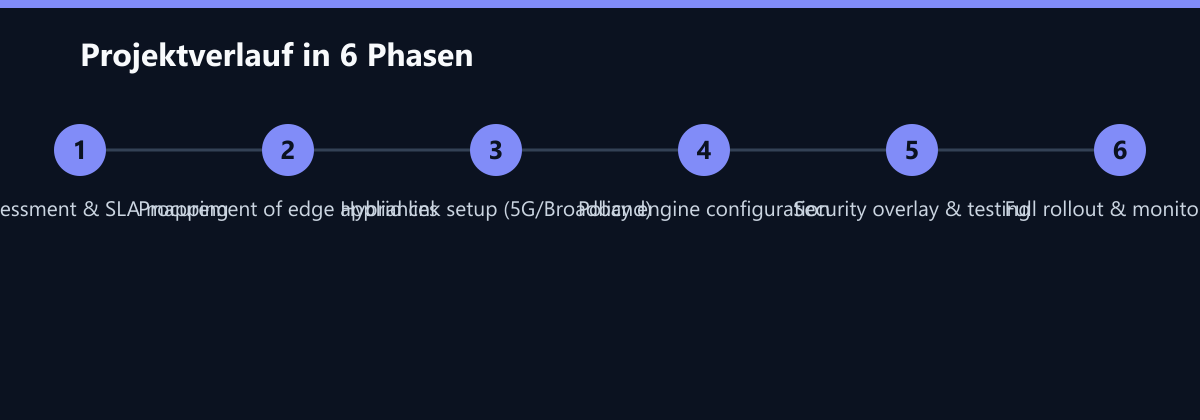
The rollout was executed in four key phases. First, we conducted a detailed site assessment, mapping critical applications like the WMS, ERP, and VoIP to their required Service Level Agreements (SLAs). This step was crucial for defining what “good” performance looked like for each app. Second, we implemented hybrid connectivity. Instead of relying solely on MPLS, we added broadband and 5G failover links. This created a multi-transport environment where the SD-WAN engine could choose the best path for each packet. Third, we configured the policy engine. This application-aware routing prioritized inventory data, ensuring that WMS transactions always took precedence over bulk file transfers. Finally, we integrated a security overlay, using IPsec encryption for all inter-site traffic. This ensured that even when traffic traveled over public broadband links, it remained secure and private.
The Results
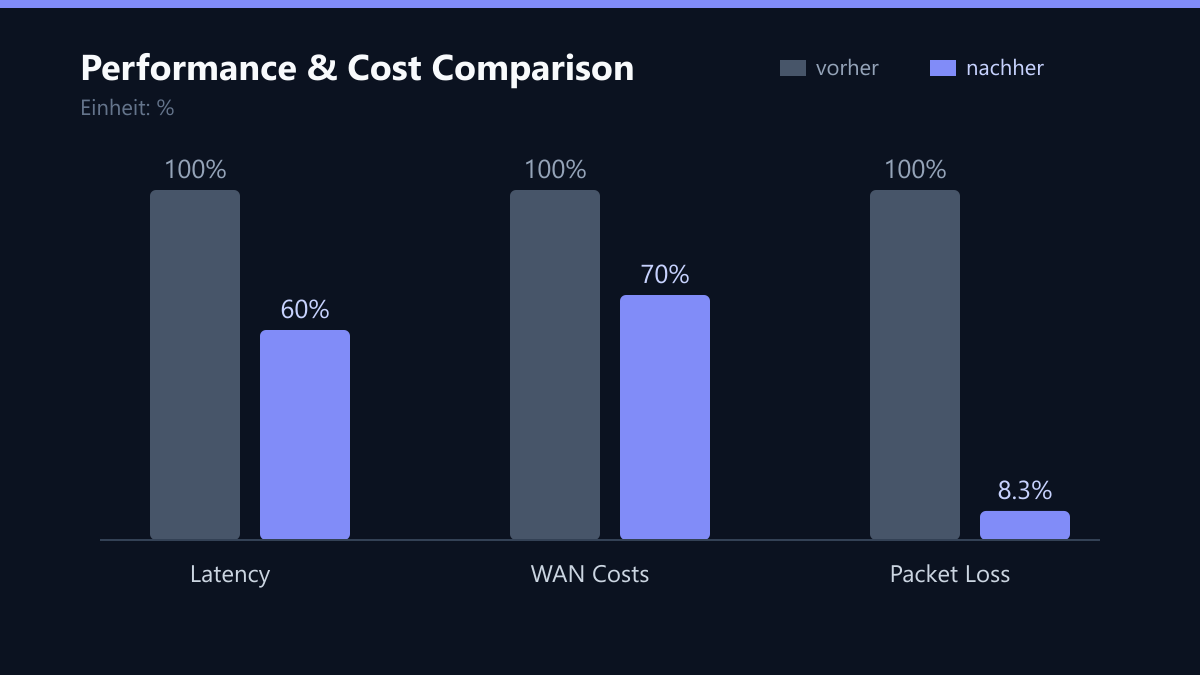
Post-implementation monitoring showed immediate and significant improvements in network stability. The intelligent routing engine dynamically shifted traffic to the fastest available path, eliminating the manual troubleshooting efforts previously required by the IT team. The results were quantifiable and substantial. The average network latency dropped from 45 ms to 27 ms, a 40% reduction. This directly improved the speed of inventory synchronization, allowing warehouse staff to work more smoothly during peak shifts. Monthly WAN costs decreased from €12,000 to €8,400, representing a 30% reduction. Packet loss, which had been a persistent issue at 1.2%, was reduced to less than 0.1%. Furthermore, the network achieved 99.9% uptime, a significant improvement in reliability. These figures were not just technical metrics; they translated directly into operational efficiency and cost savings for the business.
What We Would Do Differently Today
While the project was a success, there are areas where we would refine our approach in future engagements. First, we would invest more time in user training during the pilot phase. Although the technical implementation was smooth, some warehouse staff initially struggled with the new scanner interface behaviors, which were a side effect of the improved latency. A more focused training session would have accelerated adoption. Second, we would implement a more granular cost-monitoring dashboard from day one. While we tracked overall WAN costs, a real-time view of per-application bandwidth usage would have allowed for even more aggressive optimization of the hybrid links. Finally, we would consider a phased rollout for the 5G links, testing them in a non-critical environment first to ensure stability before relying on them for primary traffic in peak hours.
Lessons Learned
The primary lesson from this project is that MPLS alone is often overkill for non-critical traffic in modern logistics environments. Combining it with broadband and 5G provides resilience without the associated high costs. This hybrid approach allows businesses to pay for premium service only where it is truly needed, such as for ERP transactions, while using cheaper, high-speed links for other data. Application visibility is also crucial. Without the ability to identify and classify traffic, SD-WAN cannot optimize effectively. The policy engine is only as good as the data it receives. Therefore, investing in deep packet inspection and application awareness is not optional; it is a prerequisite for success. Finally, the centralization of management is key. Having a single pane of glass for all sites reduces the complexity of troubleshooting and allows for faster response times to network issues, which is critical for a 24/7 operation like logistics.
Conclusion
This case study demonstrates the tangible benefits of moving from legacy MPLS to a modern SD-WAN architecture. By reducing latency by 40% and cutting costs by 30%, the client achieved a more resilient, efficient, and cost-effective network. The project highlights the importance of a structured approach to network transformation, from baseline measurement to hybrid connectivity and intelligent routing. For logistics firms facing similar challenges, SD-WAN offers a proven path to improved operational performance and financial savings.
Passend dazu
- Data Protection in AI Usage: GDPR-Compliant Implementation of LLMs
- IT Consulting & IT Strategy
- AI Consulting & AI Strategy
- Cloud Services & Cloud Migration
- IT Compliance & Data Protection
- E-Commerce Development
- Boosting Conversion Rate by 18% Through AI-Powered Product Recommendations in a US B2B Industrial Trade Business