The Starting Point: Static Pricing in a Dynamic Market
The client, a home improvement retailer based in the Netherlands with 85 employees, operated a mid-sized online shop managing over 15,000 SKUs. Despite a solid product range, their pricing strategy was fundamentally static. A team of four analysts conducted manual reviews on a monthly basis, adjusting prices in large, infrequent batches. This approach created a significant disconnect between the retailer’s pricing and the real-time market conditions.
The core issue was responsiveness. Competitors in the home improvement sector were adjusting prices daily, reacting to stock levels, seasonal trends, and competitor moves within hours. The client, however, lagged by two to four weeks. This delay resulted in significant margin leakage during peak demand periods, where prices were set too low, and over-discounting during slow weeks, where demand was lower than anticipated. The reliance on manual spreadsheet management was not only slow but also error-prone. The analysts could not effectively account for complex variables such as real-time inventory levels, competitor stock availability, or granular seasonal demand spikes. The result was a pricing model that was reactive rather than proactive, leaving money on the table every month.
The Challenges
Before deploying any technology, we had to address three concrete operational hurdles that would have doomed a simple automation attempt.
- Data Fragmentation: Product data was spread across multiple legacy systems. Inventory levels in the Warehouse Management System (WMS) did not always sync in real-time with the Magento frontend, leading to potential overselling or outdated stock signals for the AI.
- Competitor Data Noise: Initial scraping of competitor sites revealed inconsistent data structures. Some competitors changed prices via JavaScript, others via static HTML, leading to false positives in early testing.
- Analyst Resistance: The four-person pricing team was skeptical of AI replacing their judgment. They feared losing control over strategic categories, which required a careful change management strategy alongside the technical rollout.
The Tech Stack
To solve these issues, we built a custom solution using a hybrid approach that combined rule-based logic with machine learning.
- Magento 2: The core e-commerce platform where price updates were executed via API.
- Python: Used for data ingestion, cleaning, and the core logic of the AI agents.
- PostgreSQL: Stored historical sales data, inventory snapshots, and competitor price logs for model training.
- Scrapy: A web crawling framework used to monitor the top 50 competitors in real-time.
- React Dashboard: A custom internal tool for the pricing team to monitor AI decisions and approve outliers.
Implementation: Building the AI Pricing Engine
We deployed a custom AI agent system integrated directly into the client’s Magento backend. The system was designed to ingest data from three primary sources: internal inventory levels, competitor price feeds, and historical sales velocity. The entire implementation, from initial data preparation to full production launch, took eight weeks. This timeline was aggressive but necessary to capture the upcoming seasonal peak.
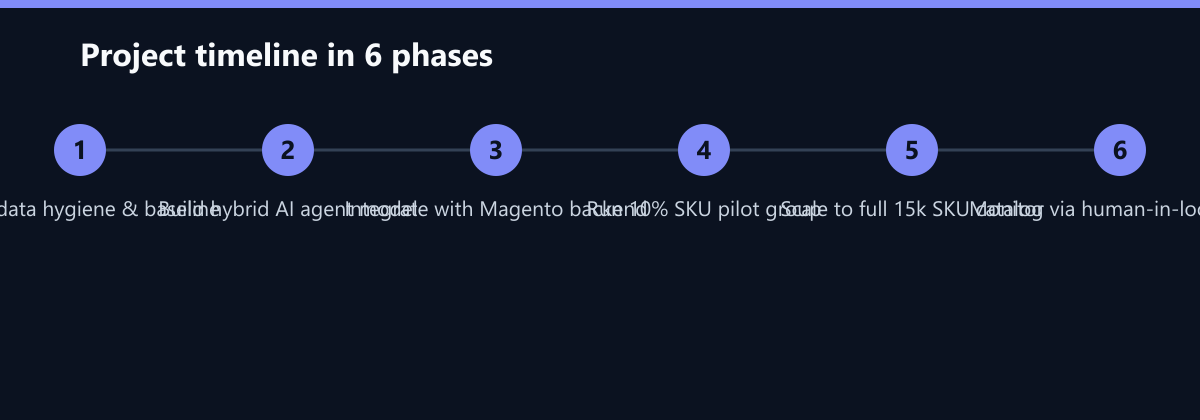
The AI agents operated on a rule-based hybrid model, designed to mimic the best decisions of human analysts while adding the speed of automation. The system comprised three core modules:
- Competitor Monitoring: The system performed real-time scraping of the top 50 competitors. It detected price changes within minutes, allowing the client to react to market shifts almost instantly. This module used a weighted average of competitor prices rather than a simple lowest-price match to avoid a race to the bottom.
- Inventory Logic: This module applied automatic price increases for low-stock items to reduce clearance risk. Conversely, for items with high stock aging over 60 days, the system suggested aggressive discounts to accelerate cash flow.
- Demand Forecasting: Machine learning models predicted weekly demand shifts based on historical data, day-of-week patterns, and local weather data (relevant for home improvement). This allowed the system to adjust pricing proactively before a demand spike occurred.
Crucially, human oversight was maintained through a governance layer. A custom dashboard flagged any price change exceeding a 15% deviation from the base price for manual approval. This ensured that the AI did not make catastrophic errors on high-value items or strategically sensitive categories. The team could also override the AI’s recommendations with a simple click, providing a safety net during the learning phase.
How We Measured It
To ensure the results were not just anecdotal, we established a rigorous measurement framework before the pilot began. We used a control group approach, comparing the performance of the AI-managed SKUs against a baseline period of static pricing.
- Gross Margin: Calculated as (Revenue - Cost of Goods Sold) / Revenue. We compared the average monthly gross margin of the first six months post-deployment against the same period in the previous year.
- Operational Efficiency: We tracked the time spent by analysts on manual price updates. This was measured via time-tracking software and validated through weekly interviews. The baseline was 40 hours per week spent on data entry and spreadsheet adjustments.
- Conversion Rate: Measured as the percentage of sessions that resulted in a purchase. We monitored this closely to ensure that dynamic pricing did not alienate customers. The baseline was established over the three months prior to implementation.
- Stock Turnover: Calculated as Cost of Goods Sold / Average Inventory. This metric helped us determine if the AI’s clearance pricing strategies were effectively reducing aging stock.
The Outcomes
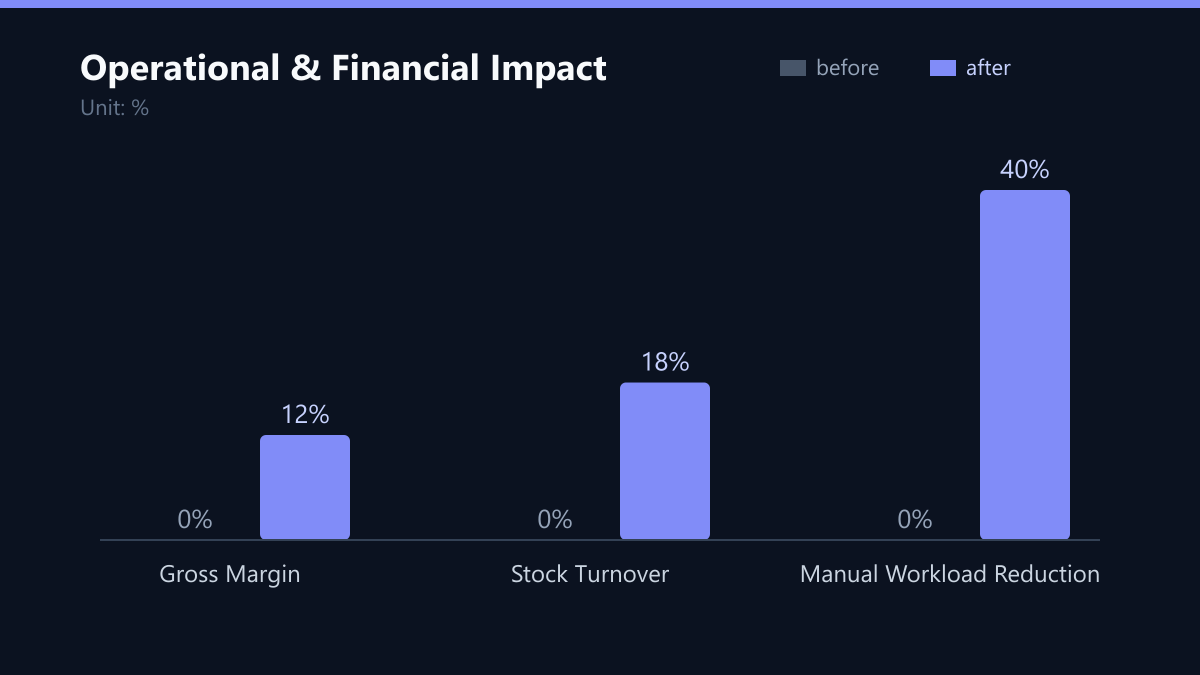
Within six months of deployment, the dynamic pricing engine delivered measurable improvements across key financial and operational metrics. The system successfully balanced price competitiveness with margin protection, eliminating the need for static discount campaigns that had previously eroded brand value.
The most significant impact was seen in profitability. The Gross Margin increased by 12% compared to the previous static pricing period. This was achieved not by raising prices arbitrarily, but by capturing value during high-demand windows and reducing unnecessary discounts during low-demand periods.
Operational efficiency saw a dramatic shift. The manual pricing workload was reduced by 40 hours per week. The four analysts were freed from the drudgery of data entry and spreadsheet management. Instead, they focused on strategy, analyzing the AI’s performance reports and adjusting the rules for specific product categories. This shift in role was critical for team morale and long-term sustainability.
Customer acceptance remained strong. The Conversion Rate remained stable at 3.2%, proving that dynamic adjustments did not negatively impact customer behavior. The subtle, real-time nature of the price changes meant that customers did not perceive them as aggressive or unfair. They simply saw competitive pricing that reflected current market conditions.
Finally, inventory management improved. Stock Turnover improved by 18% due to smarter clearance pricing on aging inventory. The AI identified slow-moving items earlier and applied targeted discounts to clear them before they became dead stock. This freed up warehouse space and capital for faster-moving products.
Lessons Learned and What We Would Do Differently
The success of this project hinged on data hygiene and human-in-the-loop governance. Clean, structured product data was critical for the AI to make accurate recommendations. Without it, the agents would have produced erratic pricing behavior. We learned that spending time on data cleaning in the first two weeks of the project was not overhead but a necessary investment.
Additionally, trust in the system grew gradually. Starting with a 10% pilot group of SKUs allowed the client to validate the AI’s logic before scaling to the full catalog. This phased approach minimized risk and ensured that the technology served the business goals rather than disrupting them. The pilot phase revealed that certain categories, such as branded tools, required different elasticity thresholds than generic accessories.
If we were to repeat this project today, we would make two changes. First, we would integrate the AI pricing engine with the customer relationship management (CRM) system from the start. This would allow for personalized pricing strategies based on customer lifetime value, a feature that was added as a later enhancement. Second, we would invest more in the visualization of the decision-making process. While the dashboard showed the what (the price change), it did not clearly explain the why (the specific factors that influenced the decision). Better explainability would have accelerated analyst trust and adoption even further.
This case demonstrates that AI in e-commerce is not about replacing humans, but about augmenting their capabilities. By handling the repetitive, data-heavy aspects of pricing, the AI allowed the team to focus on the strategic, high-value work that drives long-term business growth.
Passend dazu
- E-Commerce Development
- Magento / Adobe Commerce
- Cloud Services & Cloud Migration
- GDPR Compliance and 45 Percent Latency Reduction in Hamburg E-Commerce Cloud Migration
- Reducing Support Work by 40 Percent: AI Triage in E-Commerce for a German Magento Retailer
- Achieving 99.99 Percent Uptime: Redundant Server Infrastructure for a US Manufacturing Company
- Prozessautomatisierung im Kundenservice eines britischen E-Commerce-Unternehmens: Senkung der Ticket-Arbeit durch KI-Chatbots
- Accelerating E-Commerce Launch: Deploying Magento on Managed Kubernetes for a London Retailer