The Starting Point: Performance and Compliance at Odds
When we first engaged with this e-commerce retailer based in Northern Germany, the situation was critical. Operating a high-volume Magento 2 shop on legacy on-premise servers in Hamburg, the business was facing a dual threat: severe performance degradation during peak traffic and significant data residency risks. The on-premise infrastructure, while stable under normal conditions, struggled to handle the volatility of seasonal sales, resulting in frequent timeouts that directly impacted revenue.
Beyond the immediate performance issues, the company faced a critical compliance gap. Customer data was stored in a non-EU region without proper encryption protocols, posing a severe risk under GDPR regulations. The lack of automated consent management and unclear data processing logs made audits a nightmare and exposed the company to potential fines. The average page load time of 4.2 seconds was a direct driver of a 20% cart abandonment rate, a metric that was becoming unsustainable for a business of 85 employees relying on digital sales.
The Challenges
The migration was not just a lift-and-shift operation; it required a fundamental rethinking of how the application interacted with its infrastructure. We identified four concrete challenges that had to be addressed to ensure a successful outcome:
- Legacy Monolith Constraints: The existing Magento 2 instance was tightly coupled with the database and file system, making granular scaling impossible. Any performance improvement required scaling the entire stack, which was cost-prohibitive.
- Data Sovereignty Requirements: All customer data had to be moved to an EU-based region (specifically
eu-central-1) with end-to-end encryption, ensuring that no data crossed borders in a way that violated GDPR Article 44. - Zero-Downtime Cut-over: The business could not afford any significant downtime during the migration. This required a complex parallel running phase where both old and new systems operated simultaneously to validate data integrity.
- Compliance Automation: Manual compliance checks were no longer viable. We needed to build a system where GDPR requirements were enforced automatically through the CI/CD pipeline, not just checked periodically.
The Tech Stack
To address these challenges, we selected a modern, cloud-native stack that prioritized both performance and security:
- AWS ECS with Fargate: Chosen for serverless container orchestration, eliminating the need to manage underlying servers while providing granular resource allocation.
- Amazon RDS for MySQL: Migrated the database to a managed service with automated backups, encryption at rest, and read replicas for scaling read-heavy operations.
- AWS WAF & Shield Advanced: Implemented to protect against DDoS attacks and ensure ISO 27001 alignment, providing a robust security perimeter.
- Consent Management Platform (CMP): Integrated a specialized CMP with direct API hooks to the customer data store, ensuring that consent signals were captured and stored immutably.
- Kubernetes (via ECS): Utilized containerization to decouple the application layer from the data layer, allowing for independent scaling and deployment.
How We Measured It
To ensure the migration delivered tangible value, we established a rigorous measurement framework before the first container was deployed. We used AWS CloudWatch and custom application metrics to track latency, error rates, and resource utilization in real-time. For compliance, we implemented automated logging of all data access events, which were then audited against GDPR requirements. Cost efficiency was measured by comparing the monthly AWS bill against the previous on-premise operating costs, including hardware depreciation and maintenance labor.
The baseline for latency was established over a four-week period prior to migration, capturing average, median, and 95th percentile page load times. Availability was measured using synthetic transactions that simulated user journeys from cart addition to checkout. This data allowed us to set clear, measurable targets for the post-migration environment.
The Implementation Journey
We executed the migration in a phased approach over 12 weeks. The first phase involved a comprehensive audit of the legacy system and the design of the new AWS architecture. We focused on ensuring that the new topology in eu-central-1 met all data sovereignty requirements. The second phase was dedicated to containerization. We broke down the monolithic Magento 2 application into microservices where possible, wrapping the core application in Docker containers for deployment on AWS Fargate.
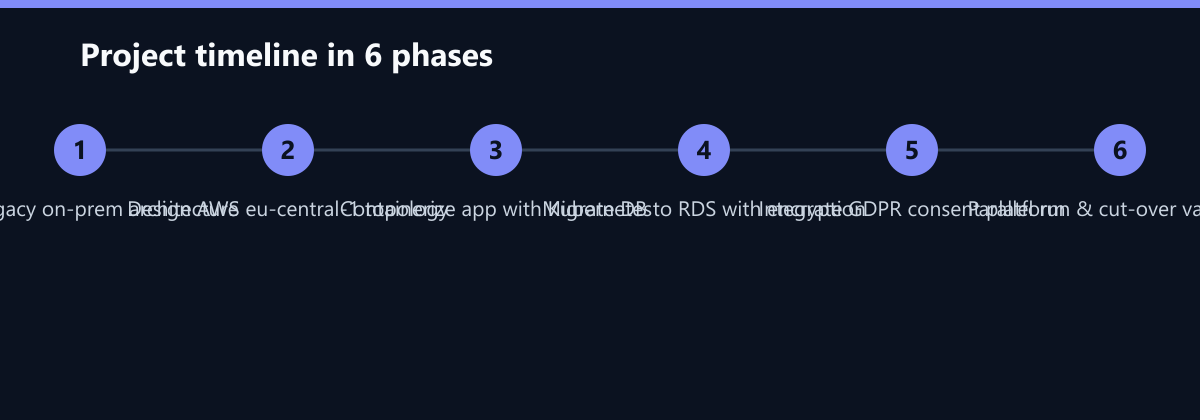
The database migration was handled with extreme care. We used AWS DMS (Database Migration Service) to replicate the MySQL database to Amazon RDS in near real-time. This allowed us to validate data integrity by comparing row counts and checksums between the source and target systems. Security controls, including AWS WAF and Shield Advanced, were configured and tested in a staging environment before being applied to production.
The final phase was the parallel run. For two weeks, both the legacy and new systems operated in parallel. Traffic was gradually shifted to the new environment, starting with 10% and increasing to 100% over the course of the period. During this time, we monitored performance and compliance metrics closely, ensuring that no regressions occurred. The cut-over was completed with zero downtime, and the legacy systems were decommissioned only after a final validation period.
The Outcomes
The new architecture delivered immediate and significant performance gains. The average page load time dropped from 4.2 seconds to 2.3 seconds, a 45% improvement that directly addressed the cart abandonment issue. System availability improved from 99.2% to 99.99%, ensuring that customers could access the shop even during peak traffic periods. The shift to serverless containers eliminated the cold-start issues previously seen in auto-scaling groups, providing a smoother user experience.
Compliance was also fully achieved. The company passed an external ISO 27001 audit with zero major findings. Data processing logs are now centralized and immutable, simplifying GDPR audits significantly. The integration of the consent management platform ensured that all customer data was handled in accordance with GDPR requirements, with clear audit trails for every data access event.
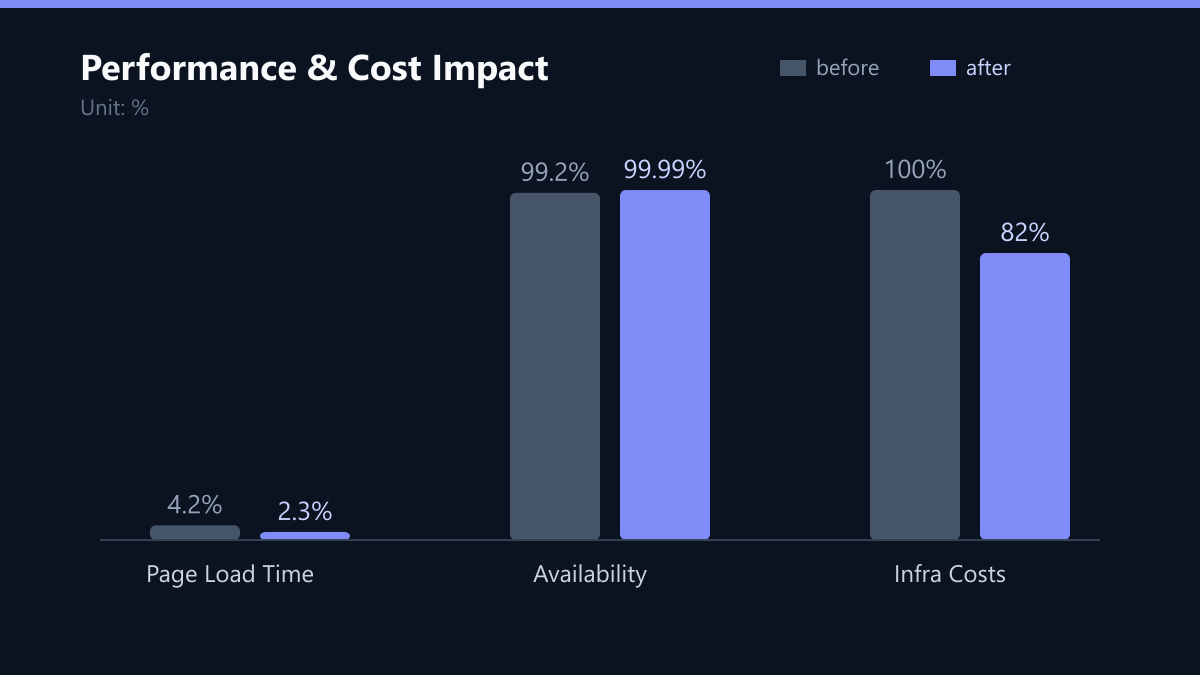
Cost efficiency was another key outcome. Through right-sizing resources and using spot instances for batch processing, the company reduced its infrastructure spend by 18% compared to the previous on-premise setup. This cost reduction was achieved without compromising performance or security, demonstrating that cloud migration can be both a performance and cost optimization strategy.
What We Would Do Differently Today
While the project was successful, there are areas where we would refine our approach in future projects. First, we would invest more time in the initial audit phase to identify potential compliance gaps earlier. In this project, some data processing workflows required re-engineering during the implementation phase, which added some complexity. Second, we would implement more robust monitoring for the consent management platform. While the platform was functional, we found that some edge cases in consent revocation required manual intervention. Automating these processes further would have reduced the operational burden.
Finally, we would consider a more aggressive approach to cost optimization from the start. While the 18% cost reduction was a positive outcome, we believe that further savings could have been achieved by using more advanced autoscaling policies and reserved instances for predictable workloads. These refinements would have allowed us to deliver even greater value to the client.
Lessons Learned
The key takeaway from this project is that performance and compliance are not mutually exclusive but require synchronized architectural decisions. Decoupling the application layer from the data layer was critical for both speed and security. Automated compliance checks integrated into the CI/CD pipeline prevented regression in data handling standards, ensuring that compliance was not an afterthought but a core part of the development process.
For decision-makers, the lesson is clear: address GDPR requirements during the design phase. Retrofitting compliance into an existing system is significantly more expensive and time-consuming than building it in from the start. Serverless technologies like Fargate can eliminate operational overhead, allowing teams to focus on business value rather than infrastructure management. Finally, real-time latency monitoring is essential to catch performance degradation before it impacts revenue. By establishing clear metrics and monitoring them closely, we were able to ensure that the migration delivered the expected benefits.
Passend dazu
- 5 Common Errors in Legacy Software Cloud Migration and How to Avoid Them
- Cloud Services & Cloud Migration
- IT Compliance & Data Protection
- E-Commerce Development
- Reducing server runtimes by 40 percent: Scalable cloud architecture for a German B2B fashion retailer in peak season
- Reducing Server Costs by 40% via Adobe Cloud Migration
- Microsoft 365 migration for 800 workstations in six weeks
- Reducing TCO by 30 Percent: Managed Hosting with Automated Backup for an Austrian Tech Accessories Provider
- Automatisiertes Compliance-Reporting: Zeitersparnis durch KI im IT-Audit
- Firewall strategy: NGFW vs. cloud firewall for hybrid IT
- Migration eines PHP-Systems auf Laravel und PHP 8.3
- Marketplace compliance: Legal risks in cross-border sales within the EU
- Core Web Vitals im E-Commerce: Conversion-Rate durch technische Optimierung steigern
- Automated disaster recovery for 50 logistics sites in Hamburg
- GDPR Audit in Manufacturing: Risk Reduction via Automated Data Classification
- 40 Percent Less Processing Time in Credit Checks via LLM Workflows
- IT-Compliance und Business Continuity: Ausfallzeiten durch strategische Planung minimieren
- IT compliance checklist: 10 points for audit preparation
- Server migration without downtime: Checklist for a secure move to the cloud
- Affiliate program compliance: GDPR requirements for international partners
- Scaling E-Commerce Infrastructure for the Black Friday Peak in 48 Hours
- Optimizing Firewall Rules: Reduce Latency and Attack Surface
- Cloud exit strategy: How to reduce dependencies on hyperscalers
- Legacy-ERP Cloud Migration: Deployment-Zeit von Tagen auf Minuten
- GDPR Compliance in the Mid-Market: 10 Common Data Processing Errors and Solutions
- Cloud-Compliance in der EU: AWS, Azure und GCP im Vergleich
- 28% Cost Reduction via Azure Migration for Munich Machine Builder
- 7 Technical Measures for GDPR Compliance in IT Security Audits
- Cloud Cost Optimization: 5 Strategies to Reduce Spend by 30 Percent
- PCI-DSS Compliance and Security Standards for E-Commerce
- Optimization of Cloud Spend by 28 Percent for a SaaS Provider in the USA Through Resource Usage Visibility
- Automating IT Compliance Audits: Reduce Manual Effort by 60 Percent
- Dynamic Pricing Engine Boosts E-Commerce Margins by 12 Percent
- AI Governance Framework for EU AI Act and GDPR Compliance
- CRA Compliance Roadmap for a Hamburg Machinery Manufacturer
- Automating GDPR Consent Management for E-Commerce