The Starting Point: Regulatory Pressure Meets Fragmented IT
For a mid-sized asset management firm in Frankfurt with 350 employees, the transition from legacy IT controls to NIS2 compliance was not just a regulatory checkbox; it was an existential threat to operational stability. The company managed complex portfolios of client data, making it a high-value target for cyber threats. However, internal audits revealed a troubling reality: security controls were fragmented across on-premise and cloud environments, incident response was reactive rather than proactive, and vendor risk management was largely manual and inconsistent.
The CIO faced a hard deadline. The next regulatory review was imminent, and the existing infrastructure lacked the centralized visibility required to demonstrate adequate protection of critical assets. The risk of significant fines and reputational damage was not hypothetical; it was a tangible threat looming over the firm’s operational continuity. The core issue was not a lack of security tools, but a lack of a unified governance framework that could tie them together into a coherent, auditable narrative.
The Challenges
To understand the scope of the intervention, we identified three specific, concrete challenges that had persisted for years:
- Silos in Security Monitoring: Logs from endpoints, cloud services, and network devices were stored in disparate systems. There was no single pane of glass for the security team, making it nearly impossible to correlate events across the hybrid environment. This siloed approach meant that a multi-stage attack could easily slip through the cracks, as no single tool had the full context.
- Manual and Inconsistent Access Controls: While some departments had implemented Multi-Factor Authentication (MFA), it was not enforced uniformly across all Microsoft 365 and on-premise systems. Access reviews were conducted manually, leading to inconsistencies and potential orphaned accounts that posed significant insider threat risks.
- Absence of a Tested Incident Response Playbook: The firm had a theoretical incident response plan, but it had never been tested under realistic conditions. When a minor security event occurred, the response time averaged four hours due to unclear roles and lack of automated alerting. This delay was unacceptable under NIS2 standards, which demand rapid detection and reporting.
The Tech Stack
We selected a technology stack that prioritized integration, automation, and scalability. Each tool was chosen to address a specific gap in the existing infrastructure:
- Azure Sentinel: Deployed as the central SIEM (Security Information and Event Management) platform to aggregate and correlate logs from all endpoints and cloud services.
- Microsoft 365 Defender: Integrated with Sentinel to provide endpoint detection and response (EDR) capabilities, ensuring real-time threat detection on all user devices.
- Power BI: Used to create automated compliance dashboards that visualize risk metrics, audit readiness, and incident trends for executive stakeholders.
- Python Scripts: Custom automation scripts were developed to streamline data collection for regulatory reports, reducing manual effort and minimizing human error.
- Standardized Vendor Scoring Model: A custom-built framework for assessing third-party service providers, integrated into the overall risk management process.
Implementation: A 12-Week Structured Approach
The implementation was executed in a phased, 12-week cycle, ensuring that each component was deployed, tested, and integrated before moving to the next. This structured approach minimized disruption to daily operations while maximizing progress toward compliance.
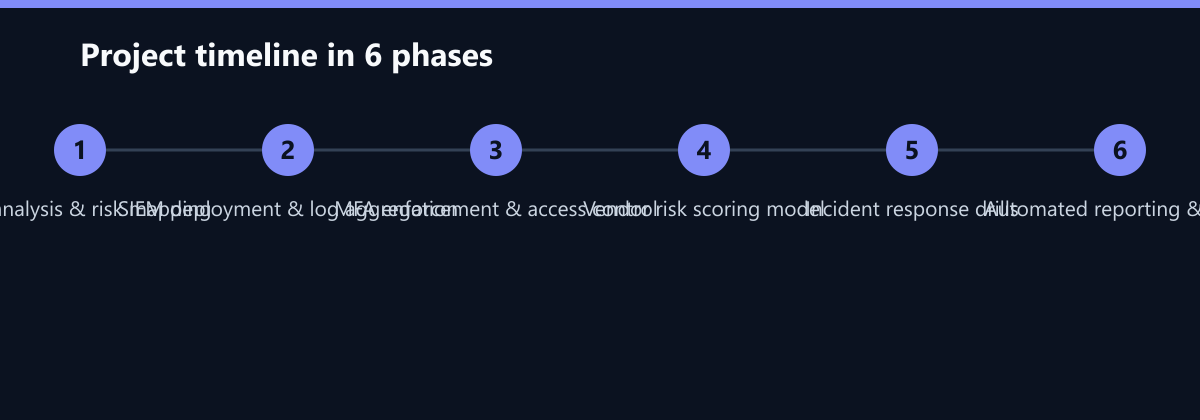
Phase 1: Gap Analysis and Baseline (Weeks 1-2) We began with a comprehensive gap analysis against NIS2 requirements. This involved mapping existing controls, identifying vulnerabilities, and establishing a baseline for key performance indicators. The team conducted interviews with key stakeholders to understand pain points and define success criteria. This phase was critical for gaining buy-in from the executive team and ensuring that the project aligned with business objectives.
Phase 2: Centralized Logging and SIEM Deployment (Weeks 3-5) The core of the implementation was the deployment of Azure Sentinel. We integrated log sources from all endpoints, cloud services, and network devices. This required configuring data connectors, normalizing log formats, and setting up correlation rules. The goal was to create a single source of truth for security events, enabling the team to see the full picture of their security posture.
Phase 3: Access Control and MFA Enforcement (Weeks 6-7) With centralized logging in place, we turned our attention to access control. We enforced MFA across all Microsoft 365 and on-premise systems. This involved working with IT teams to configure conditional access policies, ensuring that MFA was required for all sensitive resources. We also implemented automated access reviews, using Python scripts to identify and revoke orphaned accounts.
Phase 4: Vendor Risk Management and Incident Response (Weeks 8-10) In this phase, we established a standardized scoring model for third-party service providers. This model assessed vendors based on their security practices, compliance certifications, and incident history. We also developed and tested a NIS2-specific incident response plan. This included defining roles and responsibilities, establishing communication protocols, and conducting quarterly drills to ensure that the team could respond effectively to real-world scenarios.
Phase 5: Automated Reporting and Audit Preparation (Weeks 11-12) The final phase focused on automating compliance reporting. We developed Power BI dashboards that provided real-time visibility into key metrics, such as incident response time, risk findings, and audit readiness. We also used Python scripts to automate the collection of data for regulatory reports, reducing the time spent on manual data collection. This phase culminated in a mock audit, where we tested the entire framework against NIS2 requirements to ensure that the firm was ready for the external review.
How We Measured It
To ensure that the implementation delivered tangible results, we defined a set of key performance indicators (KPIs) and established a rigorous measurement methodology. These KPIs were tracked before, during, and after the implementation to provide a clear picture of the impact.
- Audit Compliance: Measured by the percentage of NIS2 core requirements that were fully met. This was assessed through a combination of internal audits and external reviews.
- Risk Findings: Tracked the number of high-severity security findings identified during internal and external audits. This metric provided a clear indication of the reduction in risk exposure.
- Incident Response Time: Measured the average time from incident detection to resolution. This was tracked using the SIEM platform and incident management tools.
- Manual Reporting Time: Assessed the time spent on manual data collection for regulatory reports. This was measured by comparing the time taken before and after the implementation of automated scripts.
The Results
The new framework delivered measurable improvements in security posture and operational efficiency. The firm successfully passed its external NIS2 audit with zero critical findings, a testament to the thoroughness of the implementation. The KPIs showed significant progress in risk mitigation and response times, validating the effectiveness of the structured approach.
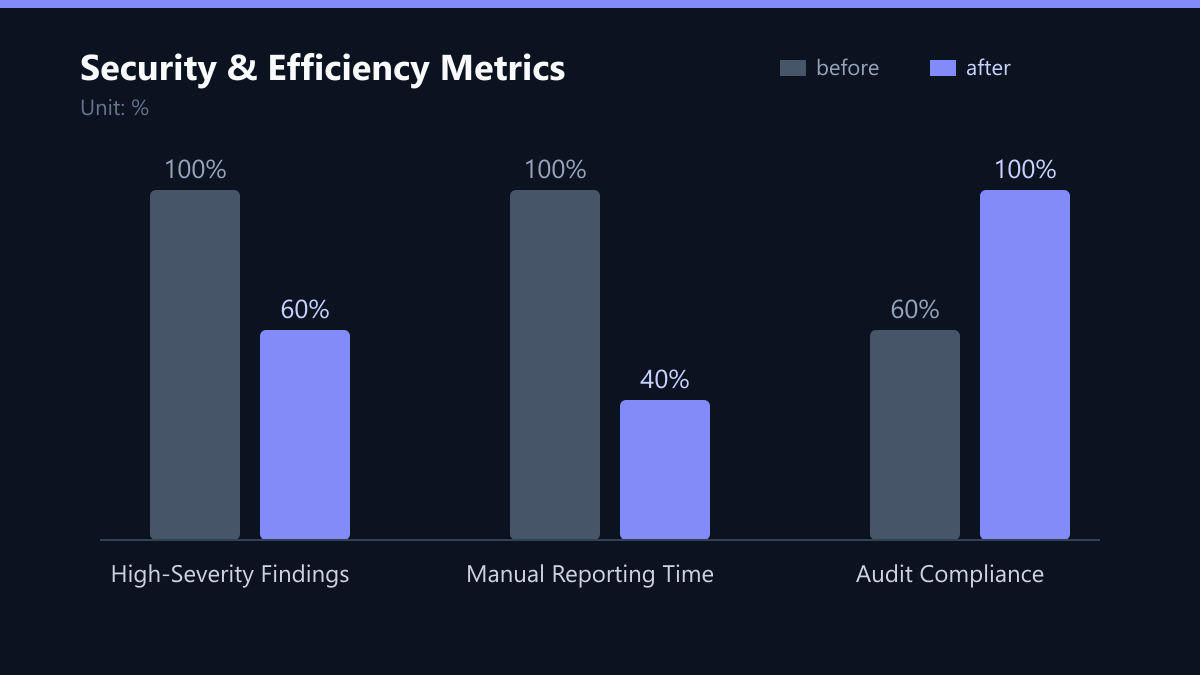
- 100% NIS2 Compliance: The firm met all core NIS2 requirements, ensuring that it was fully prepared for regulatory scrutiny.
- 40% Reduction in High-Severity Findings: The number of high-severity security findings decreased by 40%, indicating a significant improvement in the firm’s security posture.
- 45-Minute Incident Response Time: The average incident response time was reduced from four hours to 45 minutes, a dramatic improvement that demonstrated the effectiveness of the automated alerting and response processes.
- 60% Reduction in Manual Reporting Time: The time spent on manual compliance reporting was reduced by 60%, freeing up valuable resources for other strategic initiatives.
What We Would Do Differently Today
While the project was a success, we identified areas where we could improve our approach for future implementations:
- Earlier Stakeholder Engagement: We could have engaged key stakeholders more early in the process to ensure that their needs and concerns were fully addressed. This would have helped to build stronger buy-in and reduce resistance to change.
- More Phased Rollout: We could have rolled out the MFA enforcement in a more phased manner, allowing users to adjust to the new requirements gradually. This would have reduced the initial friction and improved user adoption.
- Continuous Training: We could have provided more continuous training and awareness programs to ensure that employees understood their roles in security. This would have helped to create a stronger security culture within the organization.
Lessons Learned
Compliance is not a one-time project but a continuous process. Automation is essential for maintaining NIS2 standards at scale, especially as the threat landscape evolves. Clear documentation and regular training ensure that employees understand their roles in security, fostering a culture of accountability and responsibility. Proactive monitoring transforms security from a cost center into a strategic asset, enabling organizations to respond quickly to threats and demonstrate their commitment to protecting client data. The success of this project underscores the importance of a structured, data-driven approach to compliance, where every decision is backed by evidence and every action is measured for its impact.
Passend dazu
- Cloud Services & Cloud Migration
- IT Compliance & Data Protection
- IT & Data Recovery (Disaster Recovery)
- Accelerating Compliance Audits in the Financial Sector
- Intelligent Document Routing for a Zurich Insurance Firm: Deploying AI Classification to Reduce Misfiled Claims by 95 Percent
- Automated NIS2 Readiness Checks Cut Audit Time by 40 Percent
- Compliance-automatisierung: Ein Finanzdienstleister in London erfüllt NIS2-Anforderungen in 8 Wochen durch zentralisiertes Risiko-Management