The Silent Killer of AI Initiatives: The Sandbox Trap
In the mid-market, AI is often treated as a shiny new toy rather than a core business process. The result? Most initiatives stagnate in the pilot phase, dying not from technical impossibility, but from strategic ambiguity. Without a clear path to production, stakeholders lose interest, budgets get reallocated, and the project is quietly shelved. The gap between a proof of concept and a scalable solution is frequently cited as a technical hurdle, but in reality, it is primarily a governance and strategy failure.
To understand why this happens, we must look at the root causes. Projects lacking clear executive sponsorship struggle to secure resources. Data remains trapped in departmental silos, preventing a unified view of the business. Furthermore, the quick-and-dirty code written for a pilot rarely has the robustness to handle production loads. These are not just technical issues; they are symptoms of a missing roadmap.
Failure 1: Vague Business Objectives
The most common reason for failure is starting with the technology instead of the problem. If the business case is not quantified, the project will lack the necessary support to survive budget cycles. You must define specific Key Performance Indicators (KPIs) before writing a single line of code. For example, if the goal is to reduce customer service wait times, define the current baseline (e.g., 12 minutes) and the target (e.g., 4 minutes). Without these concrete numbers, success is subjective, and funding is at risk.
- Define the Problem: What specific pain point does the AI solve? Is it speed, accuracy, or cost reduction?
- Quantify the ROI: How much time or money will be saved? Use concrete financial figures, not assumptions.
- Identify the Stakeholder: Who benefits directly from the outcome? Ensure they are actively involved.
Failure 2: Poor Data Quality and Accessibility
AI models are only as good as the data they consume. Many pilots fail because the training data is incomplete, biased, or inaccessible due to legacy systems. A scalable roadmap requires a robust data foundation from day one. If your data is scattered across Excel sheets, legacy ERPs, and email inboxes, no AI model can perform reliably. You must treat data preparation as a first-class engineering task, not an afterthought.
- Data Audit: Assess the quality, completeness, and structure of your current data. Identify gaps early.
- Integration Strategy: Plan how data will flow from source systems to the AI platform. Use APIs or ETL pipelines.
- Governance: Establish rules for data ownership, privacy, and access control to comply with regulations.
Failure 3: Ignoring Integration and Scalability
A pilot that works in isolation is useless in a real-world environment. It must integrate seamlessly with existing ERP, CRM, and workflow tools. Scaling from a single user to the entire organization requires a fundamentally different architecture. If your AI solution is a standalone script, it will break under load. You need an API-first approach that allows the AI service to be called by other applications as a microservice.
- API-First Approach: Build the AI service as a microservice that can be called by other applications.
- Load Testing: Simulate peak usage to ensure the system does not crash. Test for 10x your expected traffic.
- Latency Requirements: Define acceptable response times for real-time applications. Aim for sub-second responses where possible.
Failure 4: Lack of Change Management
Even the best AI model will fail if employees do not trust it or do not know how to use it. Resistance to change is a human factor that technical teams often overlook. You need a clear communication plan and training program. If end-users feel the AI is a threat rather than a tool, they will find workarounds, rendering the investment worthless. Involve users early in the design process to build trust and ownership.
- Stakeholder Buy-in: Involve end-users early in the design process. Show them the value before launch.
- Training: Provide hands-on workshops to build confidence and competence. Offer role-specific training.
- Feedback Loops: Create channels for users to report issues and suggest improvements. Act on this feedback.
Failure 5: Inadequate Monitoring and Maintenance
AI models degrade over time as data patterns change. This is known as model drift. Without continuous monitoring, the model’s accuracy will drop, leading to poor decisions and user distrust. Production AI requires ongoing maintenance, not just a one-time deployment. You must track performance metrics in real-time and have automated processes for retraining the model when drift is detected.
- Performance Monitoring: Track accuracy, precision, and recall in real-time. Set up alerts for degradation.
- Data Drift Detection: Alert the team when input data deviates from the training distribution.
- Retraining Schedule: Automate the process of retraining the model with fresh data. Use CI/CD for ML.
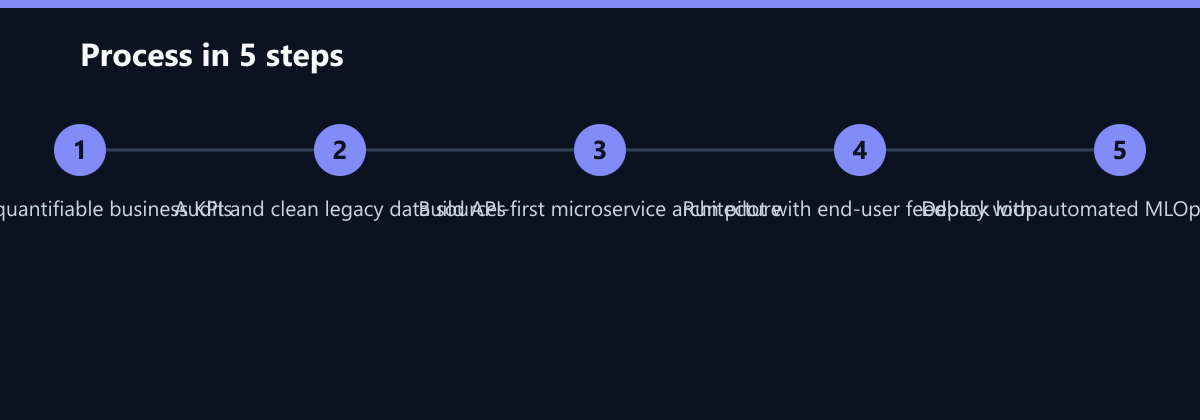
Building a Scalable Production Roadmap
To avoid these failures, structure your AI initiative as a continuous delivery pipeline. This approach ensures that the model is always up-to-date, secure, and aligned with business goals. The roadmap should be iterative, with clear milestones and exit criteria. Do not try to boil the ocean. Start small, prove value, and then scale.
Phase 1: Discovery and Data Readiness
Validate the business case and prepare the data infrastructure. This phase should take 4–6 weeks. The goal is to ensure that the data is clean, accessible, and that the business case is solid. Exit criteria: Signed-off business case and data audit report.
Phase 2: Pilot and Validation
Build the MVP, test with a small user group, and measure KPIs. This phase should take 6–8 weeks. The goal is to prove that the AI works in a controlled environment and delivers the promised value. Exit criteria: KPIs met and user feedback is positive.
Phase 3: Production Deployment
Integrate into core systems, scale infrastructure, and launch to all users. This phase should take 4–6 weeks. The goal is to make the AI solution available to the entire organization. Exit criteria: System is live and stable for 2 weeks.
Phase 4: Optimization and Expansion
Monitor performance, refine the model, and explore new use cases. This is an ongoing phase. The goal is to continuously improve the AI solution and expand its reach. Exit criteria: Continuous improvement cycle is established.
Typical Mistakes to Avoid
- Over-Engineering the Pilot: Spending too much time making the pilot perfect instead of learning from it. Keep the pilot simple and fast.
- Ignoring Data Privacy: Failing to anonymize or secure data can lead to compliance issues and loss of trust. Always involve legal and compliance teams early.
- No Exit Strategy: If the pilot fails, you should have a clear plan for what happens next. Do not let a failed pilot become a black hole for resources.
- Underestimating Change Management: Assuming that users will automatically adopt the new tool. Plan for training and support from day one.
How You Measure Success
Success is not just about technical performance. It is about business impact. Here are the KPIs you should track:
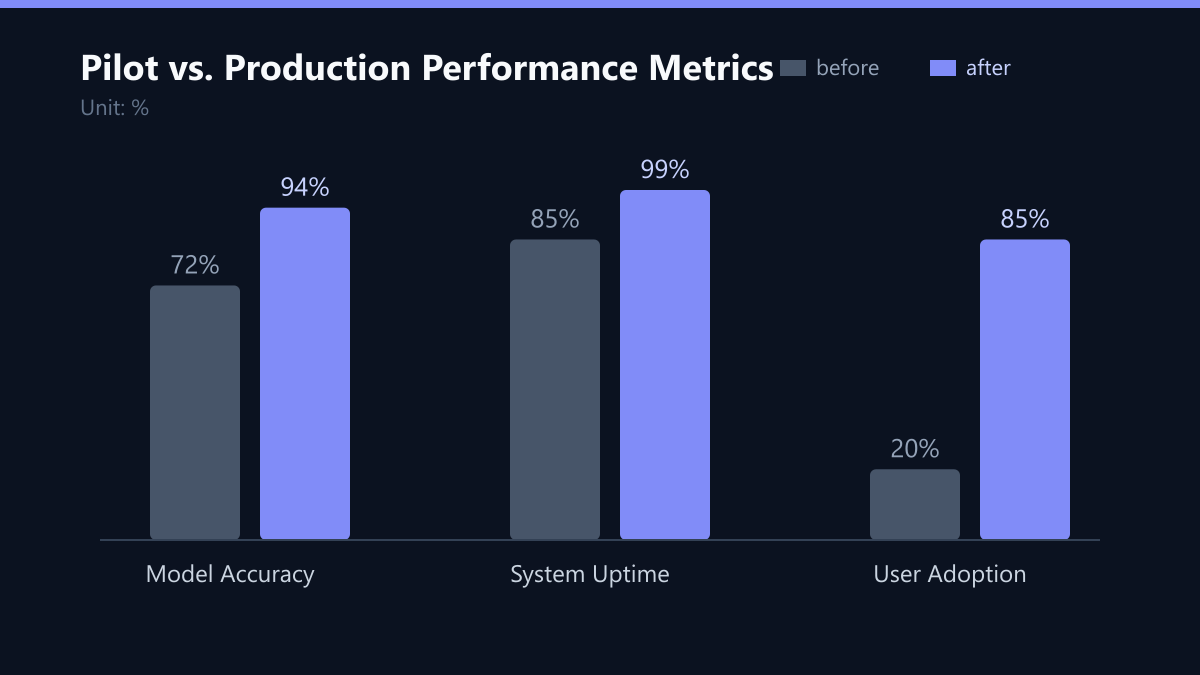
- Model Accuracy: The percentage of correct predictions. Target: >90% for critical tasks.
- System Uptime: The percentage of time the system is available. Target: >99.5%.
- User Adoption: The percentage of target users who actively use the tool. Target: >80%.
- Time Saved: The amount of time saved per task. Target: 50% reduction in manual effort.
- Cost Reduction: The reduction in operational costs. Target: 20% reduction in relevant costs.
To measure these, use a combination of automated monitoring tools and user surveys. Review these KPIs monthly and adjust the roadmap as needed.
Checklist for Your AI Roadmap
- Business Case Approved: Is the ROI clearly defined and approved by the C-suite?
- Data Audit Complete: Have you assessed the quality and accessibility of your data?
- Architecture Designed: Is the solution built as an API-first microservice?
- Pilot Tested: Have you tested the solution with a small user group?
- Monitoring Set Up: Do you have real-time monitoring and alerts in place?
- Training Provided: Have you trained the end-users on how to use the tool?
- Feedback Loop Established: Do you have a process for collecting and acting on user feedback?
- Retraining Automated: Is the model retrained automatically when data drift is detected?
By following this roadmap, you can avoid the common pitfalls of AI pilots and build a scalable, production-ready solution that delivers real business value. Remember, AI is not a magic bullet. It is a tool that requires careful planning, execution, and maintenance. Start with a clear business problem, build a solid data foundation, and focus on continuous improvement. This is the path from experiment to enterprise value.
Passend dazu
- Cloud Services & Cloud Migration
- IT Compliance & Data Protection
- IT & Data Recovery (Disaster Recovery)
- The CIO’s Guide to Building a Scalable IT Roadmap for the Next Three Years
- AI Strategy in the Mid-Market: From Pilot to Production Scaling in 90 Days
- Aligning Your 3-Year IT Roadmap with Business Growth Targets
- 5 Common Bottlenecks in Manual Data Entry and How to Automate Them Safely
- RPA Roadmap: Planning Backoffice Automation in 90 Days