The Disconnect: Why Siloed IT Planning Stalls Growth
Most IT departments operate in isolation, prioritizing technical stability over business outcomes. This disconnect creates a dangerous gap: IT budgets are consumed by maintenance, yet market opportunities are missed. A 3-year roadmap is not just a technical document; it is a strategic bridge that links every server, software license, and security protocol to a specific business KPI. Without this translation layer, IT remains a cost center. With it, IT becomes a growth engine. The core problem is often a lack of shared language between C-level strategy and IT execution. This guide provides a structured method to reverse that dynamic, ensuring that your technology investments directly support your revenue targets.
Translating Business Goals into Technical Requirements
The first step is to stop talking about “better software” and start talking about business outcomes. Document your top three business objectives for the next 36 months. These might include entering new markets, increasing operational efficiency, or launching new digital products. Each of these goals must have a corresponding, specific IT enabler.
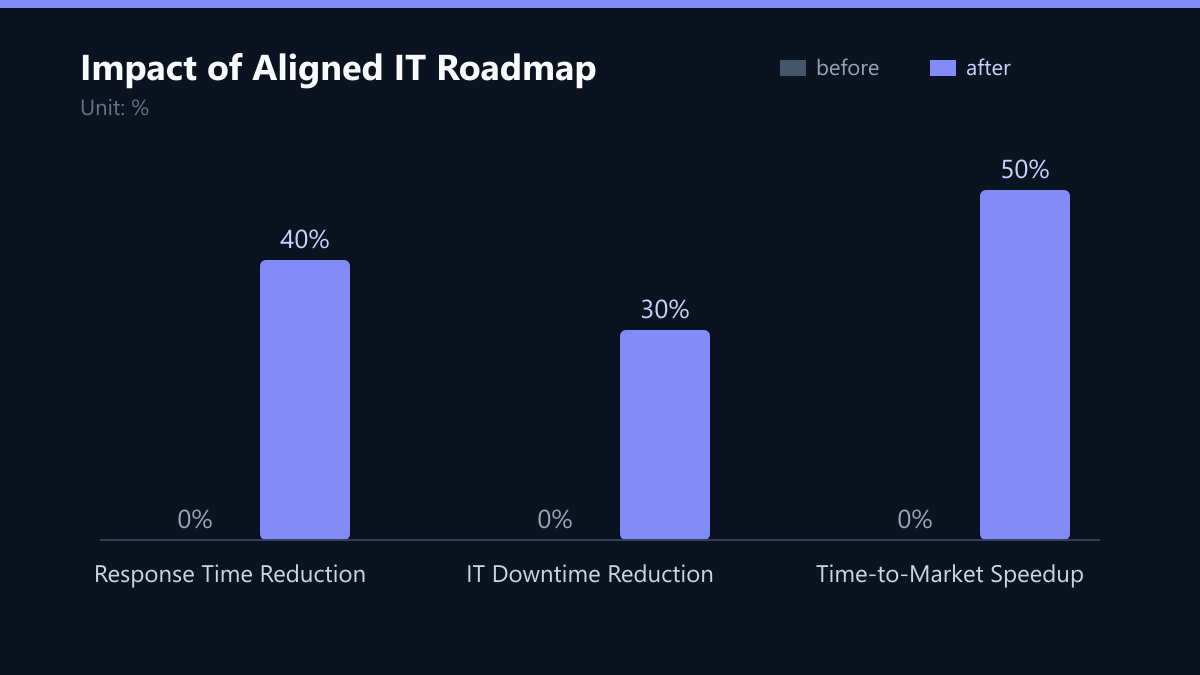
Consider a common scenario: a company aims to reduce customer response time by 40%. A vague IT requirement might be “upgrade our CRM.” A precise, value-driven requirement is “implementation of an AI-driven CRM integration with automated ticket routing.” This precision prevents projects that consume budget without delivering measurable value. It forces the IT team to design solutions that directly address the business pain point.
- Revenue Growth: Requires scalable infrastructure and marketing automation to handle increased lead volumes.
- Operational Efficiency: Needs process automation and data consolidation to reduce manual effort.
- Market Expansion: Demands localized compliance and multi-region hosting to meet regulatory requirements in new territories.
Structuring the 3-Year Phases for Risk Management
A 3-year roadmap is a phased approach, not a static document. It allows for adjustment as market conditions change. The structure is designed to manage risk and align with cash flow projections.
Year 1: Foundation and Quick Wins This phase focuses on stabilizing the core. You establish the security baseline, conduct a process audit, and begin cloud migration. The goal is reduced downtime and improved compliance. This creates a stable platform for future growth.
Year 2: Scaling and Integration With the foundation in place, you focus on scaling. This includes automation of key processes, implementation of data analytics, and team expansion. The business impact is increased throughput and better decision-making capabilities.
Year 3: Innovation and Competitive Advantage In the final year, you target innovation. This is where you integrate AI, launch new product platforms, and invest in R&D. The goal is to create new revenue streams and differentiate your market position.
| Phase | Focus Area | Key Activities | Business Impact |
|---|---|---|---|
| Year 1 | Foundation | Cloud migration, security baseline, process audit | Reduced downtime, improved compliance |
| Year 2 | Scaling | Automation, data analytics, team expansion | Increased throughput, better decision making |
| Year 3 | Innovation | AI integration, new product platforms, R&D | New revenue streams, market differentiation |
Selecting High-Impact Initiatives
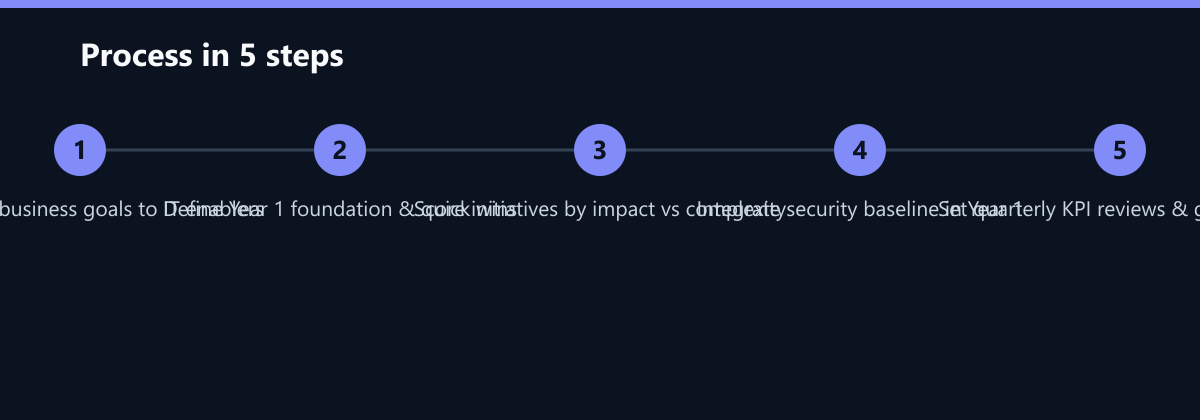
Not all IT projects are created equal. You must select initiatives that offer the highest return on investment relative to their complexity. Use a simple scoring matrix to evaluate potential projects. Consider factors like implementation time, total cost of ownership, and strategic alignment.
Prioritize projects that remove bottlenecks in your value chain. For instance, if sales teams spend 20% of their time on manual data entry, automating this process directly impacts revenue capacity. Avoid “nice-to-have” technologies that do not tie back to a core business metric. Use this matrix to categorize your projects:
- High Impact / Low Complexity: Implement immediately. These are your quick wins.
- High Impact / High Complexity: Plan carefully with a phased rollout. These are your major strategic bets.
- Low Impact / Low Complexity: Defer or automate later. These are low priority.
- Low Impact / High Complexity: Reject or re-evaluate. These are often budget traps.
Building a Resilient Security and Compliance Base
Growth without security is a liability. As you scale, your attack surface expands. Your roadmap must include a dedicated track for cybersecurity and compliance, particularly if you operate in the DACH region or handle EU data. Adhering to standards like ISO 27001 or NIS2 is not just regulatory; it is a sales enabler for enterprise clients.
Integrate security into every phase, not as an afterthought. This means including penetration testing in Year 1, automated threat monitoring in Year 2, and advanced AI-driven defense in Year 3. This proactive approach prevents costly breaches that can derail growth plans.
- Year 1: Establish baseline controls and employee training.
- Year 2: Implement continuous monitoring and incident response plans.
- Year 3: Adopt zero-trust architecture and automated compliance reporting.
Typical Mistakes to Avoid
- Vague Requirements: Defining IT projects without linking them to specific business KPIs leads to scope creep and wasted budget.
- Ignoring Legacy Systems: Failing to assess legacy systems in Year 1 creates technical debt that slows down Year 2 scaling efforts.
- Security as an Afterthought: Adding security only at the end of the project timeline increases costs and risks non-compliance.
- Static Planning: Treating the roadmap as a fixed document prevents adaptation to market changes or new opportunities.
How You Measure Success
A roadmap without measurement is just a wish list. Define clear KPIs for each initiative. These should be tied to business outcomes, such as “reduce IT downtime by 30%” or “decrease time-to-market for new features by 50%.” Review these metrics quarterly to ensure the IT department remains aligned with business realities.
Establish a governance structure that includes IT leaders, business unit heads, and finance. This cross-functional review ensures that IT spending is transparent and justified. It also allows for rapid pivots if market conditions change, ensuring your 3-year plan remains relevant and effective.
- Quarterly Reviews: Check progress against milestones.
- Annual Reassessment: Adjust strategy based on market shifts.
- Stakeholder Feedback: Incorporate user experience and operational insights.
Checklist for Your 3-Year IT Roadmap
- Identify Top 3 Business Goals: Document your primary objectives for the next 36 months.
- Map IT Enablers: Link each business goal to a specific technical requirement.
- Define Phases: Outline Year 1 (Foundation), Year 2 (Scaling), and Year 3 (Innovation) activities.
- Score Initiatives: Use a matrix to prioritize projects based on impact and complexity.
- Integrate Security: Plan security milestones for each year, starting with baseline controls.
- Set KPIs: Define measurable success indicators for each initiative.
- Establish Governance: Create a cross-functional review structure for quarterly and annual assessments.
Passend dazu
- IT Consulting & IT Strategy
- AI Consulting & AI Strategy
- Cloud Services & Cloud Migration
- IT Compliance & Data Protection
- IT & Data Recovery (Disaster Recovery)
- Social Engineering Defense: 5 Practical Drills to Test Your Team’s Resilience
- 5 Signs Your Helpdesk Is Bottlenecking Your Business Growth and How to Fix It
- Why Your IT Helpdesk Needs a Cybersecurity Focus