The Invisible Drain on Your Budget
Many mid-sized companies treat IT support as a static overhead line in their financial statements. This perspective is dangerously incomplete. When IT support operates reactively, the true cost extends far beyond the monthly invoice. It manifests as lost productivity, delayed revenue-generating projects, and elevated security risks that can threaten the company’s survival.
Reactive models create a vicious cycle of emergency fixes. Each crisis consumes senior engineering hours that should be dedicated to value-adding initiatives like digital transformation or product development. This shift from planned maintenance to crisis management is the primary driver of hidden costs that rarely appear on the P&L but significantly impact the bottom line.
- Unplanned downtime disrupts core workflows and delays critical business activities.
- Emergency interventions often trigger higher hourly rates, overtime costs, or premium support fees.
- Lack of documentation leads to repeated errors, longer resolution times, and knowledge silos.
Bottlenecking Talent with Trivial Tickets
If your staff spends significant time waiting for simple IT fixes, your support model is fundamentally failing. Basic tasks like password resets, email configuration, or printer issues should be resolved within minutes, not days. When these low-level tickets consume a disproportionate amount of support resources, you are effectively paying senior engineers to perform administrative tasks.
When Level 1 issues are not automated or filtered, senior engineers become tied up with trivial tasks. This bottleneck prevents the resolution of complex, high-impact problems that drive business value. The result is a team that feels overwhelmed and a business that feels stalled.
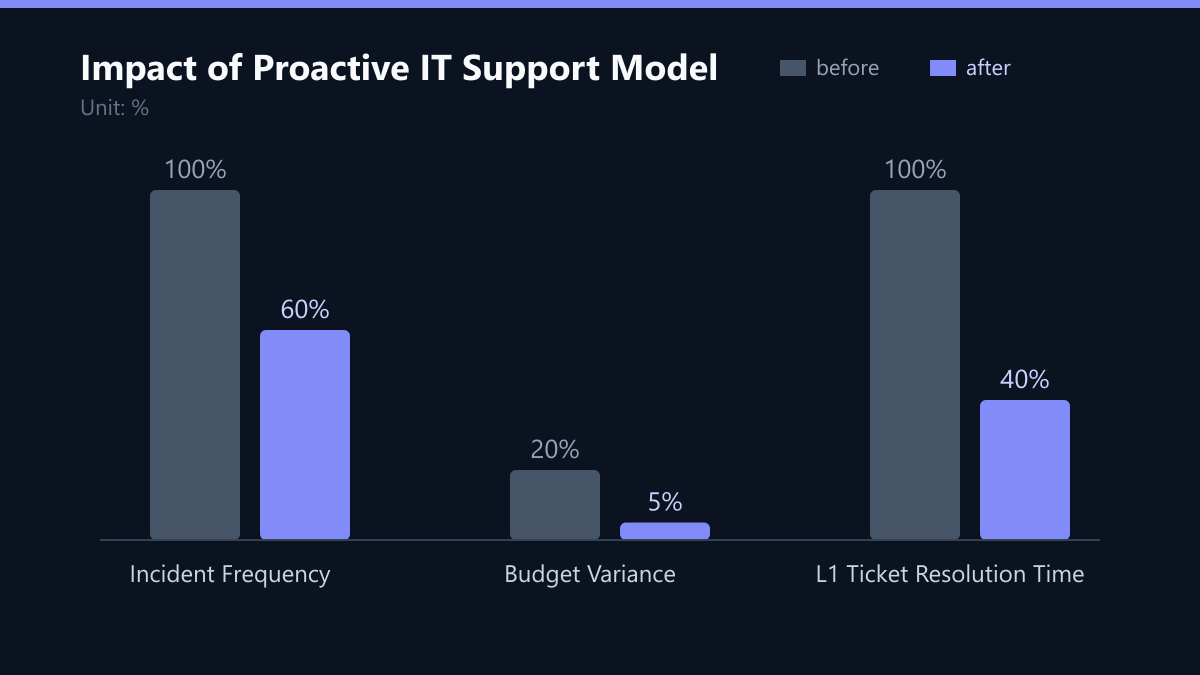
- Average resolution time for Level 1 tickets frequently exceeds 4 hours in inefficient models.
- Repeat tickets for the same issue indicate a lack of root cause analysis and proper documentation.
- Employee satisfaction with IT support often scores below 70% when basic needs are not met quickly.
Unpredictable and Inflated IT Budgets
A healthy IT support model offers predictable costs that allow for accurate financial planning. If your monthly IT spend fluctuates wildly without clear reasons, you lack visibility into your infrastructure. Surprise invoices for hardware, software licenses, or emergency services are a major red flag indicating a lack of control.
Opaque pricing structures make it difficult to forecast expenses. Without a clear breakdown of services, you cannot identify where money is being wasted. This unpredictability complicates financial planning, budget approval processes, and strategic forecasting. You should never have to guess what your IT bill will be at the end of the month.
- Monthly variance in IT spend often exceeds 20% without documented cause in reactive models.
- Lack of detailed reporting on service usage and costs prevents cost optimization.
- Frequent out-of-scope charges for basic maintenance tasks indicate poor contract management.
Security Incidents and Compliance Gaps
IT support is the first line of defense against cyber threats. If you experience frequent security alerts, successful phishing attempts, or compliance violations, your support model is not proactive enough. Security should be integrated into daily operations, not treated as a separate, afterthought project that only gets attention during audits.
Proactive security involves continuous monitoring, automated patch management, and regular user training. When these elements are missing, your organization remains vulnerable to evolving threats. The cost of a single data breach, including legal fees, fines, and reputational damage, far exceeds the annual cost of a robust security-focused support model.
- Patch compliance often falls below 95% across critical systems in reactive environments.
- Regular audit failures for GDPR, NIS2, or ISO 27001 signal systemic gaps in security operations.
- Lack of real-time monitoring for network anomalies and threats leaves blind spots for attackers.
Lack of Strategic IT Roadmap
IT support should align with business goals, not just keep the lights on. If your IT provider cannot discuss your growth plans, digital transformation, or scalability needs, they are merely a vendor, not a partner. A strategic roadmap ensures that IT investments drive tangible business value rather than just maintaining the status quo.
Strategic alignment means IT initiatives support expansion, new product launches, or market entry. Without this, you risk accumulating technology debt and making misaligned investments. Your IT team should be involved in business planning, not just ticket resolution. They need to understand the context behind the requests they handle.
- No annual IT strategy review or planning session exists.
- Technology decisions are made in isolation from business objectives.
- Inability to scale infrastructure without major downtime or cost spikes hinders growth.
Poor Communication and Lack of Transparency
Effective IT support requires clear, regular communication. If you have to chase your IT provider for status updates or explanations, you lack control. Transparency builds trust and ensures that you are getting value for your money. You should always know what is being done, why, and when it will be resolved.
Regular reporting and proactive communication are essential. Without them, you cannot measure performance or hold the provider accountable. This lack of visibility often leads to dissatisfaction, eroded trust, and eventual contract termination. You need a partner who communicates before you ask, not after you complain.
- No regular service reports or performance dashboards are provided.
- Slow response times to inquiries and status updates create frustration.
- Lack of a dedicated account manager for strategic discussions limits partnership depth.
Implementing the Proactive Shift
Identifying these signs is the first step toward cost optimization and improved efficiency. Transitioning to a proactive, managed IT support model requires a shift in mindset. You move from paying for incidents to investing in stability, security, and growth. This is not just an IT project; it is a business strategy.
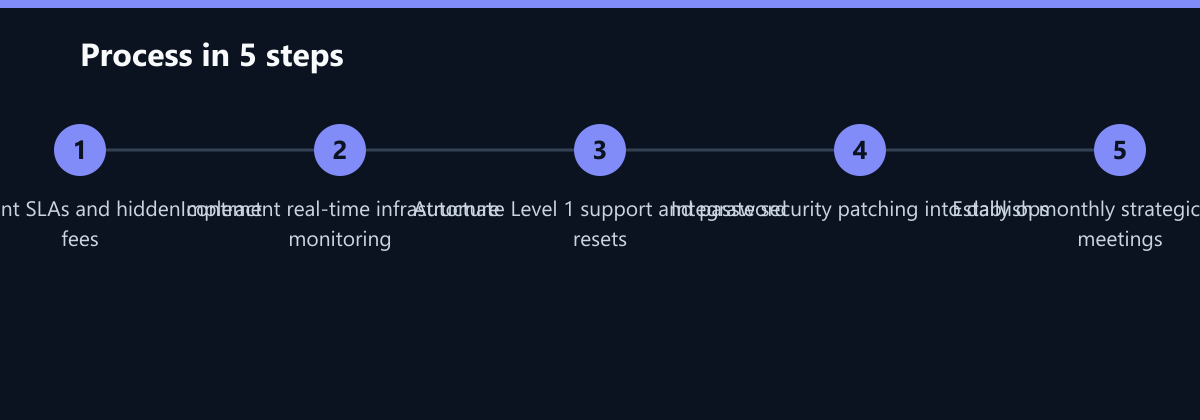
To begin this transition, consider the following immediate actions:
- Audit current contracts for hidden fees and service level agreements (SLAs).
- Implement monitoring tools to gain real-time visibility into your infrastructure.
- Automate Level 1 support to free up senior engineers for complex tasks.
- Integrate security patching into daily operations rather than monthly batches.
- Establish a monthly strategic review to align IT with business goals.
By addressing these issues, you can reduce costs, improve security, and free up your IT team to focus on innovation rather than firefighting. The goal is to transform IT from a cost center into a competitive advantage.
Typical Mistakes to Avoid
- Ignoring Indirect Costs: Focusing only on the invoice while ignoring the cost of employee downtime and lost productivity. This leads to an underestimation of the true cost of reactive support.
- Treating Security as Separate: Keeping security teams and IT support teams siloed. This creates gaps in defense and slows down incident response times significantly.
- Neglecting Documentation: Assuming that knowledge stays with the people. When staff leave, undocumented processes and configurations are lost, leading to longer resolution times for remaining staff.
How You Measure Success
To ensure your transition to a proactive model is successful, track these concrete KPIs:
- First Contact Resolution (FCR): Aim for >80%. This measures the percentage of tickets resolved on the first interaction, indicating effective Level 1 support.
- Mean Time to Resolve (MTTR): Target a reduction of 30-50% compared to your baseline. This reflects the efficiency of your support processes and tools.
- Uptime Percentage: Maintain >99.5% for critical business systems. This ensures business continuity and minimizes revenue loss due to downtime.
- Budget Variance: Keep monthly IT spend variance within ±5%. This indicates predictable costs and good financial control.
Measurement Method: Use a centralized IT service management (ITSM) tool to track ticket data automatically. Generate monthly reports that compare actual performance against these KPIs. Review these metrics in a monthly strategic meeting with your IT provider to ensure accountability and continuous improvement.
Checklist for Your IT Support Audit
- Review all current IT contracts for hidden fees and SLA gaps.
- Calculate the Total Cost of Ownership (TCO) including indirect costs.
- Assess the current patch compliance rate across all critical systems.
- Evaluate employee satisfaction with IT support via a short survey.
- Check if there is a dedicated account manager for strategic discussions.
- Verify if real-time monitoring tools are in place for infrastructure visibility.
- Determine if Level 1 support tasks are automated or handled manually.
- Confirm if IT strategy is aligned with business growth plans.
- Review the frequency and quality of service reports from your provider.
- Identify any recurring tickets that indicate a lack of root cause analysis.
Passend dazu
- IT Support & Helpdesk
- Cloud Services & Cloud Migration
- IT Compliance & Data Protection
- 5 Signs Your In-House IT Support Is Slowing Down Business Growth
- 5 Signs Your Helpdesk Is Bottlenecking Your Business Growth and How to Fix It
- Helpdesk vs. IT Support: Defining the Right Scope for Your Budget and Team
- Why Your Current IT Monitoring Is Not Enough
- SLA vs. OLA: The Difference in IT Support Contracts
- How to Audit Your Current IT Contract: 10 Red Flags That Indicate You Are Overpaying
- Why Your IT Team Is Overwhelmed: Automating Tier 1 Support with AI Chatbots