The Limitation of Activity-Based Metrics
Most Managed Service Provider (MSP) contracts rely on reactive metrics like ticket volume or average response time. While these numbers indicate that work is being done, they do not measure value. For a mid-sized enterprise, IT is a business enabler, not just a cost center. Focusing solely on activity can lead to a scenario where the MSP is busy, but your business is not moving forward.
Outcome-based KPIs shift the focus from ‘what the provider did’ to ‘what the business achieved.’ This alignment ensures that your IT partner is incentivized to improve your operational efficiency, security posture, and revenue protection, rather than just closing tickets. The following seven KPIs provide a framework for securing measurable results in your next contract negotiation.
Operational Health: Resolution and Availability
Mean Time to Resolution (MTTR) by Priority
Response time is only half the story. The true measure of operational health is how quickly a critical issue is fully resolved. A fast acknowledgment is useless if the system remains down for hours. Define ‘resolution’ clearly in your contract. It must mean the service is restored and verified by your team, not just ‘patch applied.’
- P1 (Critical): Target < 4 hours for full resolution.
- P2 (High): Target < 24 hours.
- P3 (Medium): Target < 3 business days.
Uptime and Availability of Core Services
Downtime directly impacts revenue. Define uptime for your critical business applications (e.g., ERP, E-Commerce, Email). Use a clear formula: (Total Time - Downtime) / Total Time * 100.
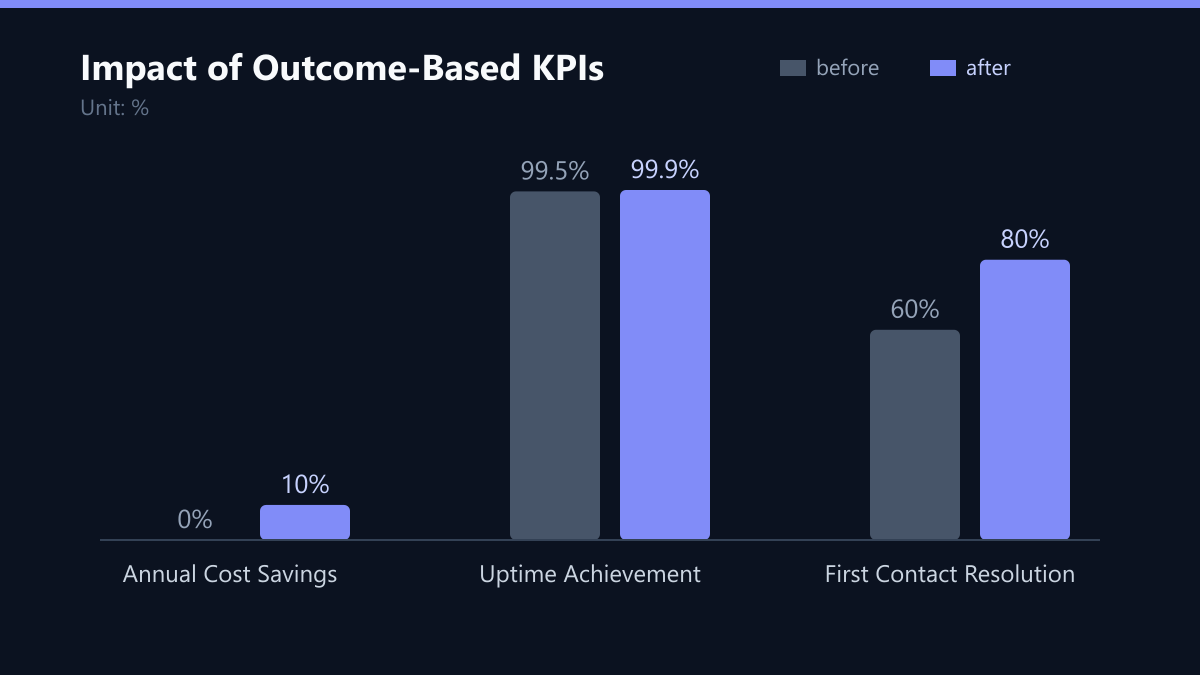
- Target: 99.9% for core services.
- Penalty Structure: Define service credits for every 0.1% drop in uptime.
Ensure that ‘maintenance windows’ are scheduled and communicated at least 7 days in advance. Unplanned downtime should be the only metric that triggers penalties. This distinction is vital to avoid disputes over planned maintenance that affects availability.
Security and Data Resilience
Security Incident Response Time
With rising cyber threats, speed is the primary defense against data breaches. Your contract must specify how quickly the MSP detects and contains security events. This KPI is critical for compliance with NIS2 and ISO 27001. It ensures that your provider has automated monitoring and a dedicated security team ready to act, rather than relying on manual checks.
- Detection Time: < 15 minutes for critical alerts.
- Containment Time: < 1 hour for active threats.
Backup Success Rate and Recovery Objectives
Data loss is an existential threat. Do not accept ‘99% backup success’ without understanding the recovery capabilities. The Recovery Point Objective (RPO) defines how much data you can afford to lose, while the Recovery Time Objective (RTO) defines the maximum downtime allowed for restoration.
- RPO: Maximum data loss tolerance (e.g., 15 minutes for databases).
- RTO: Maximum downtime allowed (e.g., 2 hours).
Action Item: Require quarterly restore tests. A backup is only as good as its last successful restoration. If the MSP cannot prove restorability, the KPI is meaningless. This is often the most overlooked aspect of data protection contracts.
Efficiency and User Experience
Proactive Patching Compliance
Reactive patching is a security risk. Your MSP should manage vulnerabilities proactively to prevent exploits. This KPI measures the percentage of critical and high-risk patches applied within a defined window. This metric ensures that your environment is hardened against known vulnerabilities and reduces the likelihood of ransomware attacks, which often target unpatched systems.
- Critical Patches: Applied within 7 days of release.
- High-Risk Patches: Applied within 30 days.
Cost Efficiency and Savings Identification
An MSP should actively optimize your IT spend. This KPI measures the value returned through license optimization, cloud cost management, and resource right-sizing. Transforming the MSP from a cost center into a value partner is achievable through specific financial targets.
- License Reconciliation: Annual audit to remove unused Microsoft 365 or SaaS licenses.
- Cloud Cost Optimization: Monthly review of Azure/AWS spend for idle resources.
Goal: Identify at least 5-10% annual savings. This tangible return on investment justifies the management fee and aligns the provider’s interests with your bottom line.
User Satisfaction and First Contact Resolution
IT service quality is ultimately judged by your employees. Low satisfaction leads to shadow IT and security risks. Track First Contact Resolution (FCR) and Net Promoter Score (NPS) for IT support. High FCR reduces ticket backlog and frees up your team to focus on strategic projects. It is a direct indicator of the MSP’s expertise and tooling effectiveness.
- FCR: > 80% of tickets resolved on first contact.
- NPS: > 50 (out of 100) from end-users.
Typical Mistakes in MSP Contracting
Even with clear KPIs, contracts can fail if foundational errors are made during the drafting phase. Here are the most common pitfalls to avoid:
- Ambiguous Definitions of ‘Resolution’: Without a strict definition, an MSP may mark a ticket as resolved when a workaround is applied, rather than when the root cause is fixed. Always require end-user verification for P1 and P2 issues.
- Ignoring Maintenance Windows: If planned maintenance is not excluded from uptime calculations, you may be penalized for downtime you scheduled. Conversely, if it is excluded without limits, the MSP may schedule maintenance during peak business hours. Define acceptable windows and advance notice periods (e.g., 7 days) clearly.
- Lack of Audit Rights: Trusting the MSP’s self-reported data without the right to audit the underlying logs or monitoring tools is risky. Ensure you have contractual access to raw data or independent verification methods.
- Static KPI Targets: Business needs change. A contract that locks in 99.5% uptime for three years may be insufficient as your e-commerce volume grows. Include clauses that allow for annual KPI reviews and adjustments based on business growth or new regulatory requirements.
How You Measure Success
To ensure these KPIs are not just theoretical, you need a concrete measurement methodology. Success is measured through a combination of automated monitoring and regular governance reviews.
KPI Measurement Method:
- Uptime & Availability: Use independent third-party monitoring tools (e.g., Pingdom, UptimeRobot) to verify the MSP’s reported uptime. The data should be timestamped and stored for audit purposes.
- MTTR & FCR: Extract data directly from the MSP’s ticketing system (e.g., ServiceNow, Jira, ConnectWise). Calculate MTTR as the average time from ticket creation to verified resolution. Calculate FCR as the percentage of tickets closed on the first interaction.
- Security Response: Review incident reports for each security event. Compare the timestamp of the alert in the SIEM (Security Information and Event Management) system with the timestamp of containment actions. This provides an objective measure of detection and containment times.
- Cost Savings: Conduct an annual financial audit of IT spend. Compare current spend against a baseline established at the start of the contract. Document all identified savings from license optimization and cloud right-sizing. A 10% reduction in operational IT costs is a strong benchmark for success.
Governance Cadence:
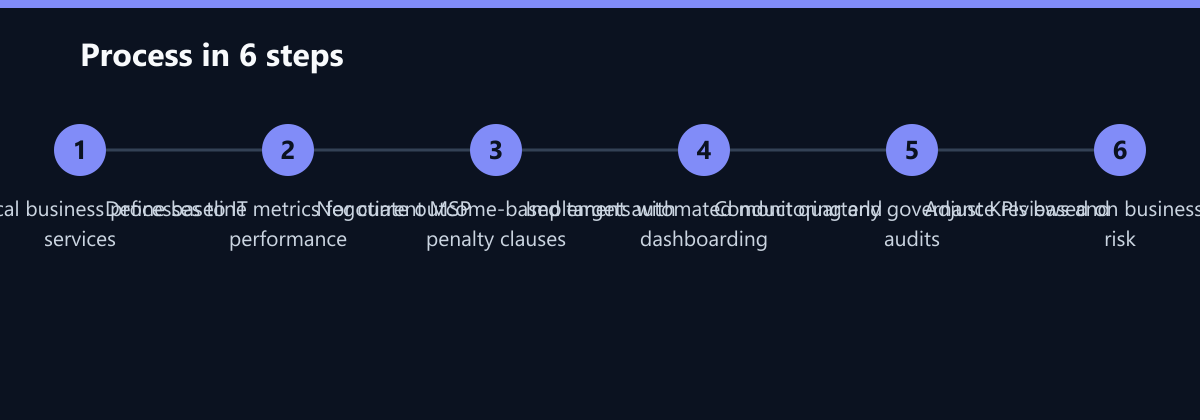
- Monthly: Operational dashboard review (Uptime, Ticket Volume, MTTR).
- Quarterly: Formal KPI review meeting. Discuss trends, missed targets, and corrective actions. Review security incident reports and patching compliance.
- Annually: Strategic review. Assess cost savings, adjust KPI targets for the coming year, and evaluate the overall value proposition of the MSP relationship.
Checklist for Contract Negotiation
Use this checklist to ensure your MSP contract includes all necessary elements for measurable success:
- Define ‘Resolution’: Is it clearly stated that resolution requires end-user verification?
- Set Priority-Based MTTR: Are targets for P1, P2, and P3 explicitly defined?
- Specify Security Response Times: Are detection (< 15 mins) and containment (< 1 hour) times contractually binding?
- Mandate Restore Tests: Is there a requirement for quarterly backup restore tests with documented results?
- Define Patching Windows: Are critical (7 days) and high-risk (30 days) patching timelines specified?
- Establish Uptime Penalties: Is there a clear service credit structure for uptime drops below 99.9%?
- Include Cost Optimization Goals: Is there a target for annual savings (e.g., 5-10%) through license and cloud optimization?
- Set User Satisfaction Targets: Are FCR (> 80%) and NPS (> 50) included in the KPI dashboard?
- Secure Audit Rights: Do you have the contractual right to audit data sources and monitoring tools?
- Plan for Review: Is there a quarterly governance meeting and an annual strategic review scheduled?
By implementing these KPIs and measurement practices, you transform your MSP relationship from a passive support function into an active partner in your business growth. The result is not just better IT, but a measurable improvement in operational efficiency, security, and cost control.
Passend dazu
- IT Consulting & IT Strategy
- AI Consulting & AI Strategy
- Reducing response time to critical security incidents in the Swiss financial sector to under 15 minutes
- NIS2 Compliance: Critical IT Weaknesses in UK Manufacturing
- Cloud Services & Cloud Migration
- IT Compliance & Data Protection
- E-Commerce Development
- Cyber Insurance for the Middle Market: 5 Critical Clauses for IT Security and Compliance
- Helpdesk KPIs in Mid-Market Companies: Measurably Improving Response Time and Satisfaction
- IT Budget Planning: KPIs for the Cost-Effectiveness of Your IT Investments
- KPIs for IT Observability: The 5 Metrics CEOs Actually Care About
- AI Consulting for Mid-Market: From Idea to Measurable ROI in 90 Days
- Building IT Governance: Making Processes Measurable and Auditable
- Securing Legal Data with MFA and Conditional Access
- Securing HIPAA-Compliant Application Performance Monitoring for US Patient Portals
- Securing Automated Workflows: Best Practices for Credential Management in RPA Bots
- Understanding Hosting KPIs: What to Monitor Beyond CPU and Memory Usage
- Managed IT Contract Structure: Fixed Price vs. Per User Models
- Securing BYOD Devices: 5 Essential Policies for Hybrid Environments
- Insider Threat Mitigation: Securing Intellectual Property in a Munich Engineering Agency