The High-Stakes Landscape of Swiss Wealth Management
For a mid-sized wealth management firm based in Zurich, the digital perimeter is not just a technical boundary; it is the primary interface for trust. With 150 employees managing portfolios for high-net-worth individuals, the stakes of a security breach extend far beyond immediate financial loss. They touch upon reputational integrity, regulatory standing under FINMA, and the confidence of clients who entrust their generational wealth to the firm. The client operated in a hybrid environment, balancing on-premise legacy systems with cloud-native applications, a configuration that, while flexible, created significant visibility gaps.
The core issue was not a lack of security tools, but a lack of cohesion. Security alerts were fragmented across multiple disjointed platforms. When a critical threat emerged, the internal IT team had to manually correlate data from different sources, a process that was both time-consuming and prone to human error. This manual approach resulted in an average response time for critical incidents exceeding 45 minutes. In the context of modern cyberattacks, where dwell time is measured in minutes, this delay represented a critical vulnerability. The firm recognized that relying solely on human speed to outpace automated threats was no longer a viable strategy.
The Challenges: Fragmentation and Fatigue
The project identified three specific challenges that needed to be addressed to achieve a resilient security posture. First, there was the issue of alert fatigue. The volume of notifications from various tools was overwhelming, leading to desensitization among analysts. Critical signals were often buried under noise, causing delays in recognition. Second, the lack of centralized visibility meant that no single team member had a complete picture of the threat landscape. Context switching between tools consumed valuable time that should have been spent on analysis and containment. Third, compliance pressure from FINMA required demonstrable evidence of rapid response and robust controls. The existing manual processes made it difficult to generate the required audit trails and performance metrics, creating a risk of non-compliance.
How We Measured It: Establishing a Baseline
Before deploying any new technology, we established a rigorous measurement framework to ensure that improvements were quantifiable and attributable. We began by logging the timestamp of every critical alert from the existing systems over a period of four weeks. This allowed us to calculate the precise “time-to-detect” and “time-to-respond” metrics. We also tracked the number of false positives per analyst per day to establish a baseline for alert fatigue. By correlating these data points with incident resolution times, we created a clear before-state profile. This baseline was crucial for later validating the impact of the automated orchestration layer. We defined success not just by speed, but by the accuracy of the automated actions and the reduction in manual effort required for routine tasks.
Implementation: From Manual Triage to Automated Orchestration
The solution architecture centered on a centralized Security Information and Event Management (SIEM) platform, specifically Azure Sentinel, integrated with endpoint detection and response (EDR) capabilities via CrowdStrike Falcon. This integration provided a unified view of all security events across the hybrid infrastructure. The goal was to move from reactive monitoring to proactive, automated response.
We developed a series of custom playbooks within the SIEM environment. These playbooks were designed to handle specific threat scenarios, such as ransomware detection, privilege escalation attempts, and data exfiltration patterns. When a threat was identified, the playbook would automatically execute containment actions, such as isolating the affected endpoint from the network or blocking malicious IP addresses. This reduced the decision-making time for analysts, allowing them to focus on complex investigations rather than routine triage.
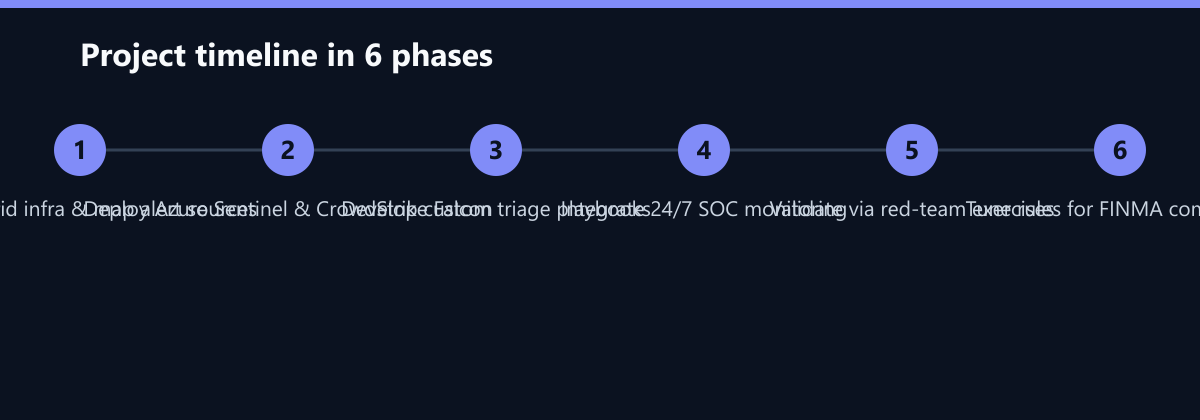
A key component of the implementation was the integration of a Managed Security Operations Center (SOC). While automation handled the initial triage and containment, the SOC provided 24/7 human oversight. Analysts monitored the automated actions, reviewing them for accuracy and handling any alerts that required deeper investigation. This hybrid model ensured that the system was not just fast, but also smart and accountable. We also implemented automated ticketing workflows that created detailed incident records in the client’s IT service management tool. This ensured that every action, whether automated or manual, was logged and auditable, satisfying FINMA requirements for documentation and traceability.
The Tech Stack
- Azure Sentinel: Served as the central SIEM, aggregating logs from all sources and providing a unified dashboard for monitoring.
- CrowdStrike Falcon: Provided endpoint telemetry and EDR capabilities, enabling detailed visibility into user and process activity on all devices.
- Microsoft 365 Defender: Integrated with Sentinel to provide cloud-native security insights and threat intelligence.
- ServiceNow: Used for automated ticketing and incident management, ensuring seamless handoff between automated systems and human analysts.
- Power Automate: Custom flows used to trigger specific containment actions and notify relevant stakeholders based on playbook outcomes.
Results: Sub-15 Minute Response and Operational Efficiency
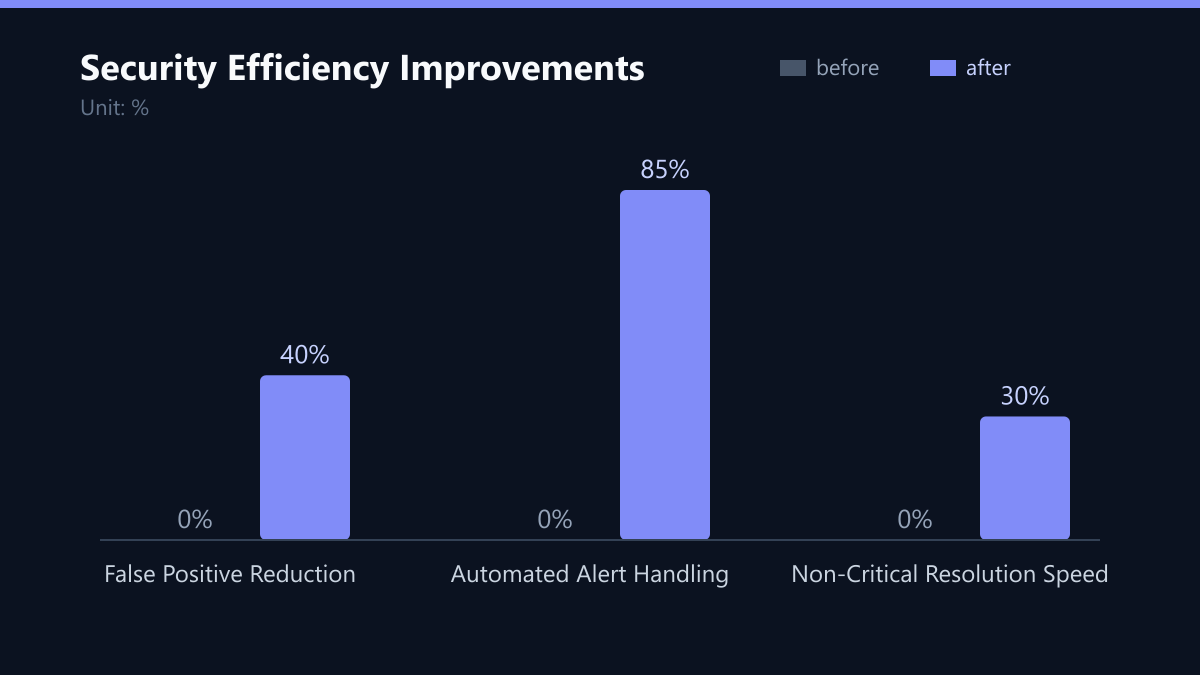
Within three months of deployment, the impact of the automated orchestration was evident. The average response time for critical security incidents dropped from over 45 minutes to under 15 minutes. This threefold improvement meant that threats were contained before they could spread across the network, significantly reducing the potential impact of any breach. The speed of response was not achieved at the cost of accuracy; in fact, the refined detection rules led to a 40% reduction in false positive alerts. Analysts reported a significant decrease in fatigue, allowing them to focus on high-value tasks such as threat hunting and strategic security planning.
The automated system successfully handled 85% of alerts without human intervention. This level of automation freed up the internal IT team to engage in strategic initiatives, such as improving network segmentation and enhancing user training programs. Incident resolution time for non-critical issues also improved by 30%, as the automated triage process quickly identified and resolved minor issues that previously required manual attention. Most importantly, the client achieved 100% compliance with FINMA information security guidelines. The automated logging and reporting capabilities provided the necessary evidence for audits, ensuring that the firm met all regulatory requirements for incident response and data protection.
The business impact extended beyond technical metrics. The proactive approach to security strengthened the client’s reputation for data security among high-net-worth investors. In an industry where trust is paramount, the ability to demonstrate robust, automated security controls became a competitive advantage. Clients felt more confident in the firm’s ability to protect their assets, leading to increased retention and new business opportunities.
Lessons Learned: The Importance of Continuous Tuning
The implementation of automated security orchestration is not a one-time project but an ongoing process. We learned that initial playbooks often require frequent adjustments to reduce false positives and refine detection logic. The first month of operation saw a higher volume of alerts that required manual review, as the system learned the normal patterns of user behavior and network activity. Close collaboration between the client’s IT staff and our security analysts was crucial for this tuning process. Regular review cycles, held bi-weekly during the initial phase, allowed us to adjust thresholds and rules based on real-world data. This iterative approach ensured that the automated responses remained aligned with the evolving threat landscape and the specific needs of the client.
Another key lesson was the importance of communication. The transition to an automated system required a cultural shift within the IT team. Analysts had to trust the system to handle routine tasks while remaining vigilant for complex threats. We facilitated this transition through regular training sessions and clear communication of the system’s capabilities and limitations. This helped build confidence in the automated processes and ensured a smooth adoption of the new workflow.
What We Would Do Differently Today
Looking back, there are a few areas where we would refine our approach. First, we would involve the client’s end-users more early in the process. While the technical implementation was smooth, there was some initial confusion among users about why certain actions (such as endpoint isolation) were happening automatically. A more proactive communication strategy, including user guides and FAQ documents, could have reduced this friction. Second, we would place greater emphasis on initial data quality. Ensuring that all log sources were properly formatted and normalized before feeding them into the SIEM would have reduced the time spent on data cleaning and mapping. Finally, we would consider implementing a pilot phase with a subset of endpoints before rolling out the full solution. This would have allowed us to validate the playbooks in a controlled environment, further reducing the risk of false positives during the initial rollout.
Conclusion
The case of this Swiss wealth management firm demonstrates the power of automated orchestration in enhancing security posture. By moving from manual, fragmented processes to a centralized, automated system, the firm achieved a significant reduction in response time, improved compliance, and freed up resources for strategic initiatives. The results underscore the importance of a proactive, technology-driven approach to security in an increasingly complex threat landscape. For organizations in similar industries, the key takeaway is that automation is not just about speed; it is about creating a resilient, efficient, and compliant security operation that can adapt to the evolving needs of the business.
Passend dazu
- Managed Security (MSSP)
- IT Security & Cybersecurity
- IT Consulting & IT Strategy
- AI Consulting & AI Strategy
- SLA Negotiation with IT Service Providers: 7 Critical Points for Mid-Market Companies
- 5 Causes of IT Helpdesk Productivity Loss and AI Solutions
- Cloud Services & Cloud Migration
- IT Compliance & Data Protection
- E-Commerce Development
- Hybride Azure-DR-Strategie: RTO auf 15 Minuten reduziert
- ISO 27001 Certification in Finance: Cutting Certification Time by 3 Months with AI
- Automatisierte NIS2-Prüfung reduziert Audit-Zeit um 40 Prozent
- Automated Ransomware Detection and Recovery: 48-Hour Backup Cycle for a 200-Person Logistics Company in DACH
- Teams vs. Zoom: IT-Security Alignment for Mid-Market Firms
- NIS2 Compliance: Critical IT Weaknesses in UK Manufacturing
- Helpdesk-KPIs im Mittelstand: Reaktionszeit und Zufriedenheit messbar verbessern
- Zero-Trust Remote Access for a Swiss Financial Boutique
- Cyber Insurance for the Middle Market: 5 Critical Clauses for IT Security and Compliance
- Teams vs. Slack: IT Security and Cost Comparison for Enterprises
- Ransomware Recovery: 5 Critical Errors in Active Directory Restoration
- Trading Conglomerate Reduces Server Fault Response Time to 15 Minutes with AIOps
- M365 E3 or E5: Choosing the Right License for Your IT Security Requirements
- Managed Detection and Response: Real Costs for SMEs
- 7 Critical KPIs in an MSP Contract: Securing Measurable Results
- Accelerating Compliance Audits in the Financial Sector
- Magento Security: Identifying Vulnerabilities in Third-Party Extensions
- Retail Chain in Berlin: Centralized Network Monitoring Reduces Incident Resolution Time from 4 Hours to 15 Minutes Across 12 Stores
- Reducing Order Confirmation Time from 48 to 2 Hours via SAP S/4HANA Integration
- Reducing Alert Fatigue: Strategies for Tuning Monitoring Thresholds in Critical Business Systems
- Email Security Beyond Spam Filters: How to Block Business Email Compromise Attacks
- Automating Customer Onboarding: Reducing Time-to-Value for B2B SaaS
- Wi-Fi 6 vs. Wi-Fi 6E: The Financial Case for Open-Plan Offices
- 5 Critical Security Measures for Your Managed Server Infrastructure
- Ransomware Response Plan: 7 Steps to Recover Operations in Under 4 Hours
- Digitizing Contract Management for a Real Estate Portfolio in New York: Reducing Compliance Risks and Retrieval Time by 75%
- How to Audit Your IT Vendor Security Posture in Under 48 Hours