The Hidden Danger of Flat Architectures
In the mid-market sector, the traditional network design often resembles a castle and moat. The outer perimeter is heavily fortified, but once an attacker breaches the wall, they have unrestricted access to the entire interior. This flat architecture is the primary enabler of lateral movement, where threat actors use a single compromised endpoint to traverse the network, seeking high-value targets like financial data or critical manufacturing systems.
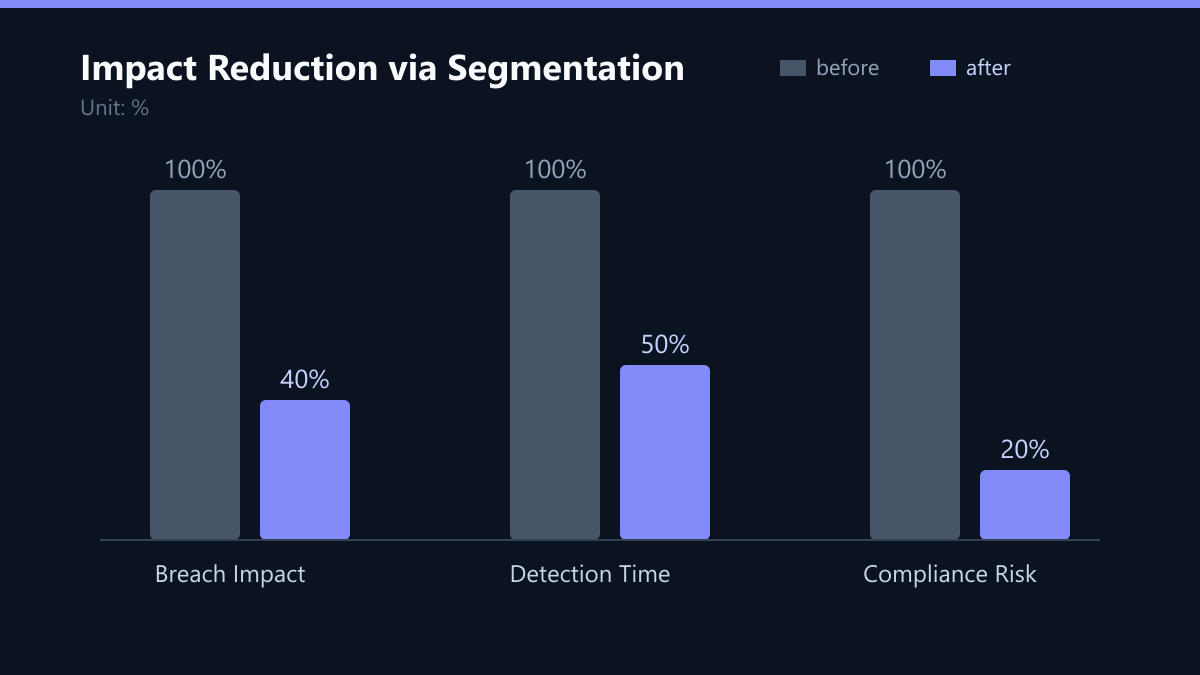
The consequences of this lack of separation are severe. A single ransomware infection can halt operations, leading to significant financial damages. Furthermore, unauthorized access to personal data triggers GDPR violations, exposing the company to regulatory fines and reputational damage. For mid-market companies, the operational continuity of processes such as accounting or production is fragile; without segmentation, a localized threat becomes a systemic crisis.
Shifting to a Zero-Trust Mindset
The solution lies in abandoning the implicit trust model. Zero Trust operates on the principle: “Never trust, always verify.” Every device, user, and application must prove its identity and authorization for every single request, regardless of its location within the network.
This approach relies on three core pillars:
- Least Privilege: Devices and users receive access only to the specific resources required for their immediate task. An engineering laptop, for instance, should not have access to the HR payroll server.
- Isolation: If a device is infected, the damage is contained within its specific segment. The attacker cannot easily jump to adjacent segments.
- Dynamic Policies: Access rights can be adjusted in real-time based on context, such as time of day, physical location, or the security status of the device.
Technical Building Blocks: VLANs and NGFWs
Physical separation of networks is often too expensive and inflexible for mid-market companies. Virtual segmentation provides the necessary agility. The foundation of this strategy involves VLANs (Virtual Local Area Networks) and Next-Generation Firewalls (NGFWs).
VLANs logically separate network sections, allowing you to group devices by function rather than physical location. NGFWs then control the data traffic between these sections, utilizing Deep Packet Inspection to detect threats that traditional firewalls might miss.
For more granular control, especially in cloud or hybrid environments, micro-segmentation is employed. This operates at the workload or container level, providing fine-grained control over east-west traffic. Additionally, Access Control Lists (ACLs) define precise rules for who can access which ports, ensuring that only authorized traffic flows between segments.
| Component | Function | Key Advantage |
|---|---|---|
| VLANs | Logical separation of network zones | Cost-effective, flexible, and standardized |
| NGFWs | Inspection and filtering of traffic | Advanced threat detection and detailed logging |
| Micro-segments | Workload-level isolation | Ideal for hybrid cloud and containerized apps |
A Lean Strategy for Mid-Market Firms
Not every company requires complex, full-scale micro-segmentation. A lean, two-tier strategy is often sufficient and far more manageable to implement. The goal is to reduce the attack surface without overwhelming the IT team with complexity.
Start by separating critical assets. Identify your most important data and systems, such as the ERP system or production control lines, and isolate them from the rest of the network. A robust basic strategy includes:
- Core Perimeter: Strictly separate the internal network from the internet using robust edge firewalls.
- Internal Separation: Isolate server rooms, production networks (OT/IT), and administrative areas from each other. This prevents a compromised office PC from accessing the factory floor.
- Guest Network: Keep visitors, contractors, and IoT devices strictly separated from corporate data. This is often the most overlooked vulnerability.
This approach significantly reduces the attack surface and can often be implemented quickly using existing hardware and software licenses, providing immediate value with minimal disruption.
Compliance: More Than Just a Security Measure
Segmentation is not merely a best practice; it is a compliance requirement. The GDPR mandates appropriate technical and organizational measures to ensure data security. Specifically, Article 32 requires organizations to implement measures suitable to the risk, which includes network segmentation to limit data exposure.
Furthermore, regulations like NIS2 and standards like ISO 27001 explicitly require minimizing the attack surface and controlling data flow. Without documented segmentation, companies are often deemed non-compliant during audits. NIS2, in particular, imposes strict protective measures on critical infrastructures, while ISO 27001 lists network segmentation as a key technical protective measure.
Documenting your segmentation strategy is crucial. It demonstrates to clients, insurers, and auditors that you actively control data flow and prevent access conflicts. This documentation strengthens your position in procurement processes and can lead to lower insurance premiums.
Step-by-Step Implementation Plan
The introduction of segmentation should be done step by step. A big-bang approach is risky, expensive, and often leads to operational disruptions. Instead, follow a phased rollout:
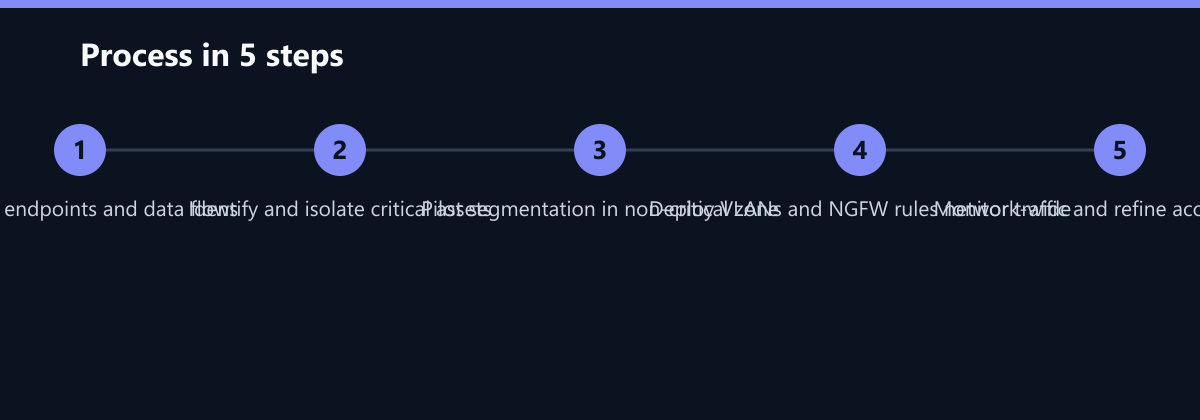
- Inventory: Create a complete overview of all devices, users, and data flows. You cannot protect what you do not know exists.
- Prioritization: Identify the most critical assets and isolate them first. Focus on high-value data and critical business processes.
- Pilot Operation: Test segmentation in a non-critical area, such as the guest network or a specific department. Monitor for issues and adjust policies.
- Rollout: Expand the strategy to the entire network, segment by segment. Ensure that all teams are aware of the changes.
- Monitoring: Continuously monitor data traffic and adjust policies based on new insights and changing business needs.
Plan training for your IT team. New tools and processes require expertise. Ensure that your team understands the reasons for segmentation and masters the tools used for management and monitoring.
Typical Mistakes to Avoid
Even with a solid plan, organizations often stumble on specific pitfalls during implementation.
- Over-Complexity: Implementing micro-segmentation everywhere from day one. This leads to management overload and policy conflicts. Start with VLANs and expand only where necessary.
- Ignoring IoT and OT: Leaving Internet of Things (IoT) and Operational Technology (OT) devices on the same network as office PCs. These devices often lack security patches and should be strictly isolated.
- Lack of Documentation: Failing to document the segmentation logic. Without clear documentation, troubleshooting becomes difficult, and compliance audits will fail.
- Static Policies: Setting rules once and forgetting them. Networks change, and so do threats. Policies must be reviewed and updated regularly to remain effective.
How You Measure Success
You cannot improve what you do not measure. To ensure your segmentation strategy is working, track these concrete KPIs:
- Mean Time to Detect (MTTD): The time it takes to identify a lateral movement attempt. Segmentation should reduce this by confining threats to smaller segments.
- Number of Blocked Lateral Connections: Monitor firewall logs for denied traffic between segments that should not communicate. An increase in these logs indicates the policy is working.
- Compliance Audit Findings: Track the number of findings related to network access and data flow control. A successful strategy should result in zero major findings in this area.
- Scope of Incident Response: Measure the number of systems affected during a security incident. Effective segmentation should limit the blast radius to a single VLAN or segment.
Checklist for Your Segmentation Project
Use this checklist to ensure your project is on track:
- Complete inventory of all network assets and data flows.
- Identification of critical assets and critical data.
- Definition of network segments (VLANs) and access rules.
- Configuration of NGFWs for inter-segment traffic control.
- Implementation of guest network isolation.
- Documentation of segmentation strategy and access policies.
- Training of IT staff on new monitoring and management tools.
- Establishment of KPIs for ongoing monitoring and improvement.
By following this structured approach, mid-market companies can significantly enhance their security posture, meet compliance requirements, and protect their operations from the ever-present threat of lateral movement.
Passend dazu
- Netzwerk-Modernisierung im Maschinenbau: Reduktion der Latenz um 40 % durch SD-WAN in drei DACH-Werken
- IT Consulting & IT Strategy
- GDPR Audit in Manufacturing: Risk Reduction via Automated Data Classification
- Networking & Network Infrastructure
- Cloud Services & Cloud Migration
- IT Compliance & Data Protection