The Situation: A Bottleneck in Order Processing
For a mid-sized industrial equipment manufacturer in the United Kingdom, the path from customer inquiry to shipped product was fraught with manual friction. With a headcount of 150 employees, the company had built a solid reputation for quality, but their digital infrastructure was struggling to keep pace with their B2B customer base. The primary channel for placing orders was still the traditional mix of phone calls and emails.
This reliance on manual communication created a significant operational bottleneck. The sales team, which should have been focused on strategic account management and new business development, found itself trapped in a cycle of administrative data entry. More than 40% of their working hours were consumed by manually transcribing order details from emails and verifying availability over the phone. This not only reduced their capacity for revenue-generating activities but also introduced a high degree of human error into the process.
The consequences of this manual approach were measurable and costly. Inconsistent data entry led to a 15% error rate in orders. These errors manifested as incorrect item quantities, wrong shipping addresses, or missed special instructions. Each error triggered a cascade of negative effects: shipping delays, customer dissatisfaction, and the logistical nightmare of processing returns and re-ships. Furthermore, customers lacked any visibility into their order status. They could not track shipments or view their historical purchase data, leading to a repetitive stream of “Where is my order?” inquiries that further clogged the support channels.
The Challenges
Digitizing this process was not simply a matter of building a website. We identified four concrete challenges that had to be addressed to ensure the project’s success:
- ERP Complexity: The client’s SAP system was the backbone of their operations but was not designed for direct external web access. Creating a secure, real-time bridge between a modern e-commerce frontend and a legacy ERP required careful architectural planning.
- User Adoption: B2B buyers in industrial sectors are often skeptical of new digital tools. They were accustomed to talking to a human representative. Convincing them to trust a self-service interface required a design that was not only functional but also intuitive and reassuring.
- Data Integrity: With a 15% baseline error rate, the new system had to enforce strict data validation rules. This meant moving away from free-text entry to structured forms that mirrored the ERP’s data requirements, a shift that could initially frustrate users if not handled correctly.
- Security and Compliance: Handling customer data, financial transactions, and proprietary pricing required strict adherence to GDPR and industry-standard security protocols, including two-factor authentication for administrative access and SSL encryption for all data in transit.
The Tech Stack
To address these challenges, we selected a technology stack that balanced performance, flexibility, and security:
- Magento 2: Chosen for its robust B2B features, including customer groups, negotiated pricing, and complex catalog management.
- Headless Architecture: We utilized a headless setup to decouple the frontend from the backend, allowing for a faster, more responsive user experience on both desktop and mobile devices.
- REST API Connectors: Custom-built connectors facilitated real-time synchronization with the SAP ERP, ensuring that inventory, pricing, and order statuses were always current.
- GDPR-Compliant Data Handling: Implemented strict data privacy measures, including secure login areas and encrypted storage of customer records.
Implementation: From Blueprint to Go-Live
The project was executed over a 12-week timeline, structured to minimize risk and ensure thorough testing at each stage. We prioritized stability and ease of use, recognizing that high adoption rates depended on a seamless user experience.
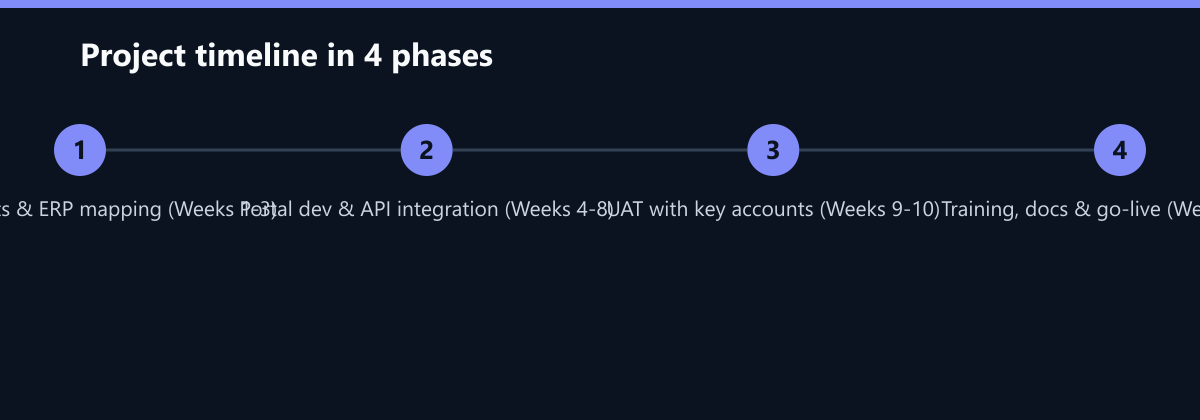
Weeks 1-3: Requirements Analysis and ERP Mapping We began by deeply auditing the existing order-to-cash process. Our team worked closely with the client’s sales and logistics teams to map every data point required for an order. We identified which fields were mandatory, which were optional, and how they mapped to the SAP system. This phase was critical for defining the scope of the API integration and ensuring that no business rules were overlooked.
Weeks 4-8: Portal Development and API Integration This was the core development phase. We built the Magento 2 frontend, customizing the checkout flow to reflect the client’s specific B2B requirements. Simultaneously, our backend team developed the REST API connectors. We implemented a sandbox environment to test data synchronization, ensuring that when a customer placed an order on the portal, it appeared correctly in SAP with all the right attributes. We also built the customer account areas, allowing users to view order history, download invoices, and manage their shipping addresses.
Weeks 9-10: User Acceptance Testing (UAT) We invited key accounts from the client’s customer base to test the portal in a staging environment. This was a crucial step. We observed how they navigated the interface, where they hesitated, and what questions they had. Based on this feedback, we made several UI adjustments, simplifying the checkout process and adding clearer error messages for data validation failures. This phase ensured that the portal was not just technically sound but also user-friendly.
Weeks 11-12: Training, Documentation, and Go-Live In the final two weeks, we focused on change management. We created comprehensive documentation for the client’s internal staff, covering how to manage the portal, handle exceptions, and monitor system health. We also prepared a quick-start guide for their customers, highlighting the benefits of self-service. The go-live was phased, starting with a small group of friendly customers before rolling out to the entire B2B base.
How We Measured It
To ensure the results were objective and verifiable, we established a clear measurement framework before the launch. We worked with the client’s IT and finance teams to define the baseline metrics for the six months prior to the portal’s introduction.
- Support Ticket Volume: We tracked the number of inbound calls and emails related to order placement and status inquiries. This data was pulled from the client’s CRM system, which logged all customer interactions with tags for topic and channel.
- Order Accuracy: We defined accuracy as the percentage of orders that were processed without any manual intervention or correction in the ERP. We sampled 200 orders per month from the pre-launch period to establish the 85% baseline (implying the 15% error rate).
- Online Order Share: We calculated the percentage of total new orders placed via the digital channel versus phone/email. This was determined by tagging orders in the ERP with their source channel.
- Fulfillment Time: We measured the time delta between order placement in the ERP and the warehouse picking the order. This data was available through the warehouse management system logs.
By comparing these post-launch metrics against the established baselines, we could clearly attribute the improvements to the new portal and its automated workflows.
Results and Impact
Within six months of launch, the portal delivered significant operational improvements. The shift to self-service fundamentally changed the interaction model between the manufacturer and its B2B clients.
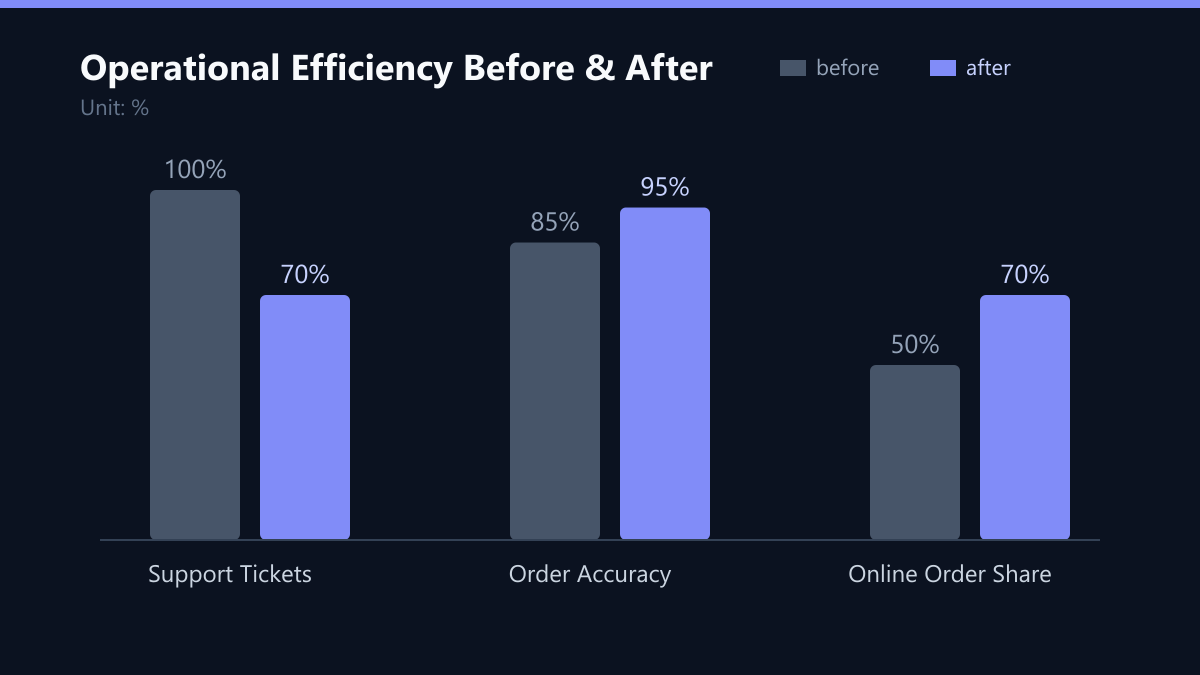
The most immediate impact was seen in support efforts. The volume of inbound calls and emails regarding order status and placement dropped by 30%. This was a direct result of the self-service checkout and the real-time order tracking features. Customers no longer needed to call to check if their order had been received; they could see the status update in their account dashboard. This freed up the sales team to focus on high-value activities.
Order accuracy improved dramatically. The automated data validation rules in the portal reduced manual entry errors to near zero, resulting in a 95% order accuracy rate. This meant fewer shipping delays, fewer returns, and a significant reduction in the administrative overhead associated with correcting mistakes. The logistics team reported a smoother workflow, as they received cleaner, more consistent order data from the ERP.
Furthermore, the portal drove a 20% increase in online orders. More than half of all new orders are now placed via the portal, indicating a successful shift in customer behavior. This not only improved efficiency but also provided the client with valuable data on purchasing patterns, which can be used for inventory planning and customer relationship management.
Finally, automated workflows reduced the time from order placement to warehouse processing by 15%. By eliminating the manual step of transcribing orders from email to ERP, the system could process orders instantly, allowing the warehouse to start picking sooner. This faster turnaround time was a key differentiator for the client, helping them compete more effectively in their market.
Lessons Learned
This project highlighted the importance of aligning digital tools with existing business processes. Success depended not just on the technology, but on the change management strategy.
Early ERP Integration: We found that testing the API connections early in the project prevented data discrepancies during go-live. By validating the data flow in the sandbox environment, we caught several mapping issues that would have caused significant problems in production.
User-Centric Design: Simplifying the checkout process was more important than adding complex features. We resisted the urge to add every possible B2B feature to the portal. Instead, we focused on making the core task of placing an order as easy as possible. This simplicity was key to driving adoption.
Stakeholder Training: Providing clear documentation and training for both the client’s staff and their customers ensured smooth adoption. We learned that customers needed more than just a login; they needed a clear understanding of how the new system benefited them. Our quick-start guides and training sessions helped bridge this gap.
What We Would Do Differently Today
While the project was a success, there are areas where we would refine our approach if we were to undertake a similar engagement today.
First, we would invest more time in the initial requirements phase to better anticipate edge cases in the ERP integration. While we caught most issues during UAT, a more rigorous data mapping exercise in the first few weeks could have reduced the number of minor bugs found during testing.
Second, we would implement a more granular phased rollout. Instead of moving from a small group to the entire customer base in the final two weeks, we would have expanded the user group more gradually over a longer period. This would have allowed us to monitor system performance and user feedback in a more controlled environment, potentially identifying adoption barriers earlier.
Finally, we would have built in more robust analytics from the start. While we measured the core KPIs effectively, having deeper insights into user behavior on the portal (e.g., where users drop off in the checkout process) would have provided more actionable data for continuous improvement post-launch.
Passend dazu
- Mitigating AI Hallucinations in Customer Support
- IT Consulting & IT Strategy
- IT Support & Helpdesk
- Cloud Services & Cloud Migration
- IT Compliance & Data Protection
- Boosting Employee Productivity by 15% in US Pharma
- Boosting Conversion Rate by 18% Through AI-Powered Product Recommendations in a US B2B Industrial Trade
- Magento Warehouse Sync Reduces Out-of-Stock Rates by 25 Percent
- Intelligent Customer Support Triage: A UK Retailer Reduces Response Times by 60% with AI-Powered Chatbots
- Building a Self-Service IT Portal: 5 Features That Reduce Helpdesk Volume by Half