The Shift from Perimeter to Process
Traditional perimeter security, built on static firewalls and signature-based antivirus, is no longer sufficient against modern ransomware campaigns. Attackers have moved beyond simple email scams to sophisticated, multi-stage operations that exploit zero-day vulnerabilities and human psychology. For mid-sized businesses, the cost of a single breach extends far beyond ransom payments; it encompasses operational downtime, reputational damage, and significant legal liabilities.
A Managed Security Service Provider (MSSP) shifts the defensive burden from reactive cleanup to proactive prevention. By operating 24/7 Security Operations Centers (SOCs), MSSPs monitor your entire digital footprint. They utilize artificial intelligence to identify anomalies that human teams might miss, ensuring threats are neutralized before critical data is encrypted. This continuous vigilance transforms security from a periodic audit into a real-time operational discipline.
Vector 1: Phishing and Social Engineering
Phishing remains the primary entry point for over 80% of ransomware incidents. Attackers craft convincing emails that mimic trusted vendors or internal communications, aiming to trick employees into clicking malicious links or downloading infected attachments. The human element is often the weakest link in the security chain.
MSSPs block this vector through a multi-layered approach:
- Advanced Email Gateway Filtering: AI-driven systems analyze email metadata and content for suspicious patterns in real-time.
- User Behavior Analytics (UBA): Monitoring for unusual login locations, time-of-day anomalies, or access attempts to restricted data.
- Security Awareness Training: Regular simulated phishing campaigns help reduce human error by educating staff on current tactics.
By combining technical filters with continuous human training, MSSPs significantly reduce the success rate of social engineering attacks, closing the gap between policy and practice.
Vector 2: Exploiting Unpatched Vulnerabilities
Outdated software and unpatched systems are open doors for attackers. Ransomware gangs actively scan the internet for known vulnerabilities in web servers, remote access tools, and operating systems. If a patch is available but not applied, the risk of compromise is high. Many organizations struggle with the volume of patches, leading to delayed deployments that extend the window of exposure.
MSSPs manage the patching lifecycle comprehensively. They prioritize patches based on criticality and threat intelligence, ensuring that high-risk vulnerabilities are closed quickly without disrupting business operations.
Key actions include:
- Automated Vulnerability Scanning: Regular checks for missing patches across all endpoints and servers.
- Managed Patch Deployment: Staged rollouts to minimize business disruption while ensuring security compliance.
- Third-Party Application Management: Securing non-standard software that is often overlooked by standard IT maintenance routines.
This proactive approach eliminates the window of opportunity that attackers exploit to gain initial access, turning a reactive maintenance task into a strategic security control.
Vector 3: Remote Access and RDP Abuse
Remote Desktop Protocol (RDP) and Virtual Private Networks (VPNs) are essential for modern distributed workforces but are also prime targets for attackers. Attackers brute-force weak passwords or exploit unsecured remote access points to infiltrate networks. Once inside, they often move laterally to reach critical servers, using the initial foothold to escalate privileges.
MSSPs secure remote access through strict authentication and continuous monitoring. Defensive measures include:
- Multi-Factor Authentication (MFA): Mandatory for all remote access, eliminating password-only logins.
- Conditional Access Policies: Restricting access based on device health, geographic location, and time of day.
- Real-Time RDP Monitoring: Detecting unusual connection patterns or brute-force attempts instantly to block access before compromise occurs.
Securing the perimeter of remote work is no longer optional. It is a critical component of ransomware defense that requires constant adjustment as work patterns evolve.
Vector 4: Supply Chain and Third-Party Compromise
Attackers increasingly target smaller vendors and partners to gain access to larger organizations. If a supplier’s system is compromised, the attacker can use that trusted connection to move into your network. This is known as a supply chain attack. These attacks are particularly dangerous because they bypass traditional perimeter defenses by leveraging pre-existing trust relationships.
MSSPs help mitigate this risk by extending monitoring to critical third-party connections. They assess the security posture of vendors who have access to your data, ensuring that your extended network is not a weak link.
Strategies include:
- Vendor Risk Assessment: Regular audits of third-party security practices and compliance.
- Network Segmentation: Isolating third-party connections from core business data to limit lateral movement.
- Traffic Inspection: Monitoring data flows to and from external partners for anomalies or data exfiltration attempts.
Understanding your supply chain risk is essential for a comprehensive security strategy. You are only as secure as your most vulnerable partner.
Vector 5: Insider Threats and Credential Theft
Not all threats come from outside. Disgruntled employees, negligent staff, or stolen credentials can be used to deploy ransomware. Credential theft is particularly dangerous because it bypasses perimeter defenses entirely, allowing attackers to move within the network as a legitimate user.
MSSPs implement strict access controls and continuous monitoring to detect insider threats. They ensure that access rights are aligned with job roles and are reviewed regularly to prevent privilege creep.
Key controls include:
- Least Privilege Access: Users only have access to the data they need for their specific role.
- Privileged Access Management (PAM): Securing and monitoring admin accounts with session recording and approval workflows.
- Data Loss Prevention (DLP): Blocking unauthorized data exfiltration before encryption or theft occurs.
By controlling who can do what, you reduce the impact of both malicious insiders and compromised credentials, creating a robust internal defense line.
How MSSP Services Provide Continuous Protection
Blocking these five vectors requires more than just tools. It requires a continuous, intelligent process. MSSPs provide the expertise and technology to manage this complexity. The value of an MSSP lies in its ability to monitor 24/7, respond automatically via playbooks that trigger immediate isolation of infected devices, and report clearly to executives on security posture and incident trends.
For mid-sized businesses, partnering with an MSSP is often more cost-effective than building an in-house SOC. It provides enterprise-grade security with the flexibility of a managed service. By addressing each attack vector with specific, proven controls, you create a resilient defense that protects your business from ransomware and other cyber threats.
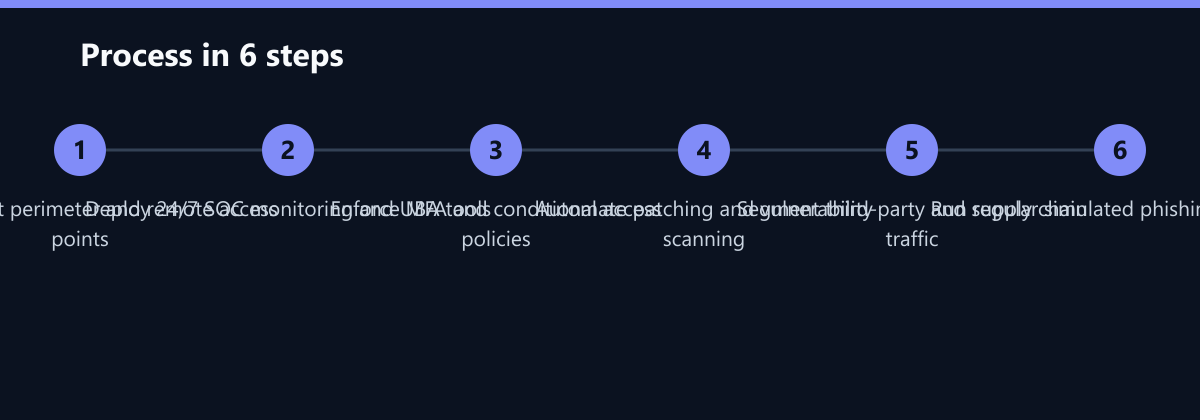
Typical Mistakes in Ransomware Defense
Even with an MSSP, organizations often make critical errors that undermine their security posture. Here are three common pitfalls:
- Ignoring Endpoint Detection: Relying solely on perimeter security while neglecting endpoint detection and response (EDR) tools. Ransomware often executes locally, making endpoint visibility crucial.
- Inconsistent MFA Enforcement: Allowing exceptions for MFA for “convenience” or legacy applications. These exceptions become the primary entry points for attackers.
- Lack of Segmentation: Treating the entire network as a flat environment. Without proper segmentation, a single compromised device can lead to a full network breach.
How You Measure Success
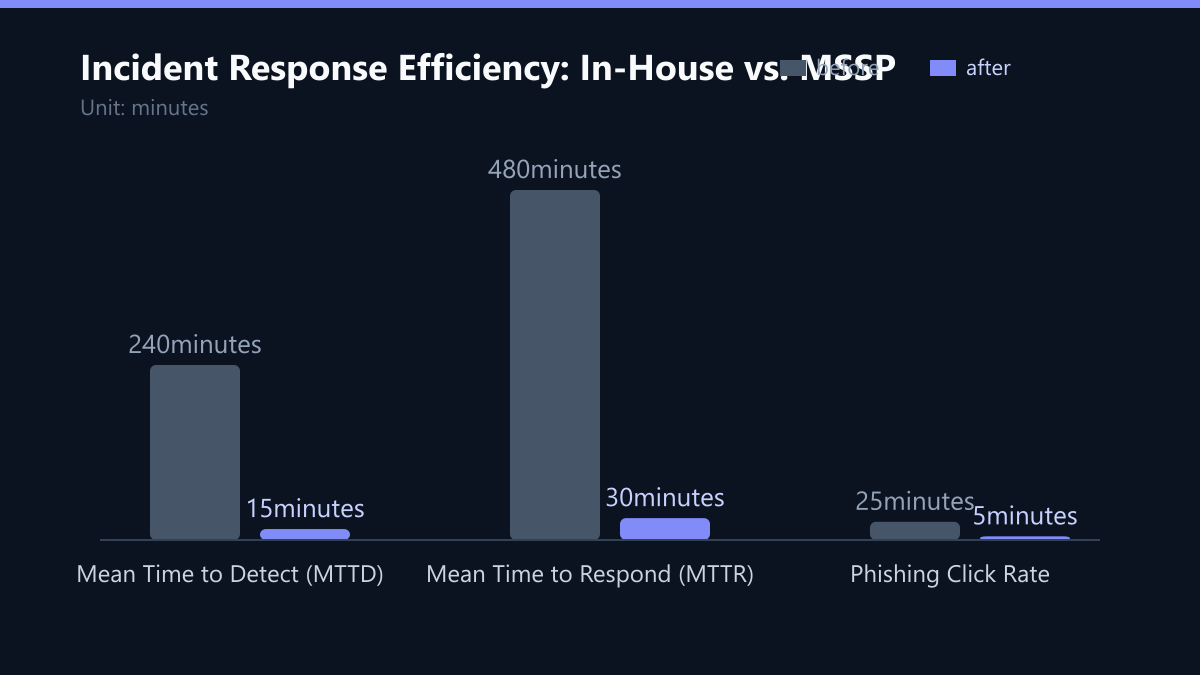
To determine if your MSSP and security strategy are effective, you must track specific Key Performance Indicators (KPIs). These metrics provide a clear picture of your security posture and response efficiency.
| KPI | Target | Method |
|---|---|---|
| Mean Time to Detect (MTTD) | < 15 minutes | Time from threat initiation to SOC alert. |
| Mean Time to Respond (MTTR) | < 30 minutes | Time from alert to containment/isolation. |
| Phishing Click Rate | < 5% | Percentage of employees clicking simulated phishing links. |
| Patch Compliance | > 95% | Percentage of critical patches applied within 7 days. |
Regularly reviewing these metrics ensures that your security investments are translating into tangible risk reduction. A decreasing MTTD and MTTR indicate an improving detection and response capability.
Checklist for Ransomware Resilience
Use this numbered checklist to assess your current readiness and identify gaps in your defense strategy:
- Audit Remote Access: Verify that MFA is enforced on all RDP and VPN entry points.
- Review Patch Management: Confirm that automated patching is active for all critical systems.
- Test Email Filtering: Send a simulated phishing email to a random group of employees to gauge awareness.
- Map Third-Party Connections: Identify all vendors with network access and assess their security posture.
- Validate Segmentation: Ensure that critical data stores are isolated from general user networks.
- Backup Verification: Perform a test restore of critical data to ensure backups are viable and offline.
By systematically addressing these vectors and measuring your progress, you transform your security posture from reactive to proactive. This resilience is not just about preventing attacks; it is about ensuring that if an attack occurs, your business can recover quickly with minimal impact.
Passend dazu
- Cloud Services & Cloud Migration
- Managed IT Services (MSP)
- Managed Security (MSSP)
- 5 Common Bottlenecks in Manual Data Entry and How to Automate Them Safely
- 5 Common Errors in Legacy Software Cloud Migration and How to Avoid Them
- IT Security in the Mid-Market: 5 Common GDPR Violations and How to Prevent Them
- 5 Common IT Support Mistakes That Increase Operational Costs