The Operational Bottleneck
In the fast-paced environment of London’s fintech sector, speed is not just a competitive advantage; it is a survival mechanism. Our client, a B2B fintech scale-up with 150 employees, was experiencing a severe disconnect between their rapid growth in new client acquisitions and their ability to onboard them efficiently. The core issue was a manual, fragmented onboarding process that had become a critical bottleneck for revenue recognition.
With a surge in B2B clients, the existing workflow relied heavily on human intervention for data entry and compliance checks. Staff members were manually cross-referencing identity documents, bank details, and risk assessments across multiple disparate platforms. This labor-intensive approach resulted in an average setup time of 14 days. For a fintech promising seamless digital experiences to its customers, this delay was unacceptable, leading to frustrated prospects, increased churn risk, and rising operational costs for both the IT and compliance teams.
The Challenges
The primary challenge was not a lack of data, but the fragmentation of that data. Information was scattered across various legacy systems, email threads, and file storage solutions. Staff had to manually copy-paste data from PDFs into structured databases, a process that introduced a significant 12% error rate in initial data capture. These errors often required subsequent manual corrections, further delaying the onboarding process and increasing the risk of compliance violations.
Additionally, the team faced a capacity crisis. As client volume grew, the number of hours spent on routine data entry skyrocketed, leaving little time for complex compliance reviews or strategic initiatives. The client needed a scalable solution that could maintain high security standards while drastically reducing human intervention in routine tasks. The solution had to be robust enough to handle unstructured documents like signed contracts and KYC forms, yet precise enough to meet strict regulatory requirements.
The Tech Stack
We selected a cloud-native, AI-driven approach to address these challenges. The core of the solution was built on the following technologies:
- Microsoft Azure AI: Utilized for advanced document intelligence and natural language processing (NLP) to extract key data points from unstructured files.
- Power Automate: Configured to orchestrate the workflow, triggering AI agents and routing exceptions to human reviewers based on confidence scores.
- Azure Key Vault: Implemented for secure storage of sensitive credentials and API keys, ensuring compliance with security best practices.
- Existing CRM Integration: Custom connectors were developed to push validated data directly into the client’s CRM, eliminating manual re-entry.
Implementation: From Audit to Automation
The project was executed over an eight-week period, designed to minimize disruption to daily operations. We began with a comprehensive data mapping exercise, aligning internal CRM fields with the AI’s extraction capabilities. This step was crucial for ensuring that the AI understood the specific context of the client’s documents.
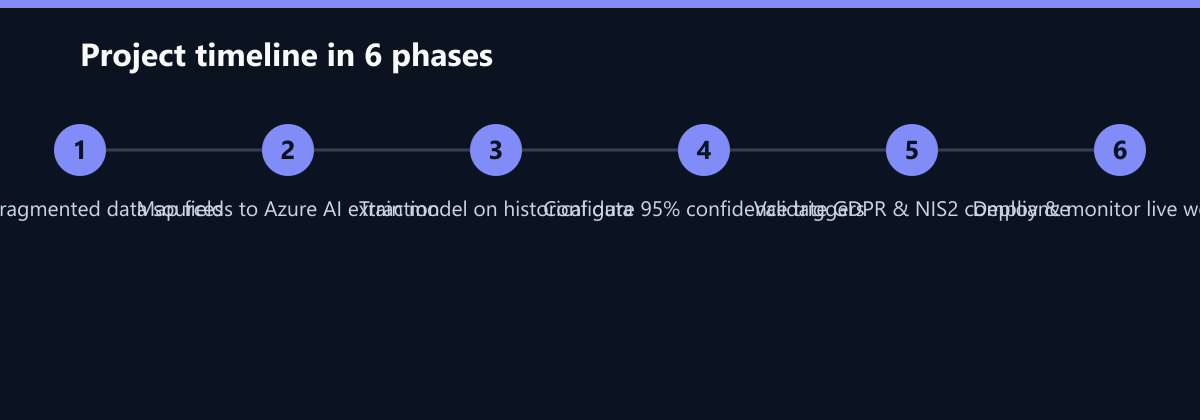
Next, we focused on agent training. We fed the model with a curated dataset of historical onboarding documents to improve recognition accuracy. This phase involved iterative testing, where we adjusted the NLP parameters to handle variations in document formats, such as different bank letterheads or identity document layouts. The goal was to achieve a high baseline accuracy before any live deployment.
A key architectural decision was the implementation of automated validation rules. We configured the system to check data consistency against external databases in real-time. For example, bank account numbers were validated against IBAN structures, and company registration numbers were cross-checked with official registries. This layer of automation ensured that even if the AI made a minor extraction error, the validation rules would catch it before the data was committed to the CRM.
How We Measured It
To ensure the success of the project, we established a clear set of Key Performance Indicators (KPIs) before deployment. The primary metric was the average onboarding time, measured from the moment a client initiated the sign-up process to the point where their account was fully activated and ready for use. We tracked this using timestamps in the CRM and the document management system.
We also monitored the error rate by comparing the data captured by the AI against the final verified data in the CRM. Any discrepancy was logged as an error, allowing us to calculate the initial error rate and track improvements over time. Team capacity was measured by analyzing the number of onboarding cases processed per employee per week, comparing this figure against the pre-implementation baseline. Finally, AI extraction accuracy was determined by a sample-based audit, where human reviewers manually verified the AI’s output against the source documents for a random subset of 10% of all onboarding cases.
The Results
The impact of the AI-driven onboarding agent was immediate and measurable. By automating the initial data capture and validation, the team eliminated most manual entry tasks. The system flagged anomalies with high precision, allowing human reviewers to focus solely on complex cases rather than routine checks.
The average onboarding time was cut in half, dropping from 14 days to just 7 days. This 50% reduction in time-to-value significantly improved the customer experience, as prospects could start using the platform much sooner. Furthermore, the decrease in manual data entry errors reached 80%, resulting in a much cleaner data foundation for the company’s analytics and compliance reporting.
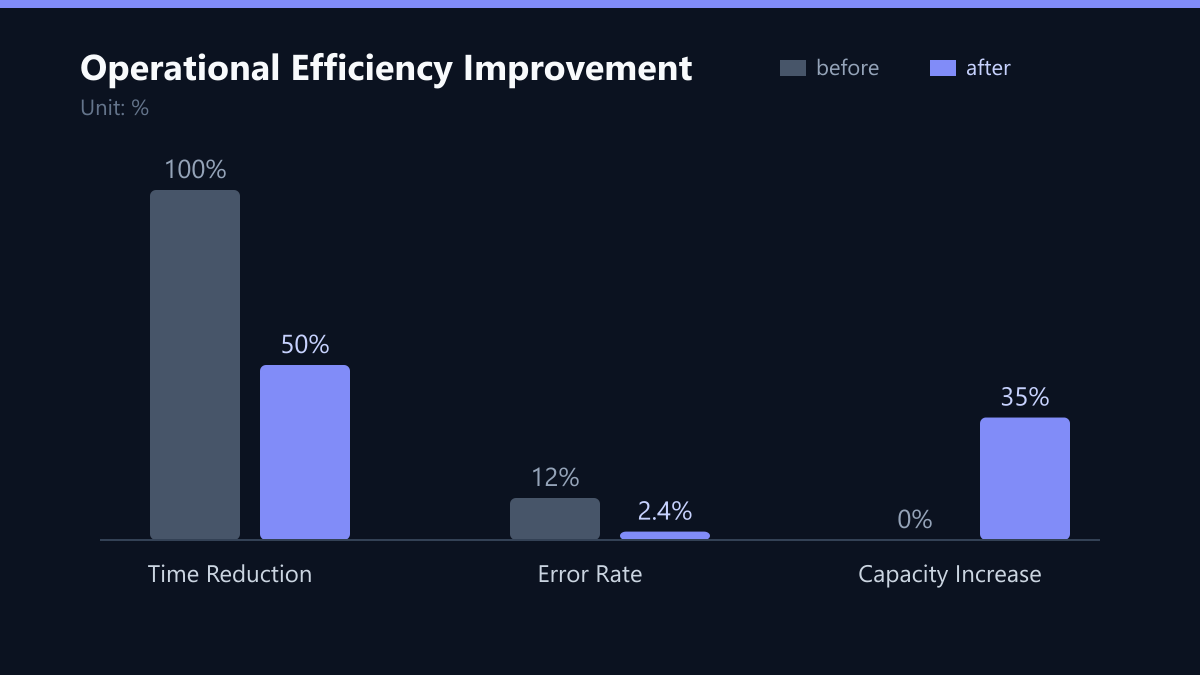
Perhaps most importantly, the onboarding team saw a 35% increase in capacity. With routine tasks automated, the team could handle a higher volume of new clients without hiring additional staff. The AI data extraction accuracy rate stabilized at 99.2%, well above the 95% confidence threshold required for automated processing. The client reported a significant improvement in their Net Promoter Score (NPS) for the onboarding phase, as customers experienced a smoother, faster, and more reliable sign-up process.
Lessons Learned
This project highlighted that AI is most effective when paired with clear human oversight protocols. The biggest gain was not just speed, but the standardization of data quality across all new accounts. By enforcing strict validation rules and confidence thresholds, we ensured that only high-quality data entered the system. This standardized data foundation has since enabled the client to offer more personalized services to their customers, based on accurate and complete profiles.
We also learned that change management is as critical as technical implementation. The onboarding team initially had concerns about the AI replacing their roles. By positioning the AI as a tool to eliminate tedious tasks and allow them to focus on high-value compliance work, we gained their buy-in and active participation in the training and testing phases.
What We Would Do Differently Today
While the project was successful, there are areas where we would refine our approach in future engagements. First, we would invest more time in the initial data mapping phase. In this project, we encountered several edge cases in document formats that were not represented in the initial training data. A more thorough audit of historical document variations would have allowed us to train the model more effectively from the start, potentially reducing the number of iteration cycles needed during the training phase.
Second, we would implement a more granular feedback loop for the AI model. Currently, the system learns from the corrections made by human reviewers, but this process is somewhat manual. In future projects, we would look into more automated retraining pipelines that can ingest these corrections in real-time, allowing the model to adapt more quickly to new document types or changes in regulatory requirements.
Finally, we would place greater emphasis on user experience design for the human-in-the-loop interface. While the current system is functional, the interface for reviewing exceptions could be more intuitive. A more streamlined review dashboard would further reduce the time it takes for human reviewers to resolve complex cases, maximizing the efficiency gains achieved by the AI.
Conclusion
The transformation of the onboarding process for this London-based fintech demonstrates the power of AI-driven automation in solving complex operational challenges. By leveraging Microsoft Azure AI and a robust workflow automation strategy, we were able to halve onboarding time, significantly reduce errors, and increase team capacity. This case study underscores the importance of combining cutting-edge technology with clear governance and human oversight to achieve sustainable results. For organizations looking to scale their operations while maintaining high standards of data quality and compliance, AI-driven onboarding offers a proven path forward.
Passend dazu
- IT Consulting & IT Strategy
- AI Consulting & AI Strategy
- Automating Customer Onboarding: Reducing Time-to-Value for B2B SaaS
- Mitigating AI Hallucinations in Customer Support
- Cloud Services & Cloud Migration
- IT Compliance & Data Protection
- IT & Data Recovery (Disaster Recovery)
- Berlin Fintech Cuts Audit Prep Time by 65% with Continuous Compliance
- Reducing Onboarding Friction for 500 New Employees in a UK Fintech via Centralized IT Support
- Cross-Border HR Onboarding Automation: Reducing Time-to-Productivity by 50% for Pan-European Tech Startups
- Hybride Azure-DR-Strategie: RTO auf 15 Minuten reduziert
- Cutting Document Search Time by 60% for a Singaporean Legal Practice
- AI-Driven Automation vs. Rule-Based RPA: Selecting the Right Fit
- Automating IT Onboarding and Offboarding in Hybrid Workplaces
- Headless Commerce Setup for a London Luxury Brand: Decoupling Frontend from Backend to Enable Faster Feature Releases
- Kollaborations-Setup für Kanzlei in London: Compliance-orientierte SharePoint-Architektur und Dokumentenkontrolle mit 100 Prozent Audit-Trail