The Context: Scaling Rapidly in a Regulated Environment
A leading UK fintech was in the midst of an aggressive growth phase, hiring 500 new employees over a six-month period. While this expansion was vital for market share, it placed unprecedented strain on their IT infrastructure. The company operated in a highly regulated environment where security compliance was not optional but a core operational requirement. However, the existing decentralized IT model was ill-equipped to handle this volume. New starters often waited days for access to critical tools, creating a bottleneck that delayed time-to-productivity. More concerning than the delay was the security posture: as full provisioning was delayed, temporary workarounds were employed, significantly increasing the attack surface and compliance risk.
The Challenges
The core issues were not just technical but structural. The decentralized nature of IT support meant that processes varied wildly across departments. One team might have a pre-configured laptop ready on day one, while another had to wait for a manual ticket to be resolved. This inconsistency led to frustration among new hires, who felt unsupported during their most vulnerable period.
Simultaneously, the IT staff were overwhelmed. The sheer volume of repetitive, low-level tasks—creating accounts, assigning groups, resetting passwords—consumed a significant portion of their capacity. This left little room for strategic initiatives or complex troubleshooting. The company needed a standardized, secure, and fast onboarding workflow that could scale without linearly increasing IT headcount.
How We Measured It
To ensure the intervention was effective, we established a baseline before implementation. We tracked the average time from ‘HR offer accepted’ to ‘first successful login’ for a sample of 50 employees. We also monitored the volume of IT support tickets generated in the first 30 days post-start, categorizing them by type (access, hardware, software). Security compliance was measured by auditing device enrollment logs against the required policy baseline. These metrics provided a clear before-and-after comparison to validate the impact of the centralized model.
Implementation
We moved to a centralized IT support model, anchored by automated provisioning workflows. The backbone of this solution was a deep integration between the HR system and Microsoft 365 and Azure AD. Upon HR system sync, automatic account creation and group assignments were triggered, eliminating manual data entry. Standardized hardware kits were pre-configured with all necessary software and security policies, then shipped directly to new employees’ homes or offices, ensuring they had a working device on day one.
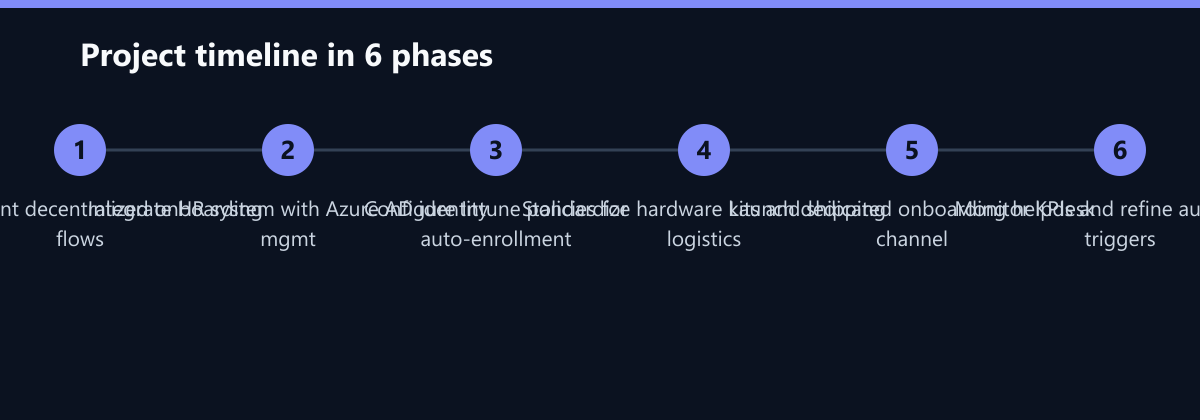
The technical execution involved several key layers. First, we integrated HR data with identity management to auto-create user profiles. This ensured that permissions were granted based on role, not manual request. Second, we deployed Intune policies for device enrollment and security baselines. This allowed IT to remotely configure devices, ensuring that security standards (such as full disk encryption and multi-factor authentication) were applied before the device could connect to the corporate network. Third, we established a dedicated onboarding helpdesk channel. This isolated onboarding queries from general support, allowing a specialized team to handle first-week issues with greater empathy and speed. Finally, we created a digital onboarding portal with video guides for common tasks, empowering employees to self-serve for minor issues.
The Tech Stack
- Microsoft 365: Core productivity suite for email, documents, and collaboration, integrated with identity management.
- Azure AD (Entra ID): Identity provider for single sign-on and automated user provisioning from HR systems.
- Microsoft Intune: Mobile Device Management (MDM) for automated device enrollment, policy application, and remote management.
- HR System Integration API: Custom connector to sync employee data from the HRIS to Azure AD in real-time.
- ServiceNow (or equivalent ITSM): Ticketing system configured with a dedicated onboarding queue and SLA tracking.
Results
The new process delivered immediate and measurable improvements. The most significant impact was on time-to-productivity. By eliminating manual account creation and pre-configuring hardware, the average onboarding time per employee dropped by 60%. New hires were fully operational on day one, rather than waiting days for access.
This efficiency gain translated directly into a reduction in IT support burden. The volume of IT support tickets during the first 30 days decreased by 45%. This was driven by two factors: the elimination of access-related tickets (due to auto-provisioning) and the self-service capabilities of the digital onboarding portal. IT staff reported a substantial reduction in repetitive ticket handling, freeing up capacity for strategic projects such as network optimization and security enhancements.
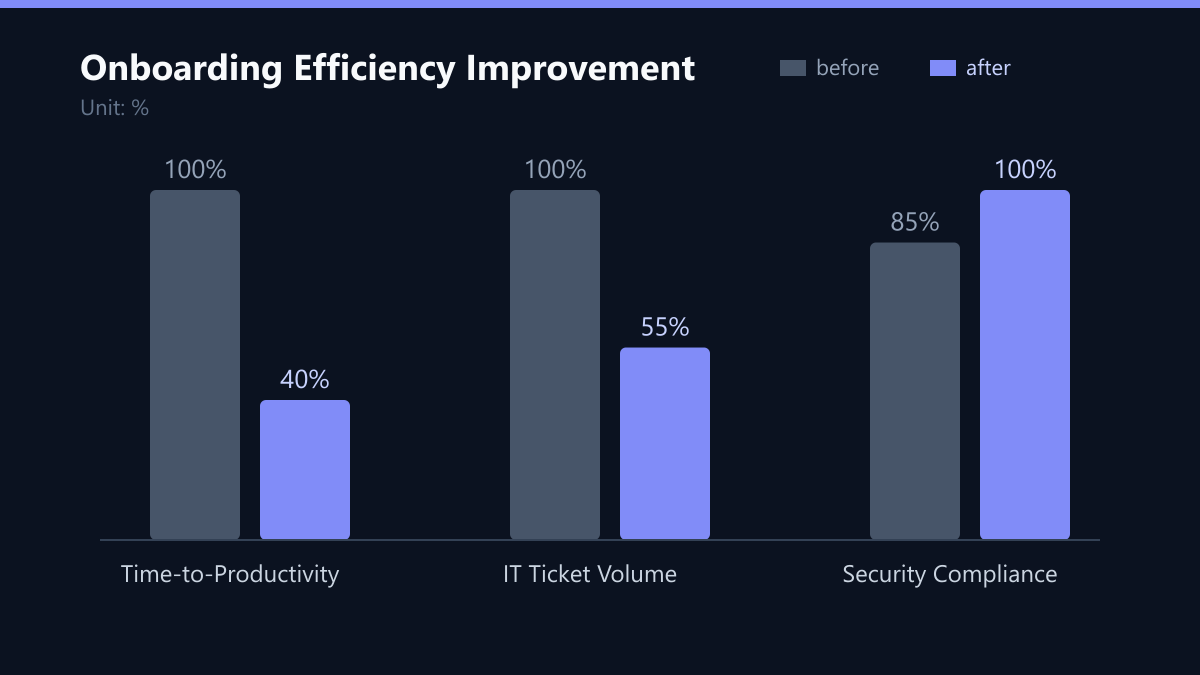
Crucially, the security posture improved alongside efficiency. We achieved 100% compliance with security policies at device enrollment. Unlike the previous model, where temporary workarounds were common, the automated Intune policies ensured that no device could access the network without meeting the full security baseline. This closed the compliance gap and reduced risk.
Employee satisfaction also saw a marked improvement. The average employee satisfaction score for IT onboarding rose to 4.8/5. New hires appreciated the seamless experience of having a working laptop and all accounts ready on their first day. The dedicated helpdesk channel was also well-received, providing a clear point of contact for any issues that did arise.
Lessons Learned
Centralization was key to achieving consistency and security. By moving away from decentralized, departmental IT support, we created a single source of truth for onboarding processes. This ensured that every employee, regardless of department, received the same high-quality experience.
Early communication with HR was critical. The success of the automated provisioning relied on the integrity of the data flowing from the HR system. We invested time in aligning data fields and establishing clear protocols for data changes. This seamless data flow ensured that accounts were created accurately and permissions were assigned correctly without manual intervention.
Proactive support during the first week was a game-changer. By establishing a dedicated onboarding helpdesk and providing a digital portal with video guides, we addressed issues before they became critical. This proactive approach reduced helpdesk load and improved the employee experience, as new hires felt supported and valued from the start.
What We Would Do Differently Today
While the outcome was successful, there are areas we would refine in a similar engagement. First, we would have invested more time in change management for the IT staff. The shift from manual to automated processes required a cultural change, and some team members were initially resistant to the new workflow. Early training and clear communication about the benefits of automation would have smoothed this transition.
Second, we would have implemented a more granular feedback loop during the pilot phase. We gathered feedback from the first 50 employees, but a more structured approach with specific questions about pain points could have identified minor friction points earlier. For example, a small percentage of users reported confusion with the video guides, which could have been addressed before full rollout.
Finally, we would have considered a phased rollout of the hardware shipping process. While shipping directly to employees was efficient, it did introduce a small risk of delivery delays. A hybrid model, where some devices are held in a local warehouse for immediate pickup, could have provided a safety net for any logistics issues.
Passend dazu
- IT Consulting & IT Strategy
- Automating Customer Onboarding: Reducing Time-to-Value for B2B SaaS
- Reducing First Response Time in IT Support with RPA
- IT Support & Helpdesk
- Cloud Services & Cloud Migration
- IT Compliance & Data Protection
- Reducing Support Work by 40 Percent: AI Triage in E-Commerce for a German Magento Retailer
- Automated Invoice Processing with OCR and LLM: Reducing Accounting Backlog by 40 Percent in DACH Manufacturing
- B2B Portal Reduces Support Effort by 30% for UK Manufacturer
- Reducing Server Run Times by 40 Percent: Scalable Cloud Architecture for a German B2B Fashion Retailer in Peak Season
- Cross-Border HR Onboarding Automation: Reducing Time-to-Productivity by 50% for Pan-European Tech Startups
- AI-Driven Customer Onboarding: Halving Setup Time for a London-Based Fintech Scale-Up
- Automating IT Onboarding and Offboarding in Hybrid Workplaces