The Silent Erosion of Marketing ROI
The client, a mid-sized D2C cosmetics manufacturer with 45 employees based in Spain, operates across Southern Europe. Like many brands in the beauty sector, their growth strategy relied heavily on email and SMS marketing via Klaviyo. However, by early 2024, the team noticed a troubling trend: marketing spend was increasing, but the return on investment (ROI) was stagnating. The culprit was not a lack of creative effort, but a fundamental breakdown in data integrity caused by browser privacy updates.
Traditional client-side tracking, which relied on third-party cookies, was becoming unreliable. As browsers like Safari and Chrome began blocking these trackers, the client’s view of the customer journey fragmented. They could see a user click an email, but they could no longer reliably track if that user completed a purchase, especially if the user switched devices or cleared their cache. This led to a “black box” effect where high-value segments were misidentified, and budget was wasted on low-performing channels.
The core issue was not just technical; it was strategic. Without accurate attribution, the brand could not determine which campaigns drove repeat purchases. In a competitive market where customer acquisition costs are high, retaining existing customers is the most efficient path to growth. The client needed a solution that was privacy-compliant, accurate, and fast to deploy.
The Challenges
Before diving into the solution, it is important to understand the specific hurdles the team faced. These were not generic IT problems, but specific barriers to data accuracy.
- Fragmented Customer Identity: The same customer often appeared as multiple distinct profiles in the CRM. One profile might have purchase history from a desktop session, while another had browsing data from a mobile app. This split prevented the creation of a unified customer view.
- Attribution Blind Spots: With third-party cookies blocked, the “last click” attribution model was failing. A customer might read a newsletter on Monday, browse on Tuesday, and buy on Wednesday. If the Tuesday session was lost due to cookie blocking, the email campaign received no credit, leading to underinvestment in email.
- GDPR Compliance Risks: The client was operating in a strict regulatory environment. They needed to ensure that any new tracking method did not violate data minimization principles or consent requirements, making simple “workarounds” for cookie blocking legally risky.
The Tech Stack
To solve these issues, we utilized a specific set of tools designed for server-side data handling. Each component played a distinct role in the architecture.
- Klaviyo Server-Side API: The primary destination for data, allowing direct ingestion of events without relying on the browser.
- Shopify Functions & Webhooks: The source of truth for transactional data, capturing real-time events like purchases and cart additions directly from the e-commerce platform.
- Custom Node.js Middleware: A lightweight server deployed on AWS Lambda to receive, validate, and forward data from Shopify to Klaviyo.
- Hashing Library: Used to anonymize customer identifiers (email and phone numbers) in transit, ensuring compliance with data protection standards.
Implementation Strategy
We approached the project not as a simple “fix,” but as a data architecture overhaul. The goal was to move the tracking logic from the client’s browser to the client’s server, where it is immune to browser privacy settings.
The process began with a comprehensive data audit. We mapped every critical event in the customer journey: from “Viewed Product” to “Added to Cart” to “Purchased.” We identified which events were currently being lost or misattributed. This baseline allowed us to measure the impact of the new system later.
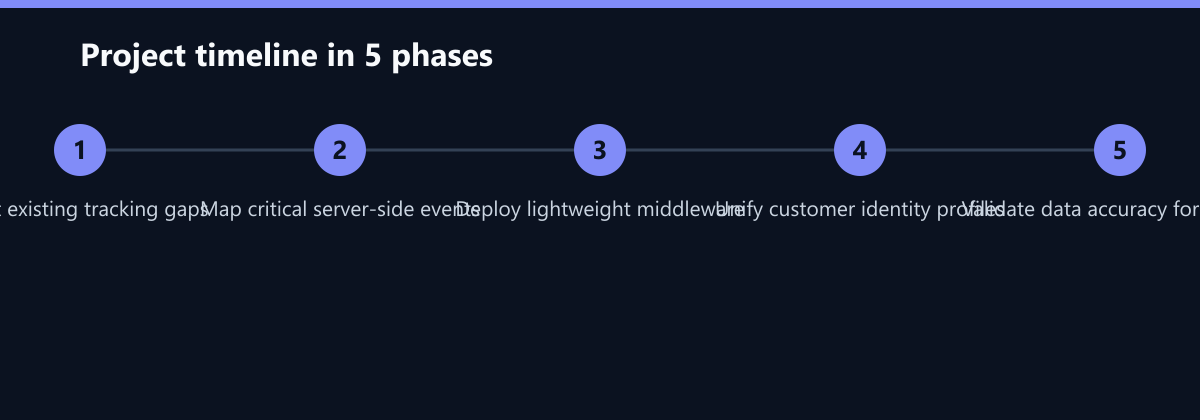
Next, we built the middleware. This was a critical step. Instead of relying on the browser to send data to Klaviyo, we set up a server-side endpoint that listened to Shopify webhooks. When a customer made a purchase, Shopify sent a webhook to our middleware. The middleware then validated the data, enriched it with any necessary context, and pushed it directly to Klaviyo via the Server-Side API. This bypassed the browser entirely, ensuring that the event was recorded even if the customer’s browser was in private mode or had cookies disabled.
A major part of the implementation was Identity Resolution. We unified customer profiles by using hashed email addresses as the primary key. If a customer had a profile in Klaviyo from a previous cookie-based session, and now made a purchase via the server-side path, the system linked these two data points. This created a single, robust profile for each customer, regardless of the device or browser they used.
Finally, we updated the attribution model within Klaviyo. We moved away from a simple last-click model to a weighted multi-touch model. This allowed the platform to credit multiple touchpoints along the journey. For example, an email that introduced a product might get 30% of the credit, while the final SMS reminder got 70%. This provided a much more accurate picture of channel performance.
The entire setup was completed within six weeks. This timeline included two weeks for data mapping and middleware development, two weeks for integration and testing, and two weeks for validation and team training. The team was trained on how to interpret the new data and how to adjust their campaign strategies based on the new insights.
How We Measured It
To ensure the results were not just anecdotal, we established a rigorous measurement framework before the go-live. We selected three core KPIs that directly reflected the business goals: repeat purchase rate, email ROI, and data discrepancy rate.
Repeat Purchase Rate was calculated as the percentage of customers who made a second purchase within 90 days of their first purchase. We compared this metric from the three months prior to implementation with the three months following. We segmented this data by customer cohort to ensure that the improvement was not due to external market factors.
Email ROI was measured by dividing the revenue attributed to email campaigns by the cost of the email program (including tool costs and labor). We used the new multi-touch attribution model to ensure that revenue was accurately credited to email, rather than being lost to last-click bias. We compared the ROI index (where 100 is the baseline) before and after.
Data Discrepancy Rate was a technical metric. We compared the number of transactions recorded in Shopify with the number of transactions recorded in Klaviyo. A discrepancy rate of 0% was the target. We measured this by running automated scripts that checked for missing or mismatched order IDs between the two systems. A high discrepancy rate indicated data loss or tracking errors.
Results
Within three months of the implementation, the impact was clear. The shift to cookieless, server-side attribution provided the brand with a clear, unobstructed view of their customer base.
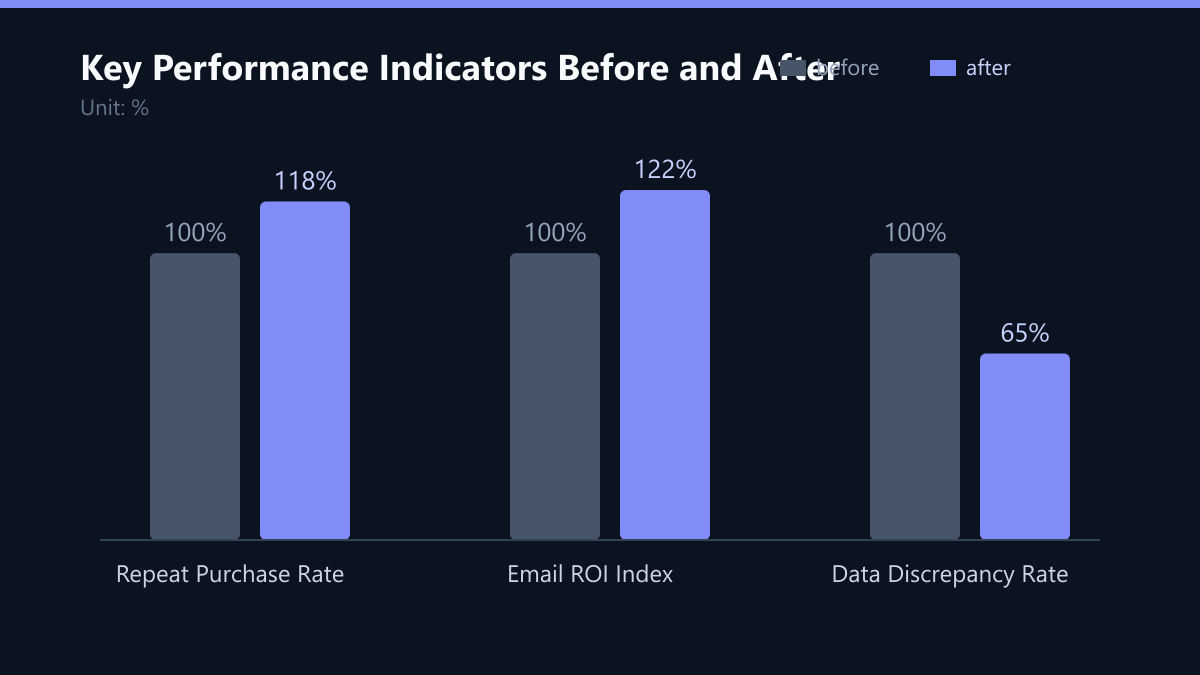
The most significant outcome was the 18% increase in repeat purchase rate among targeted segments. By accurately identifying customers who had shown interest but not yet purchased, the team could send highly relevant re-engagement emails. These emails were no longer generic; they were tailored to the specific products the customer had viewed, thanks to the reliable server-side data.
Additionally, the brand saw a 22% improvement in email ROI. Because the attribution model now correctly credited email for its role in the journey, the team could see which specific campaigns and segments were driving revenue. This allowed them to double down on high-performing strategies and pause underperforming ones, optimizing their budget allocation.
Perhaps the most critical operational improvement was the 35% reduction in data discrepancies. The automated validation scripts showed that the gap between Shopify and Klaviyo data had narrowed significantly. This meant that the marketing team could trust the numbers they were seeing. Decisions made based on this data were now based on reality, not estimates.
Finally, the solution ensured full GDPR compliance. By relying on first-party data and explicit consent, the brand eliminated the legal risks associated with third-party cookie tracking. This provided peace of mind and allowed the brand to focus on growth rather than compliance anxiety.
What We Would Do Differently Today
While the project was successful, there are areas where we would adjust our approach in future engagements.
First, we would invest more time in the initial data mapping phase. In this project, we spent two weeks on mapping, but some edge cases in the customer journey were not fully identified until the testing phase. A more thorough audit upfront could have saved time during integration.
Second, we would provide more training on the new attribution model. While the team was trained on how to use the tool, understanding the nuances of multi-touch attribution took longer than expected. We would now include a dedicated workshop on data interpretation to ensure the team can fully leverage the insights.
Lessons Learned
This project reinforced a critical lesson for D2C brands: first-party data ownership is no longer optional; it is essential. In the post-cookie era, relying on client-side tracking creates blind spots that directly impact marketing effectiveness. Brands that continue to rely on third-party cookies are operating with incomplete data, leading to poor decision-making and wasted budget.
Server-side tracking is the standard for accurate attribution in 2024 and beyond. It provides a reliable, privacy-compliant way to capture customer behavior. However, it is not a magic bullet. It requires clean data hygiene and unified customer profiles to be effective. The foundation of a successful Klaviyo strategy is not just the tool, but the quality of the data feeding into it.
For businesses in regulated markets like the EU, this approach ensures long-term sustainability. It allows brands to grow their customer base while respecting privacy laws. The result is a more predictable and scalable growth model, where marketing efforts are driven by data, not guesswork. For the Spanish cosmetics brand, this shift transformed their marketing from a cost center into a primary driver of revenue.
Passend dazu
- Magento 2 Multi-Store Setup for Regional Pricing and Tax Compliance in DACH and EU
- Multi-Currency and Multi-Language Setup for European E-Commerce
- The 3-2-1-1-0 Backup Rule: A Practical Implementation Guide for IT Managers
- IT Consulting & IT Strategy
- AI Consulting & AI Strategy
- 3DS Backup Verification: Why Regular Restore Tests Are Mandatory
- 5 Causes of IT Helpdesk Productivity Loss and AI Solutions
- Cloud Services & Cloud Migration
- IT Compliance & Data Protection
- E-Commerce Development
- KI-Suchmaschinen-Ranking für eine spanische Logistik-Software: Steigerung der organischen Klicks um 40%
- Entwicklung einer IoT-Steuerungsplattform für einen Fertigungsautomatisierer: 25 Prozent Reduktion der Stillstandzeiten in der Produktion
- Automatisierung der Kreditorenbuchhaltung bei einem deutschen Maschinenbauer: Reduktion der Durchlaufzeit um 60 Prozent
- Prozessautomatisierung im Kundenservice eines britischen E-Commerce-Unternehmens: Senkung der Ticket-Arbeit durch KI-Chatbots
- Multi-Channel-Integration: Bestandsmanagement über 3 Marktplätze für einen US-Food-Distributor