The Bottleneck: When Manual Entry Slows Down Science
For a Berlin-based biotech startup with 45 employees, the path to clinical trial approval was not blocked by a lack of scientific innovation, but by an invisible administrative drag. The core issue was the preparation of clinical trial data. The team relied on manual extraction from a heterogeneous mix of source documents—ranging from scanned PDFs of lab reports to complex Excel sheets. This process consumed 40% of the data team’s weekly capacity, a significant drain on a lean organization.
The impact was immediate and tangible. Regulatory submissions were delayed, not because the science wasn’t ready, but because the data wasn’t clean. The reliance on error-prone copy-paste methods led to frequent data quality issues. Every error meant rework, every rework meant lost time. In an industry where speed-to-market is a competitive advantage, this bottleneck was a critical risk. The leadership recognized that the manual process was not just inefficient; it was a single point of failure for their entire regulatory pipeline.
The Challenges: Navigating Unstructured Data in a Regulated Environment
The task was not simply to automate data entry; it was to do so in a high-stakes, regulated environment where accuracy is non-negotiable. We identified three core challenges that had to be addressed before any solution could be designed.
First, the heterogeneity of source data. The documents were not standardized. Some were clean digital PDFs, others were scanned images with varying quality. The AI needed to handle both structured and unstructured data seamlessly. Second, the domain-specific complexity. Medical terminology is precise and context-dependent. A generic AI model would struggle to distinguish between similar terms or understand the nuance of clinical metrics. Third, the integration risk. The solution had to plug into the client’s existing Laboratory Information Management System (LIMS) without disrupting ongoing operations. A failed integration would have halted the data flow entirely, creating a crisis rather than solving one.
The Tech Stack: Building a Robust AI Pipeline
To address these challenges, we designed a custom AI pipeline integrated with Microsoft Azure. The stack was chosen for its scalability, security, and ability to handle complex AI workloads.
- Microsoft Azure AI Services: Provided the foundational infrastructure for document processing and natural language understanding.
- Fine-tuned Large Language Model (LLM): A specialized model trained on the client’s historical data to understand specific medical terminology and clinical trial structures.
- Azure Data Factory: Orchestrated the data flow between source documents, the AI processing layer, and the LIMS.
- Power BI: Used for real-time monitoring of pipeline performance and data quality metrics.
- Azure DevOps: Managed the CI/CD pipeline for continuous deployment and updates to the AI model.
Implementation: From Baseline to Automated Pipeline
The implementation was structured into six weeks of intensive work, divided into three phases: discovery, development, and deployment.
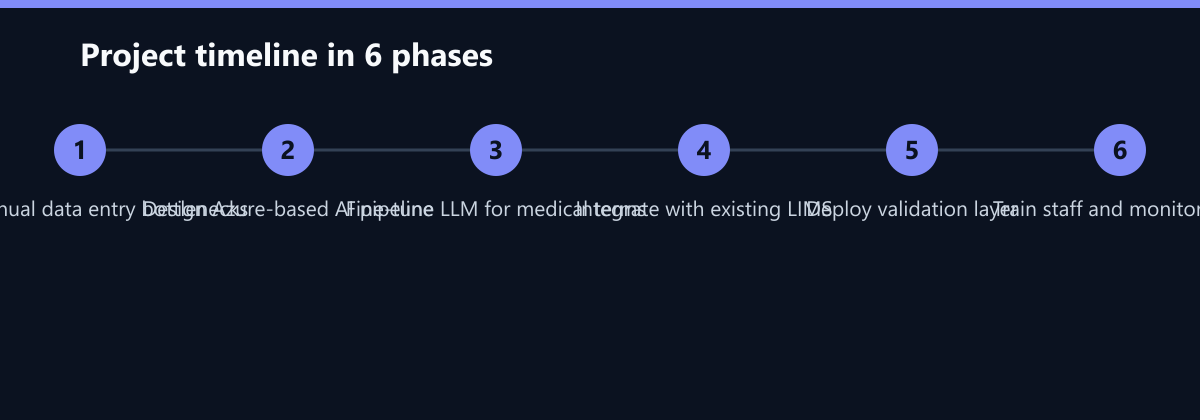
Phase 1: Discovery and Baseline (Weeks 1-2) We began by auditing the current manual process. We tracked the time spent on each step of the data entry workflow and measured the error rate. This gave us a clear baseline: 40% of weekly capacity was consumed by manual extraction, and data accuracy was at 92%. We also mapped the data flow to identify integration points with the LIMS.
Phase 2: Development and Training (Weeks 3-5) This was the core of the project. We developed the document ingestion module to parse PDFs and scanned reports. The AI model was fine-tuned using a dataset of historical clinical documents, ensuring it could accurately identify and structure key clinical metrics. Crucially, we built a validation layer. This rule-based system flagged anomalies and low-confidence predictions for human review. This human-in-the-loop approach was essential for maintaining data integrity in a regulated environment.
Phase 3: Integration and Deployment (Week 6) The final phase focused on integrating the pipeline with the client’s LIMS. We tested the end-to-end workflow, ensuring that data flowed seamlessly from source documents to the LIMS. We also trained the data team on the new system, emphasizing the importance of reviewing flagged anomalies.
How We Measured It: Defining Success
To ensure the solution delivered tangible value, we defined clear KPIs and established a measurement methodology. We tracked three core metrics:
- Trial Preparation Time: Measured as the total time from data receipt to LIMS entry. We compared the average time before and after implementation.
- Data Accuracy: Measured as the percentage of records that passed validation without manual correction. We tracked this metric weekly to monitor trends.
- Hours Saved per Analyst: Calculated by comparing the pre-implementation time spent on manual entry with the post-implementation time spent on validation and exception handling.
We used Azure Monitor and Power BI to collect and visualize this data in real-time. This allowed us to identify any issues quickly and make data-driven adjustments to the pipeline.
Results: Measurable Efficiency Gains
The impact of the AI-driven extraction pipeline was immediate and significant. The automation reduced manual data entry time by 30%, freeing up staff for higher-value analysis. Data accuracy improved from 92% to 99.5%, significantly reducing rework. The startup accelerated its trial preparation phase, enabling earlier submission to regulatory bodies.
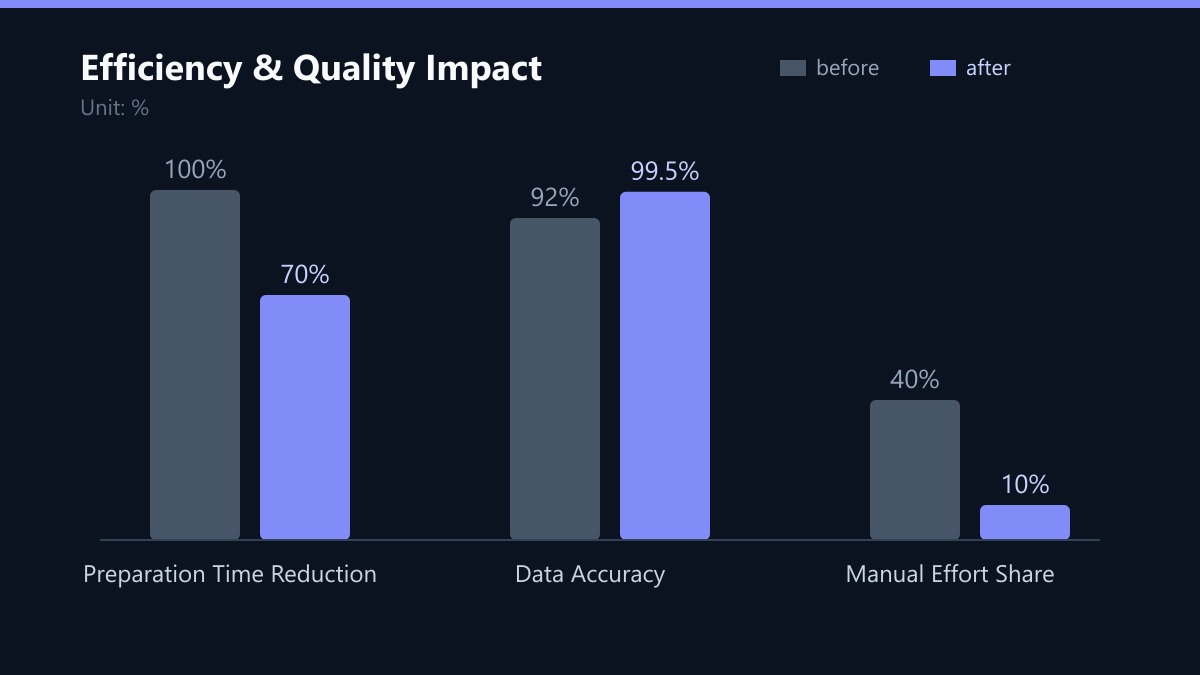
The 20 hours saved per week per analyst were not just a number; they represented a fundamental shift in the team’s workflow. Analysts were no longer bogged down by repetitive data entry. Instead, they could focus on data analysis, quality control, and strategic insights. This shift not only improved efficiency but also enhanced job satisfaction and retention. The improved data accuracy also reduced the risk of regulatory penalties and delays, providing a significant financial and reputational benefit.
Lessons Learned: The Value of Human-in-the-Loop
This case study highlights several key lessons for organizations considering AI automation in regulated industries.
First, human-in-the-loop is essential. While AI can handle the bulk of extraction, a human validation step is critical for high-stakes data. The system’s ability to flag low-confidence predictions proved vital for maintaining data integrity. Removing this step would have introduced unacceptable risk.
Second, early integration is key. Integrating with the client’s LIMS from the start ensured seamless workflow adoption. A bolt-on solution would have created friction and reduced user acceptance. We recommend starting with integration requirements in the discovery phase.
Third, specialized models outperform generic ones. A fine-tuned LLM for medical terminology provided significantly better accuracy than a general-purpose model. Investing in domain-specific training is crucial for achieving high-quality results.
What We Would Do Differently Today
While the project was a success, there are areas where we would refine our approach if we were to do it again.
- Expand the Validation Layer: We would invest more time in developing the rule-based validation layer. A more robust set of rules would have reduced the number of anomalies flagged for human review, further increasing efficiency.
- Automate Model Retraining: We would implement a more automated process for retraining the AI model as new data becomes available. This would ensure the model remains accurate and up-to-date without manual intervention.
- Enhance User Experience: We would focus more on the user experience of the validation interface. A more intuitive interface would have made it easier for analysts to review and correct anomalies, further reducing the time spent on validation.
Conclusion: Accelerating Innovation Through Automation
For this Berlin-based biotech startup, the AI-driven data extraction pipeline was not just a technical upgrade; it was a strategic enabler. By cutting trial preparation time by 30% and improving data accuracy to 99.5%, the team was able to focus on what they do best: scientific innovation. The solution demonstrated the power of combining specialized AI models with robust cloud infrastructure to solve complex problems in regulated industries. As the startup continues to grow, this automated pipeline will serve as a scalable foundation for future data-intensive initiatives.
Passend dazu
- 5 Common Bottlenecks in Manual Data Entry and How to Automate Them Safely
- IT & Data Recovery (Disaster Recovery)
- IT Consulting & IT Strategy
- AIOps in Mid-Market Companies: Automated Root-Cause Analysis Without a Data Science Team
- Automated Compliance Reporting: Saving Time with AI in IT Audits
- IT Compliance & Data Protection
- Cloud Services & Cloud Migration
- E-Commerce Development
- Accelerating Compliance Audits in the Financial Sector
- Scaling a Berlin E-Commerce Startup to 50,000 Monthly Orders
- Fintech Startup in Berlin: Multi-Cloud Strategy Reduces Vendor Lock-In Risks
- GDPR Audit in Manufacturing: Risk Reduction via Automated Data Classification
- Remote IT Support Security: Best Practices for Protecting Sensitive Data
- Understanding MSP Pricing Models: Hourly, Per User, or Outcome-Based Contracts Explained
- Accelerating Data Analysis by 50% with Cloud Infrastructure in US Healthcare
- Healthcare Data Protection: Reducing HIPAA Violations by 70 Percent via Micro-Learning for Clinical Staff
- Outsourcing vs. Insourcing: A Data-Driven Decision Model for CIOs
- Data Loss Prevention vs Data Recovery: Clarifying the Difference
- Building a Secure Azure Landing Zone for Data-Intensive AI Workloads
- Reduce GDPR Audit Costs by 30% with Automated Data Mapping
- From Excel Chaos to Automated Dashboards: Implementing Power BI and Azure Data Factory
- SOC 2 Type II Preparation for SaaS Companies Targeting US Enterprise Clients