The Initial Bottleneck
In the high-stakes environment of automotive manufacturing, data is not just information; it is the lifeline of quality assurance. For a Tier-1 automotive supplier based in Munich, the gap between sensor data generation and actionable insight had become a critical operational liability. With 350 employees across the DACH region, the company operated a complex assembly line that generated a staggering 2 TB of raw sensor data every single day. This data stream, captured by high-frequency sensors monitoring torque, temperature, and alignment, was the primary input for real-time quality control decisions.
However, the infrastructure supporting this data flow was archaic relative to its importance. The architecture relied on a centralized cloud model where all raw data was transmitted from the factory floor to a remote data center for processing. This design created a severe bottleneck. Engineers and quality control managers were waiting up to 15 minutes for insights that should have been available in real-time. In a production environment where a single defect can trigger a line stoppage or a recall, a 15-minute lag was unacceptable. It slowed down defect detection, delayed corrective actions, and ultimately threatened the efficiency of the entire production cycle.
The Challenges
The root causes of this latency were multifaceted, stemming from both hardware limitations and architectural design flaws. The existing setup was not merely slow; it was fragile and unsustainable for future growth.
- Single Point of Failure: The initial data aggregation relied on a single on-premise server. If this server failed, the entire data pipeline halted. There was no redundancy, no failover mechanism, and no distributed processing capability.
- Bandwidth Saturation: The network uplink was operating at 90% capacity, saturated by the transfer of raw, unfiltered data. This not only caused latency but also left no headroom for other critical business applications, such as ERP systems or communication tools, leading to intermittent network congestion.
- Scalability Constraints: The architecture was static. Adding a new production line or increasing sensor density required major hardware upgrades and network re-engineering. The system could not scale horizontally, making it difficult to adapt to the increasing complexity of modern automotive manufacturing, which demands more data points per unit.
The Tech Stack
To address these issues, we selected a hybrid edge-cloud architecture that leveraged industrial-grade hardware and robust cloud services. The following tools formed the core of the solution:
- Industrial Edge Servers: Ruggedized devices capable of withstanding factory environments (dust, heat, vibration), deployed at each production line.
- Docker Containers: Used for lightweight, consistent deployment of data filtering and aggregation logic on the edge.
- Azure IoT Hub: The central ingestion point for pre-processed data, ensuring secure and scalable cloud integration.
- VLANs and QoS Rules: Network segmentation tools to isolate control data from general traffic and prioritize critical packets.
- Mutual TLS (mTLS): For end-to-end encrypted and authenticated communication between edge devices and the cloud.
Implementation: Moving Intelligence to the Edge
The solution was designed to shift the burden of processing from the cloud to the factory floor. By deploying industrial edge devices at each production line, we enabled local filtering and aggregation of data. Only the relevant, pre-processed data packets were transmitted to the cloud, drastically reducing the volume of data in transit.
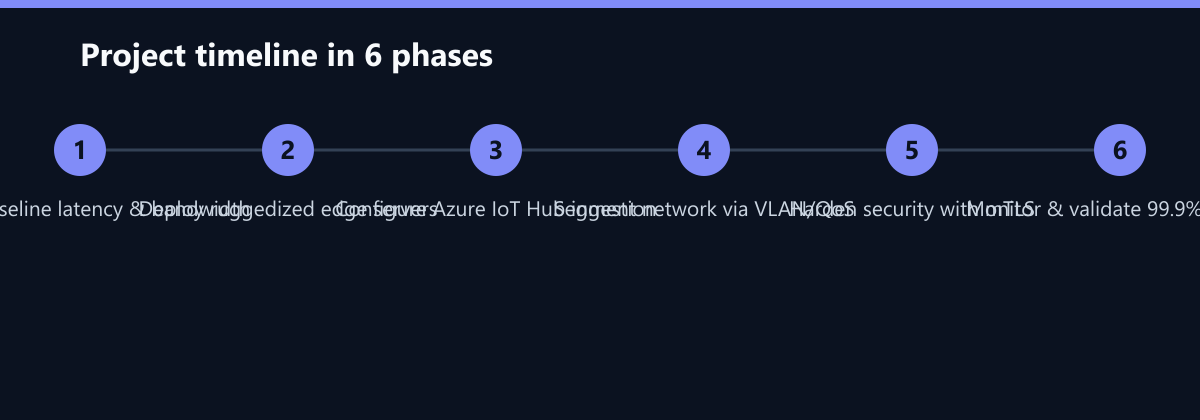
The implementation was executed in four distinct phases over a period of eight weeks. The first phase involved a detailed baseline assessment, where we mapped the data flow and identified the specific points of congestion. We measured the raw data volume, the network utilization, and the exact latency points in the current pipeline. This data served as the benchmark for our success metrics.
In the second phase, we deployed the ruggedized edge servers. These devices were configured to run Docker containers that executed custom data filtering algorithms. The algorithms were designed to discard noise and redundant data points locally, ensuring that only high-value information was passed upstream. This local processing was the key to reducing bandwidth consumption.
The third phase focused on cloud integration and network optimization. We configured Azure IoT Hub to ingest the streamlined data packets. Simultaneously, we segmented the factory network using VLANs. Quality of Service (QoS) rules were implemented to prioritize control data over other traffic, ensuring that even if the network was busy, critical quality control signals would always get through. This step was crucial for maintaining the integrity of real-time operations.
Finally, the fourth phase involved security hardening and validation. We implemented mutual TLS authentication for all edge-to-cloud communications, ensuring that only authorized devices could send data to the cloud. Data was encrypted at rest and in transit. We then conducted extensive load testing, simulating peak production scenarios to verify that the new architecture could handle the 2 TB daily data load without degradation in performance.
How We Measured It
To ensure the results were objective and verifiable, we established a rigorous measurement framework. Latency was measured end-to-end, from the moment a sensor triggered an event to the moment the insight was available in the quality control dashboard. We used network probes to capture packet timestamps at the edge and at the cloud ingestion point. Bandwidth consumption was monitored via network interface counters on both the edge devices and the cloud gateway, comparing the total bytes transferred before and after the optimization. Uptime was tracked using a lightweight monitoring stack deployed on the edge devices, which reported heartbeats to a central observability platform. This allowed us to calculate the system availability with high precision over a 30-day stabilization period.
Results: From Minutes to Seconds
The transformation of the data pipeline was immediate and profound. The new hybrid architecture turned a bottleneck into a strategic asset. Real-time insights became available within seconds, enabling immediate corrective actions on the production line.
The key performance indicators demonstrated a significant improvement in operational efficiency:
- 50% Reduction in Processing Time: Data availability was reduced from 15 minutes to under 5 seconds. This meant that quality control engineers could react to defects in real-time, preventing the production of faulty units.
- 60% Bandwidth Savings: The volume of raw data transferred to the cloud decreased significantly. By filtering data at the edge, we reduced the network load by more than half, freeing up bandwidth for other critical applications.
- 99.9% Uptime: The distributed nature of the edge processing, combined with automated failover mechanisms, improved system reliability. The single point of failure was eliminated, resulting in a near-perfect uptime record.
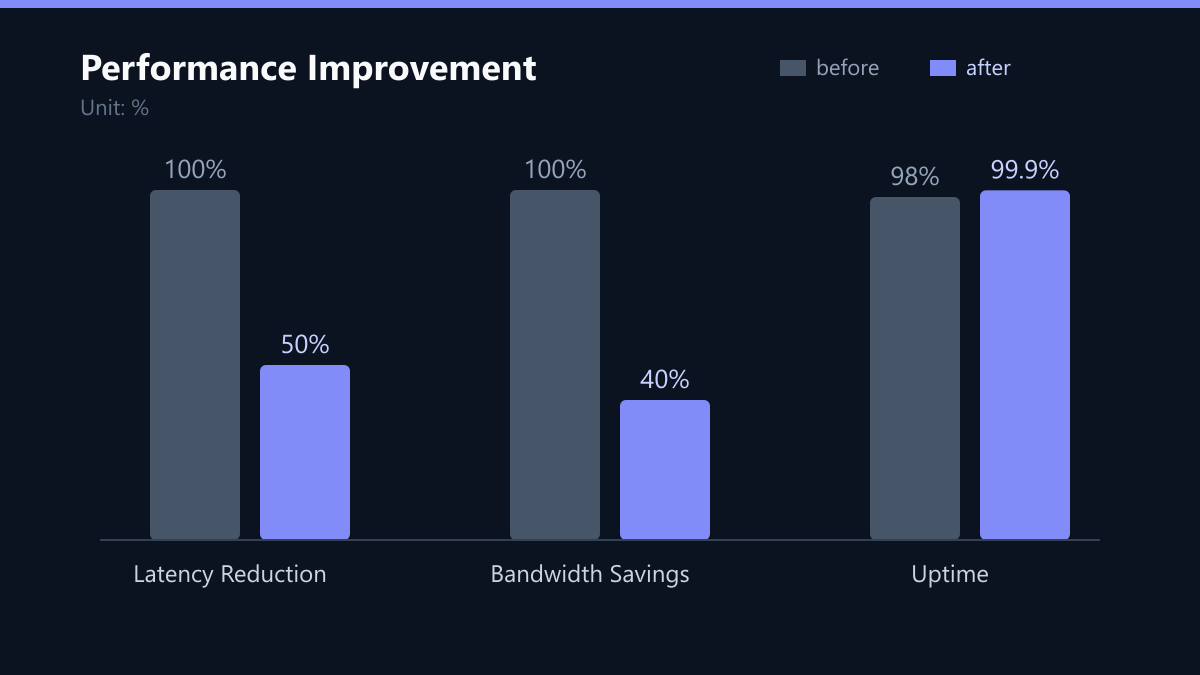
These results were not just technical achievements; they had a direct impact on the business. The reduction in latency allowed for faster identification of quality issues, reducing waste and rework. The bandwidth savings translated into lower operational costs, as the company no longer needed to upgrade its network infrastructure to handle the data load. The improved uptime ensured that production lines could operate without interruption, maintaining high throughput.
Lessons Learned
The project highlighted several critical insights for future edge-cloud integrations. First, network segmentation is not optional; it is essential. In industrial environments, where control data and general traffic share the same infrastructure, QoS rules are vital to prevent congestion. Without them, even optimized data transfer can lead to latency spikes.
Second, edge computing requires robust local monitoring. Unlike centralized cloud systems, where monitoring is built-in, edge devices are distributed and often in harsh environments. We learned that a lightweight, proactive monitoring stack is necessary to detect local failures before they impact production. This allowed us to maintain the 99.9% uptime target by identifying and resolving issues before they escalated.
Finally, the importance of security cannot be overstated. In a hybrid architecture, the attack surface is expanded to include edge devices. Implementing mutual TLS and encryption at rest was not just a compliance requirement but a necessity to protect sensitive production data. We found that a security-first approach, rather than an afterthought, significantly simplified the deployment and integration process.
What We Would Do Differently Today
Reflecting on the project, there are a few areas where we would adjust our approach. First, we would have invested more time in the initial network assessment. While we did perform a baseline assessment, a more detailed analysis of the existing network topology would have allowed us to anticipate some of the QoS configuration challenges. This would have reduced the time spent in the network optimization phase.
Second, we would have considered a more phased rollout of the edge devices. While the eight-week timeline was efficient, deploying all edge servers simultaneously created a high-risk window. A phased approach, starting with one production line and scaling up, would have allowed for more granular testing and reduced the impact on production during the transition.
Lastly, we would have integrated the monitoring stack earlier in the development process. While we implemented it in the final phase, having real-time visibility into the edge devices from the start would have allowed us to fine-tune the data filtering algorithms more effectively. This iterative approach would have led to a faster stabilization period and potentially even better performance metrics.
Passend dazu
- GDPR in the Cloud: Ensuring Legal Compliance for Data Processing in the USA
- Cloud Cost Optimization: 5 Strategies to Reduce Spend by 30 Percent
- Cloud Services & Cloud Migration
- IT Compliance & Data Protection
- E-Commerce Development
- 40 Percent Less Processing Time in Credit Checks via LLM Workflows
- Reducing Server Run Times by 40 Percent: Scalable Cloud Architecture for a German B2B Fashion Retailer in Peak Season
- Optimization of Cloud Spend by 28 Percent for a SaaS Provider in the USA Through Resource Usage Visibility
- GDPR Compliance and 45 Percent Latency Reduction in Hamburg E-Commerce Cloud Migration
- Multi-Channel-Integration: Bestandsmanagement über 3 Marktplätze für einen US-Food-Distributor
- How to Reduce Cloud Bill Waste by 20% Using Infrastructure Monitoring Data
- Cloud FinOps for SMEs: 7 Tactics to Stop Overspending on Idle Resources
- Accelerating Data Analysis by 50% with Cloud Infrastructure in US Healthcare
- Healthcare Data Protection: Reducing HIPAA Violations by 70 Percent via Micro-Learning for Clinical Staff
- Outsourcing vs. Insourcing: A Data-Driven Decision Model for CIOs
- Optimizing Collaboration for a Frankfurt Legal Firm: Streamlining SharePoint and Teams Integration
- How to Calculate Cloud Savings for IT Decision Makers
- Cloud Security: Configuring IAM and Encryption for Sensitive Data
- Insider Threat Mitigation: Securing Intellectual Property in a Munich Engineering Agency
- Preventing Data Leakage in a Singaporean E-Commerce Firm with Cloud Access Security Broker Implementation