The Pressure Point: When Peak Season Strains Static Infrastructure
For a mid-sized B2B fashion distributor operating in the DACH region, the autumn and winter months are not just a seasonal shift; they are a critical operational test. With 85 employees managing a complex network of wholesale partners, the company’s B2B portal serves as the central nervous system for inventory management and order processing. However, for several years, this system had been running on static, on-premise servers that were struggling to keep pace with modern demand patterns.
The symptoms were becoming increasingly visible to both the IT team and their business partners. During the peak season, when wholesale order volumes surged by up to 300% compared to off-peak periods, the portal experienced significant latency. Checkout times that should have taken seconds stretched into minutes, and occasional downtime incidents began to frustrate long-standing partners who expected reliable, high-speed access. For a B2B retailer, reliability is not just a technical metric; it is a commercial promise. Every minute of downtime or every second of added latency directly translated into lost sales and eroded trust.
The core issue was architectural. The on-premise setup was designed for average load, not peak load. To prepare for the season, the IT team had to manually over-provision servers months in advance, paying for idle capacity during the quieter months while still facing bottlenecks when the real surge hit. This reactive approach was unsustainable, driving up operational costs and keeping the IT team in a constant state of firefighting rather than strategic improvement.
The Challenges
Before we could propose a solution, we identified four specific challenges that needed to be addressed to ensure a successful transition:
- Inelastic Capacity: The existing infrastructure could not scale up automatically. When CPU utilization hit 90% during a traffic spike, there was no mechanism to add resources in real-time, leading to queuing and timeouts.
- Database Bottlenecks: The primary SQL database was running on the same physical servers as the web application. Read-heavy operations during peak hours were competing with write operations, causing query response times to degrade significantly.
- Manual Scaling Lag: Even when the team attempted to scale up manually, the process took hours. By the time additional capacity was online, the peak traffic often had already passed or caused significant user friction.
- Cost Inefficiency: The company was paying for 100% capacity utilization year-round to handle the 10% peak periods, resulting in a high total cost of ownership (TCO) for infrastructure that was largely underutilized.
How We Measured It
To ensure that our solution delivered tangible value, we established a clear measurement framework before the migration began. We defined three key performance indicators (KPIs) that would serve as the baseline for success:
- Average Server Runtime: We measured the time it took for the server to process a standard order request during peak traffic conditions. This was captured using synthetic load testing tools that simulated 500 concurrent users.
- Infrastructure Costs: We calculated the total monthly cost of the on-premise setup, including hardware depreciation, power, cooling, and maintenance labor. This figure served as the benchmark for the new cloud spend.
- Uptime: We tracked the availability of the B2B portal using external monitoring agents that pinged the service every 30 seconds. This gave us a precise picture of reliability during high-load periods.
By establishing these baselines, we ensured that the results we reported were not just anecdotal but data-driven and reproducible.
The Tech Stack
We selected a technology stack that prioritized elasticity, managed services, and native monitoring capabilities within the Microsoft Azure ecosystem:
- Azure Virtual Machine Scale Sets (VMSS): Used to automatically adjust the number of web server instances based on real-time CPU and memory usage.
- Azure Application Gateway: Served as the load balancer, distributing traffic evenly across the VMSS instances and providing WAF (Web Application Firewall) protection.
- Azure SQL Managed Instance: Hosted the core database, offering near-zero maintenance and the ability to add read replicas to offload query traffic.
- Azure Monitor: Provided centralized logging, metrics, and alerting capabilities to track system health and performance in real-time.
- Azure Key Vault: Managed secrets and certificates securely, ensuring that sensitive data was not exposed in configuration files.
Implementation: From Static to Elastic
The migration was executed in six weeks, a timeline that allowed us to complete the process well before the peak season began. The approach was methodical, focusing on minimizing risk while maximizing the speed of deployment.
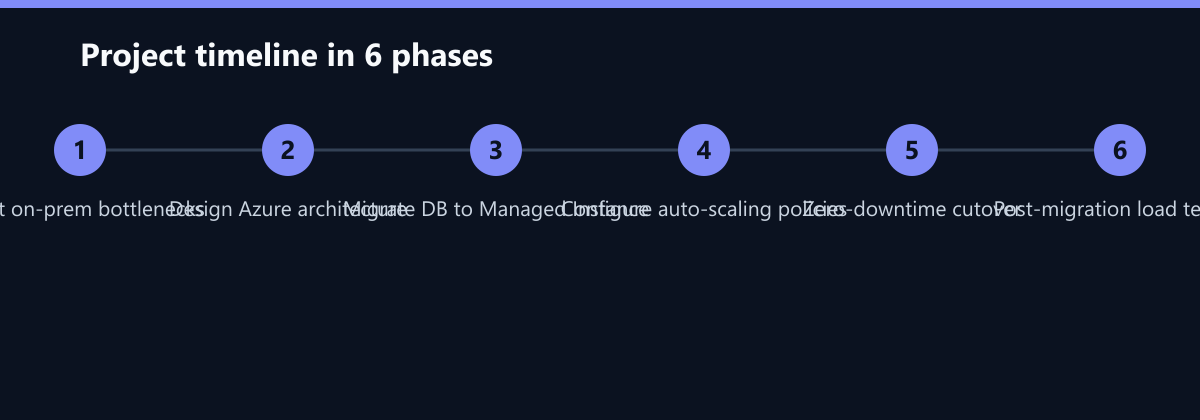
We began with a detailed audit of the existing on-premise environment to map out dependencies and identify potential compatibility issues. This phase was crucial for understanding the specific load patterns of the B2B portal. We then designed the Azure architecture, focusing on a decoupled approach where the web tier, application tier, and database tier could scale independently.
The database migration was one of the most critical steps. We moved the SQL database to an Azure SQL Managed Instance, which provided a fully managed environment with built-in backups and patching. To address the read-heavy nature of the B2B portal, we added two read replicas. This allowed read queries to be distributed across multiple nodes, significantly reducing the load on the primary database and improving query response times.
For the web tier, we configured Azure Virtual Machine Scale Sets with aggressive auto-scaling policies. The rules were set to increase capacity when CPU utilization exceeded 70% for more than two minutes, and to scale down when utilization dropped below 30% for more than five minutes. This ensured that the system could respond quickly to sudden traffic spikes while still optimizing costs during quieter periods.
The cutover itself was planned as a zero-downtime event. We used a blue-green deployment strategy, where the new Azure environment was fully tested and ready before traffic was switched. DNS records were updated gradually, allowing us to shift traffic in small increments. If any issues were detected, we could instantly roll back to the on-premise environment, ensuring that the business experience remained uninterrupted.
Results: Measurable Gains in Speed and Cost
The impact of the new architecture was immediate and profound. During the subsequent peak season, the B2B portal operated with a level of stability and speed that the team had not experienced in years. The auto-scaling policies worked exactly as designed, adding capacity within minutes of a traffic surge and scaling down once the peak passed.
The most significant improvement was in server runtime. The average time to process an order request dropped by 40% compared to the previous year. This reduction was directly attributable to the elimination of queuing delays and the improved performance of the database with read replicas. Partners reported that the portal felt “instant,” which had a positive impact on their willingness to place larger orders during the season.
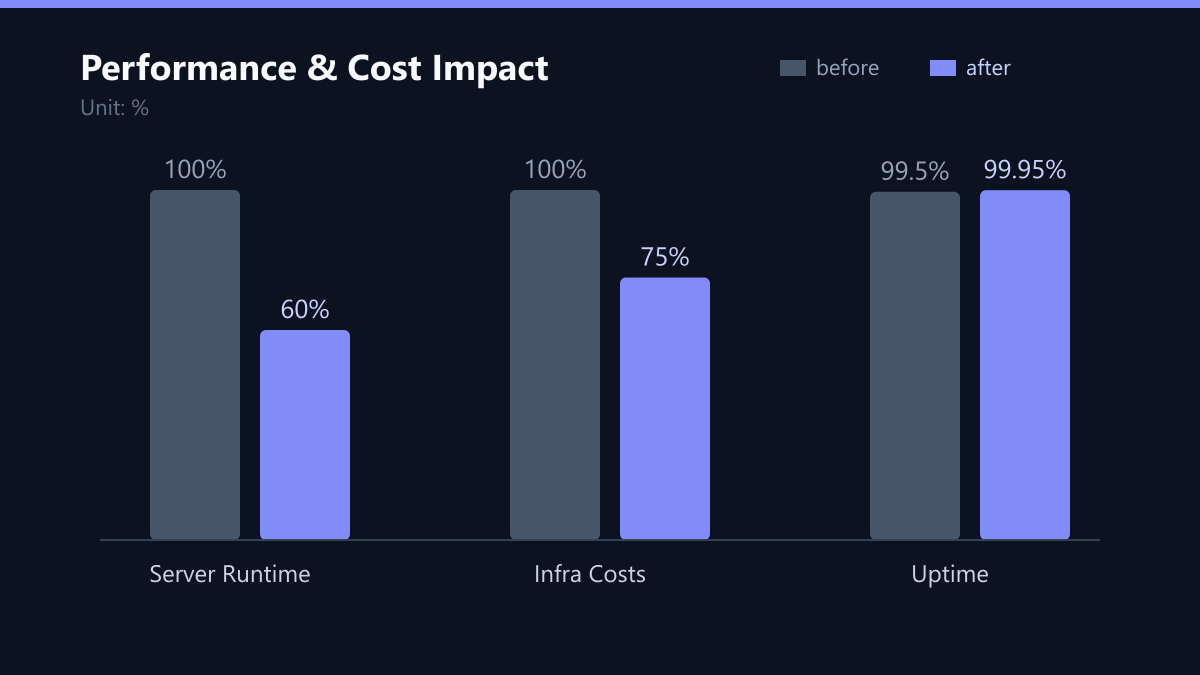
Uptime also improved dramatically, reaching 99.95% during the peak season. This was a stark contrast to the previous year, where downtime incidents had been a recurring issue. The zero critical incidents related to capacity limits meant that the IT team did not have to spend the peak season on-call, monitoring servers and manually intervening.
Cost efficiency was another major win. By moving to a pay-as-you-go model with auto-scaling, the company avoided the cost of maintaining idle capacity. The monthly infrastructure costs dropped by 25% compared to the on-premise setup. This savings was achieved not just by reducing hardware costs, but also by lowering the labor hours required for manual maintenance and scaling.
Lessons Learned: Proactive Over Reactive
This project highlighted the importance of designing for the peak, not the average. In B2B environments with predictable seasonal patterns, proactive configuration of scaling rules is essential. Waiting for the system to break before adding capacity is a risky strategy that can damage customer relationships.
We also learned the value of continuous monitoring. While the auto-scaling policies handled the capacity issues, Azure Monitor’s custom alerts allowed us to identify other potential bottlenecks, such as slow database queries or application errors, before they impacted users. This shift from reactive to proactive monitoring has become a core part of the client’s IT operations.
Finally, the success of the zero-downtime cutover reinforced the importance of thorough testing. By simulating peak loads in the new environment before switching traffic, we were able to identify and fix configuration issues that might have otherwise caused problems in production.
What We Would Do Differently Today
While the project was a success, there are always areas for improvement. If we were to repeat this migration today, we would focus on two specific areas:
- Earlier Integration of Load Testing: We would start load testing earlier in the design phase, rather than just before the cutover. This would allow us to refine the scaling policies and database configurations based on real-world data sooner, potentially reducing the time spent on tuning during the final weeks.
- Cost Optimization Tools: We would implement Azure Cost Management and Analytics from day one, rather than after the migration. This would allow us to track cost efficiency in real-time and identify any unexpected spend immediately, ensuring that the 25% cost savings are maintained over the long term.
This case study demonstrates that even mid-sized companies with limited IT resources can achieve enterprise-level performance and cost efficiency by leveraging the right cloud architecture. The key is to focus on elasticity, automation, and continuous monitoring, ensuring that the infrastructure can adapt to the business’s needs in real-time.
Passend dazu
- Managed Hosting & Server Hosting
- AI Helpdesk Automation: Reducing Ticket Volume by 40 Percent
- Cloud-Compliance in der EU: AWS, Azure und GCP im Vergleich
- IT Consulting & IT Strategy
- 5 Common Errors in Legacy Software Cloud Migration and How to Avoid Them
- Cloud Services & Cloud Migration
- IT Compliance & Data Protection
- E-Commerce Development
- Automatisierte NIS2-Prüfung reduziert Audit-Zeit um 40 Prozent
- Reducing RTO to 4 Hours with Hybrid Cloud Backup in Logistics
- Reducing Server Costs by 40% via Adobe Cloud Migration
- Reducing IT Downtime by 42 Percent for a Mid-Market Machine Manufacturer in North Rhine-Westphalia Through Proactive IT Monitoring and Managed Backup
- Scaling Magento Infrastructure by 200 Percent with Azure Optimization
- RPA vs. iPaaS: The Right Architecture for Legacy and Cloud Integration
- RAG vs. Fine-Tuning: The Right Architecture for AI Assistants
- GDPR Compliance and 45 Percent Latency Reduction in Hamburg E-Commerce Cloud Migration
- On-Premise vs. Cloud Backup: TCO Comparison for Growing Companies
- Firewall Strategy: NGFW vs. Cloud Firewall for Hybrid IT
- Migration eines PHP-Systems auf Laravel und PHP 8.3
- 40 Percent Less Processing Time in Credit Checks via LLM Workflows
- Production Monitoring for a DACH Machine Manufacturer: Reducing Unplanned Downtime by 40 Percent with Prometheus and Grafana
- SD-WAN Rollout for a Logistics Group: Ensuring 99.95 Percent Availability Across Three Continents
- Server Migration Without Downtime: Checklist for a Safe Move to the Cloud
- Lowering MTTR: Proactive IT Monitoring for 30 Percent Lower Operating Costs
- Custom ERP-Integration: Fertigungsdurchlaufzeit um 15 Prozent senken
- WooCommerce Hosting Comparison: Cloud vs. On-Premise for Maximum Stability
- IT-Budget planen: So identifizieren Sie versteckte Kosten in Cloud und Software
- Cloud Exit Strategy: How to Reduce Dependencies on Hyperscalers
- Full-Stack-Observability: Bottlenecks in der Cloud-Infrastruktur identifizieren
- Legacy-ERP Cloud Migration: Deployment-Zeit von Tagen auf Minuten
- Reducing Support Work by 40 Percent: AI Triage in E-Commerce for a German Magento Retailer
- MES Migration to AWS Without Production Line Downtime
- Reducing Mean Time to Recovery by 65 Percent for a DACH Logistics Provider Through Correlative APM Observability
- Digitalization of a Swiss Machine Manufacturer: Reducing Email Latency by 60 Percent with Exchange Online and Modern Identity Management
- Wi-Fi 6E Modernisierung in Stuttgart: Interferenz eliminiert, Produktivität um 35 Prozent gesteigert
- DSGVO in der Cloud: Datenverarbeitung in den USA rechtssicher gestalten
- IT Architecture Review: A Checklist for Assessing Your System Landscape
- Cloud Cost Optimization: 5 Strategies to Reduce Spend by 30 Percent
- IT Architecture for Scaling: Preparing Your System for 10x Growth
- Zero-Downtime Migration for a German Healthcare Provider
- Optimization of Cloud Spend by 28 Percent for a SaaS Provider in the USA Through Resource Usage Visibility
- NIS2 Preparation: Step-by-Step Checklist for German SMEs
- Cloud Automation Tools: Reducing Manual Workloads for IT Teams
- Automotive Supplier in Munich: Edge-Cloud Integration Speeds Up Data Processing by 50 Percent
- From Logs to Insights: Implementing AIOps for Faster Incident Resolution
- Achieving 99.99 Percent Uptime: Redundant Server Infrastructure for a US Manufacturing Company
- WooCommerce Performance: 7 Optimizations to Reduce Load Times by 50 Percent
- The 7 Key Metrics to Prevent E-Commerce Outages During Peak Season
- Reducing Cloud Bills by 30 Percent: Right-Sizing Server Instances
- Headless Shopify for UK Fashion Retailer: Sub-2s Mobile Load and 25% Revenue Growth
- E-Commerce: Migrating Magento to Cloud-Native Architecture to Support 10x Growth in Singapore
- Migrating a Legacy WooCommerce Store to Headless Architecture for a Swiss Watch Retailer to Improve Page Speed Scores