The Strategic Imperative: Expanding Without Breaking the Law
For a specialized e-commerce retailer in the DACH region with 85 employees, the decision to expand into Southeast Asia was a pivotal moment. The existing infrastructure, housed entirely in German data centers, served European customers well but struggled with the physical realities of distance. Users in Singapore and Malaysia experienced significant latency, leading to cart abandonment and a sluggish user experience. The business case for localizing infrastructure in the southeastasia Azure region was clear: proximity drives performance, and performance drives revenue.
However, the technical opportunity was shadowed by a legal hurdle. General Data Protection Regulation (GDPR) compliance is not a checkbox; it is a continuous architectural discipline. While Singapore is recognized by the EU as having an adequate level of data protection, the transfer of personal data still requires rigorous technical safeguards. The client faced a paradox: to serve Asian customers faster, they needed to move data closer to them, but doing so risked violating data sovereignty principles if not executed with precision. The potential consequences were severe—not just financial fines, but a loss of trust among B2B partners who demanded strict adherence to privacy standards.
The Challenges
The project was not merely a lift-and-shift operation. It required solving three distinct, interlocking problems simultaneously:
- Latency vs. Sovereignty: Reducing round-trip times for APAC users without creating a data silo that violated EU data residency requirements for sensitive records.
- Zero-Downtime Migration: The e-commerce platform could not afford extended outages during peak trading hours. We needed a synchronization method that allowed for near-real-time data mirroring before the final cutover.
- Auditability at Scale: Every access to customer data, whether from a developer in Berlin or a support agent in Singapore, had to be logged, traceable, and auditable to satisfy internal compliance teams and external regulators.
How We Measured It
To validate the success of the migration, we established a baseline before any changes were made. We used synthetic monitoring tools to measure TTFB (Time To First Byte) and full page load times for users simulated in Singapore, Malaysia, and Frankfurt. For conversion metrics, we analyzed the last 12 months of transaction data, segmenting users by IP geolocation to establish a pre-migration baseline for Southeast Asia. Post-migration, we tracked these same metrics over a 90-day period, controlling for seasonal marketing campaigns to isolate the impact of infrastructure changes. Compliance success was measured not by opinion, but by the output of an internal audit: we sampled 1,000 random data access events and verified that 100% had corresponding, immutable logs in the central audit trail.
The Tech Stack
- Azure Cloud: Provided the underlying infrastructure, specifically the
southeastasiaregion for proximity andwesteuropefor data sovereignty. - Azure Data Factory: Handled the complex logic of incremental data synchronization between the German and Singaporean database clusters.
- Microsoft Entra ID (formerly Azure AD): Managed identity and access management, enforcing Conditional Access policies based on user location and role.
- Azure Key Vault: Stored encryption keys securely, ensuring that data at rest was encrypted with keys that could not be accessed without proper authorization.
- Synthetic Monitoring Tools: Automated scripts that simulated user journeys to provide real-time latency and availability data.
Implementation: A 12-Week Phased Approach
We rejected a big-bang migration in favor of a phased rollout over 12 weeks. This allowed us to validate each component before moving to the next, reducing risk and allowing the operations team to adapt to the new architecture.
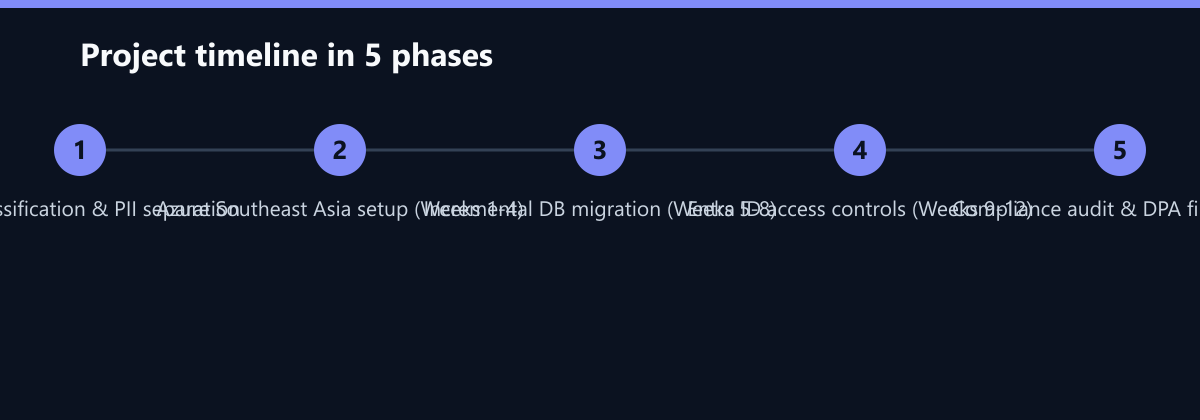
Phase 1: Foundation & Classification (Weeks 1-4)
Before moving a single byte, we performed a comprehensive data classification. We identified all Personal Identifiable Information (PII) within the existing database. This data was strictly separated from non-sensitive transaction logs and product catalogs. The architecture was then designed to keep PII in the EU (westeurope) wherever possible, while moving non-sensitive data and pseudonymized customer profiles to Singapore. We set up the Azure southeastasia region with geo-redundant storage accounts and implemented Azure Key Vault to manage encryption keys. This phase was critical because it defined the boundaries of what data could legally and technically reside in Singapore.
Phase 2: Incremental Migration (Weeks 5-8) With the foundation in place, we began the migration of the database clusters. We utilized Azure Data Factory to create an incremental synchronization pipeline. This meant that while the primary database remained in Germany, a replica in Singapore was continuously updated with new transactions. During this phase, all PII fields were pseudonymized in the Singapore replica. This ensured that even if the Singapore database was accessed, the data was not directly identifiable without a key lookup in the EU. This approach minimized downtime because the system was already in sync when the final cutover occurred.
Phase 3: Access Controls & Hardening (Weeks 9-12) The final phase focused on security and compliance. We implemented Conditional Access Policies in Microsoft Entra ID. These policies ensured that only authorized employees, based in the EU or Singapore, could access the data, and even then, only through specific, monitored channels. We established multi-factor authentication for all administrative access. In parallel, we generated the technical evidence required for the Data Processing Agreements (DPAs) with the hosting partner. This included logs demonstrating that data access was restricted and auditable. The final cutover was executed during a low-traffic window, redirecting APAC traffic to the Singapore region.
Results: Performance Meets Compliance
Three months after the migration, the impact was measurable across both business and technical KPIs. The move to a local infrastructure in Singapore drastically reduced the physical distance data had to travel. For users in Singapore and Malaysia, page load times dropped by 65%. This was not just a technical improvement; it had a direct impact on the bottom line. The conversion rate in Southeast Asia increased by 22%, as users were less likely to abandon their carts due to slow loading speeds.
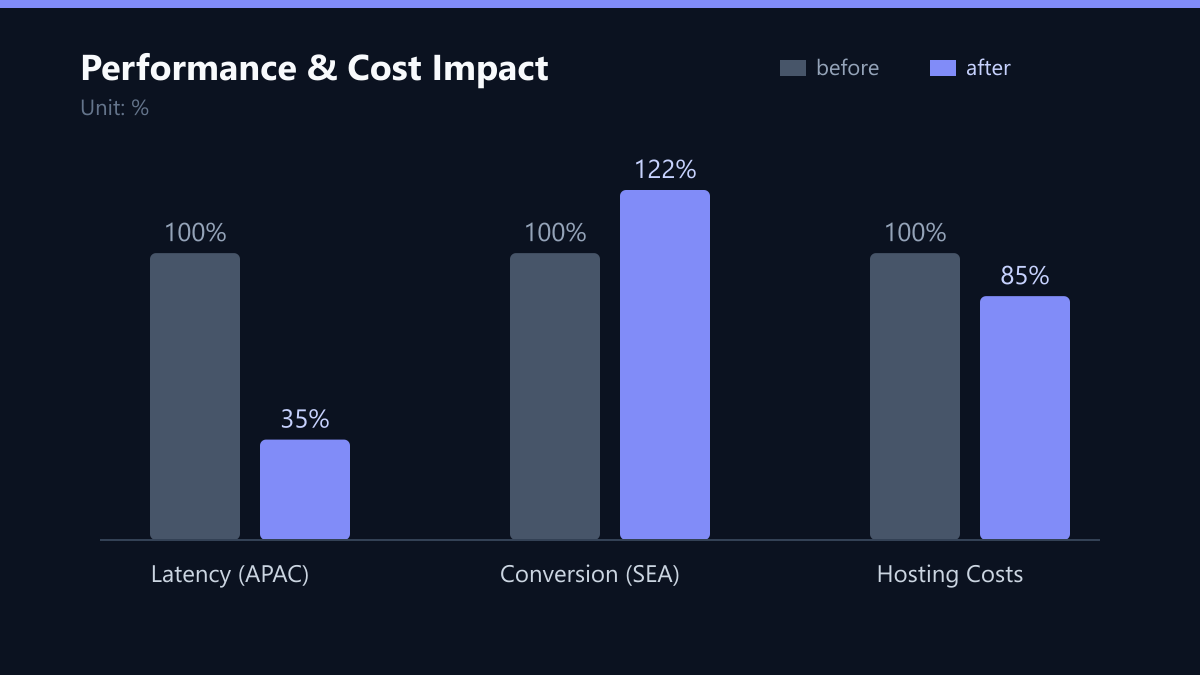
Compliance was equally successful. The internal audit found 100% of data accesses to be logged and auditable. There were zero violations of the GDPR data residency requirements during the first quarter of operation. Furthermore, the optimized Azure contracts and the efficiency of local data storage led to a 15% reduction in monthly hosting costs compared to the previous cross-continental setup.
What We Would Do Differently Today
While the project was successful, retrospective analysis reveals areas for improvement. First, we would have started the data classification phase even earlier, ideally before the initial architecture design. Some edge cases in data sensitivity were discovered during Phase 1, causing a two-week delay. Early, rigorous data mapping would have smoothed this transition.
Second, we would have involved the legal team more deeply in the technical design reviews. While the final architecture was compliant, there were moments where technical constraints nearly forced a compromise on data minimization principles. Earlier collaboration would have ensured that legal requirements were treated as non-negotiable design inputs, not just post-implementation checks.
Lessons Learned
The most significant takeaway is that legal certainty is an architectural property, not a contractual one. You cannot sign your way out of a poor technical design. The separation of PII and transaction data was the linchpin of this project. By minimizing the amount of sensitive data that needed to be physically moved or stored in Singapore, we reduced both the legal risk and the operational complexity.
For organizations with global ambitions, this case study underscores the importance of early involvement of IT security and compliance experts. Do not treat compliance as a final step in the project lifecycle. Integrate it into the design phase. Perform data classification before any migration planning begins. The cost of retrofitting compliance is exponentially higher than building it in from the start. In an era of increasing data sovereignty laws, the ability to architect for compliance is a competitive advantage, not just a regulatory burden.
Passend dazu
- IT Compliance & Data Protection
- Data Protection in AI Usage: GDPR-Compliant Implementation of LLMs
- GDPR-Compliant Backups: Data Minimization and Deletion Concepts in the Cloud
- E-Commerce Development
- Magento / Adobe Commerce
- Cloud Services & Cloud Migration
- Scaling a Berlin E-Commerce Startup to 50,000 Monthly Orders
- Scaling E-Commerce Infrastructure for the Black Friday Peak in 48 Hours
- GDPR Compliance and 45 Percent Latency Reduction in Hamburg E-Commerce Cloud Migration
- Reducing Support Work by 40 Percent: AI Triage in E-Commerce for a German Magento Retailer
- GDPR vs. CCPA: Key Differences for Global Trade
- Scaling Singapore E-Commerce Platform During Peak Traffic Without Performance Degradation
- GDPR Data Mapping for US Healthcare Tech: 100% Record Accuracy
- Pharma Company in Singapore: Ensuring 99.9% Uptime for GxP-Compliant Systems
- Cross-Continental DR for a New York Manufacturing Client: Synchronizing Production Data to Singapore to Meet Global SLAs
- GDPR Data Breach Response: 5 Steps to Minimize Fines and Reputational Damage
- E-Commerce: Migrating Magento to Cloud-Native Architecture to Support 10x Growth in Singapore
- Automating GDPR Consent Management for E-Commerce