The Cost of Data Lag in Global Retail
For a pan-Asian and DACH-based consumer goods retailer with 450 employees, the difference between a real-time inventory view and a stale one was measured in lost revenue. Operating across Singapore, Germany, and Austria, the client faced a fragmented IT landscape where legacy ERP systems in the DACH region and local POS systems in Asia ran on completely separate schedules.
The result was a data lag ranging from 15 minutes to two hours. In a retail environment where demand spikes are unpredictable, this delay was critical. Popular items were oversold online before the physical stock could be adjusted in the backend, leading to cancelled orders and damaged customer trust. During peak seasons, the financial leakage from these inventory errors became a significant line item in the P&L.
However, the speed was only half the problem. The deeper issue was fragmentation. Each region had different data structures, update frequencies, and even status code definitions. The IT team was effectively acting as a human API, spending an average of 40 hours per week manually reconciling spreadsheets to prevent financial discrepancies. This manual process was not only inefficient but also error-prone, creating a cycle of constant firefighting rather than strategic IT development.
The Challenges
Before we could build a solution, we had to identify the specific bottlenecks that made the existing setup unviable:
- Schema Heterogeneity: The DACH SAP system and Asian POS platforms used incompatible data models for product attributes and stock statuses.
- Latency Sensitivity: Batch processing was too slow for e-commerce needs; the client required near-instant updates to reflect stock availability to customers.
- Network Fragmentation: Secure, low-latency connectivity between the Frankfurt and Singapore data centers was not established, leading to high transmission times.
- Fault Tolerance Gaps: The previous setup lacked robust error handling; a single timeout in one region could block the entire synchronization cycle.
The Tech Stack
To address these challenges, we selected a cloud-native stack focused on reliability and speed:
- Azure API Management: Served as the central gateway to secure, throttle, and monitor all API traffic.
- Azure Functions: Provided serverless compute for lightweight, event-driven transformation tasks.
- Azure Event Hubs: Handled high-throughput, low-latency streaming of inventory events.
- Azure Virtual Network Peering: Established secure, private connectivity between regional networks.
- C#: Used for custom transformation logic to map disparate data structures.
Implementation: Building the Orchestration Layer
We designed a centralized API orchestration layer that acts as a single source of truth. This middleware normalizes data from disparate sources before distribution, ensuring that whether a sale happens in Berlin or Singapore, the inventory update is consistent and immediate.
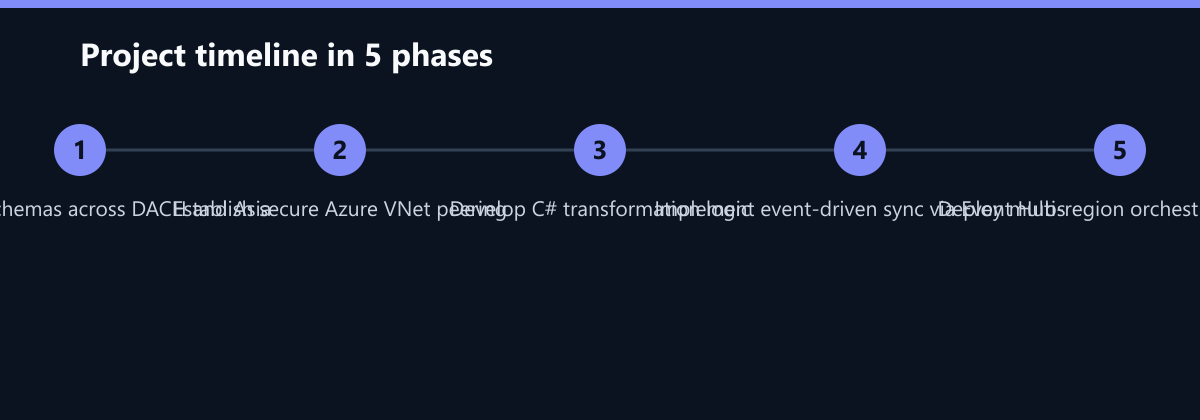
The build process was executed in three distinct phases over a 12-week period. The first phase, spanning weeks 1–4, focused on foundational work. We mapped the complex data schemas between the DACH SAP system and the Asian POS/e-commerce platforms. Simultaneously, we established secure connectivity using Azure Virtual Network Peering, ensuring that data moved over private, encrypted channels rather than the public internet. This phase was critical for establishing the security baseline and understanding the exact data flow requirements.
In weeks 5–8, we moved to development. This involved writing custom transformation logic in C#. The challenge here was not just moving data, but translating it. We had to handle currency conversions, unit standardizations (e.g., converting ‘pieces’ to ‘cases’ where applicable), and status code mappings. For example, a ‘Reserved’ status in the Asian POS had to be correctly interpreted as ‘Pending’ in the DACH ERP to prevent double-selling. This layer ensured that the data arriving at the orchestration hub was clean and standardized.
The final phase, weeks 9–12, implemented the real-time event-driven synchronization. We leveraged Azure Event Hubs to create a low-latency pipeline. Instead of polling the database for changes, the system now listens for events. When a stock change occurs, an event is published, triggering an Azure Function to process and distribute the update. We prioritized fault tolerance in this phase. The architecture was designed so that if one region’s API timed out, the system would queue the events for retry without blocking other transactions. This decoupling ensured zero downtime for end-users, even during transient network issues.
How We Measured It
To validate the success of the implementation, we established a baseline before deployment and monitored key performance indicators (KPIs) continuously for six months post-launch. We used Azure Monitor to track API latency, error rates, and throughput. For business metrics, we integrated the orchestration layer’s logs with the e-commerce platform’s analytics tools to correlate inventory accuracy with conversion rates. The ‘stock discrepancy’ metric was defined as the number of instances where the online stock count differed from the physical stock count by more than 1 unit. The ‘manual reconciliation time’ was tracked via time-tracking tools used by the IT team, comparing the pre-implementation 40-hour weekly average to the post-implementation hours spent on manual checks.
Results: Measurable Impact on Operations
The new architecture delivered immediate operational clarity. Stock data now propagates across regions in under 500 milliseconds. This sub-second latency eliminated the manual reconciliation process entirely, freeing up the IT staff to focus on strategic projects rather than spreadsheet maintenance.
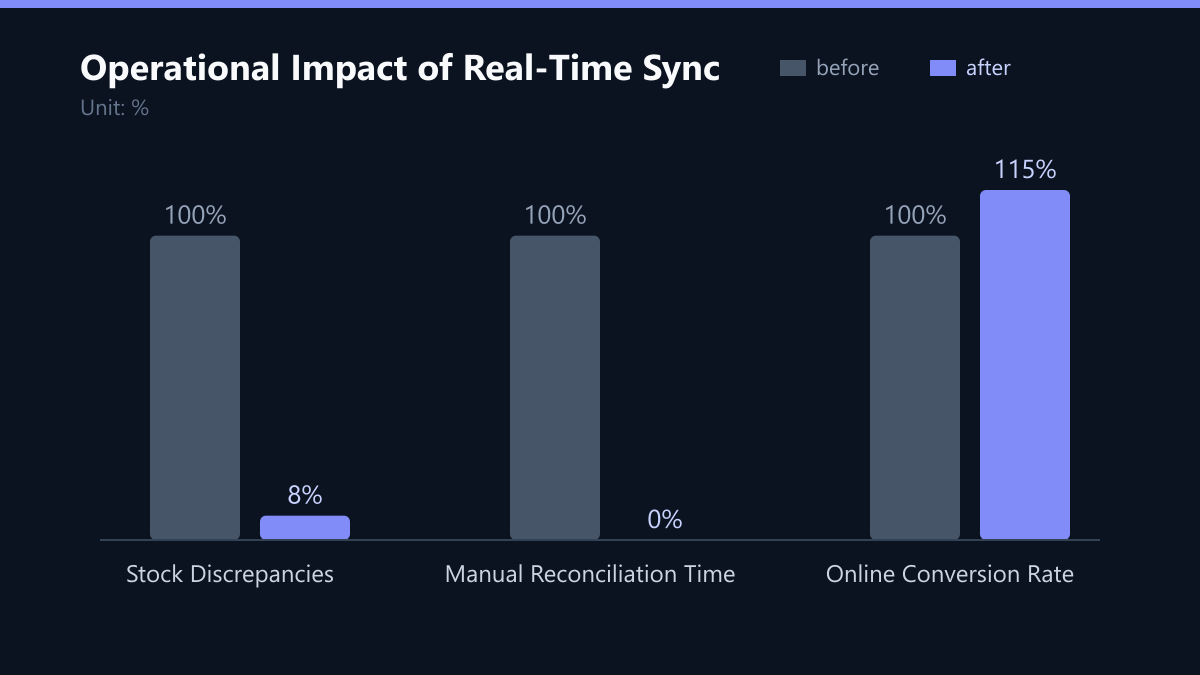
The quantitative impact was significant. We observed a 92% reduction in stock discrepancy incidents within the first quarter. This was not a marginal improvement; it fundamentally changed the reliability of the inventory data. Consequently, there were zero overselling events recorded in the first quarter post-deployment. The synchronization service maintained 100% uptime over the six-month monitoring period, validating the fault-tolerant design.
Beyond operational metrics, the business impact was visible in the front end. The retailer reported a 15% increase in online conversion rates. Customers, seeing accurate and real-time availability, were more likely to complete their purchases. Financial leakage from inventory errors dropped to negligible levels, directly contributing to bottom-line improvement.
What We Would Do Differently Today
While the project was successful, retrospective analysis reveals areas for optimization. First, we would have invested more time in the initial data governance phase. Standardizing data definitions before building the pipeline saved weeks of debugging later, but doing this more rigorously at the start could have accelerated the overall timeline. Second, we would have considered a more granular approach to latency optimization. While deploying in both Singapore and Frankfurt was effective, implementing edge caching for read-heavy operations could have further reduced response times for local users. Finally, we would have implemented more comprehensive user training for the IT team on the new monitoring dashboards earlier in the process, ensuring they could independently manage the system from day one.
Lessons Learned
This project highlighted that cross-regional data synchronization is as much a data governance challenge as it is a technical one. The success of the API orchestration layer depended heavily on the quality of the data it processed. Standardizing data definitions upfront was crucial. We found that event-driven architectures consistently outperform batch processing for retail scenarios where speed is critical. Batch processing, while simpler, cannot meet the sub-second latency requirements of modern e-commerce.
Another key insight was the importance of local latency optimization. By deploying the orchestration layer in both Singapore and Frankfurt, we ensured sub-second response times for local users, which is essential for maintaining a seamless customer experience. For global retailers, investing in a robust API orchestration layer is no longer optional; it is essential for maintaining competitiveness in real-time markets. The ability to provide accurate, real-time inventory data is a key differentiator in the digital retail space.
Passend dazu
- IT & Data Recovery (Disaster Recovery)
- IT Consulting & IT Strategy
- Automated Compliance Reporting: Saving Time with AI in IT Audits
- Reducing First Response Time in IT Support with RPA
- IT Compliance & Data Protection
- Cloud Services & Cloud Migration
- E-Commerce Development
- ISO 27001 Certification in Finance: Cutting Certification Time by 3 Months with AI
- Magento Warehouse Sync Reduces Out-of-Stock Rates by 25 Percent
- Retail Chain in Berlin: Centralized Network Monitoring Reduces Incident Resolution Time from 4 Hours to 15 Minutes Across 12 Stores
- Trading Conglomerate Reduces Server Fault Response Time to 15 Minutes with AIOps
- Churn Prediction in B2B SaaS: Retaining 25% More Customers with Behavioral AI Models in New York
- Securing Legal Data with MFA and Conditional Access
- Accelerating Data Analysis by 50% with Cloud Infrastructure in US Healthcare
- Berlin Fintech Cuts Audit Prep Time by 65% with Continuous Compliance
- Outsourcing vs. Insourcing: A Data-Driven Decision Model for CIOs
- Cross-Continental DR for a New York Manufacturing Client: Synchronizing Production Data to Singapore to Meet Global SLAs
- Building a Robust Data Sync Pipeline Between Magento and ERP